
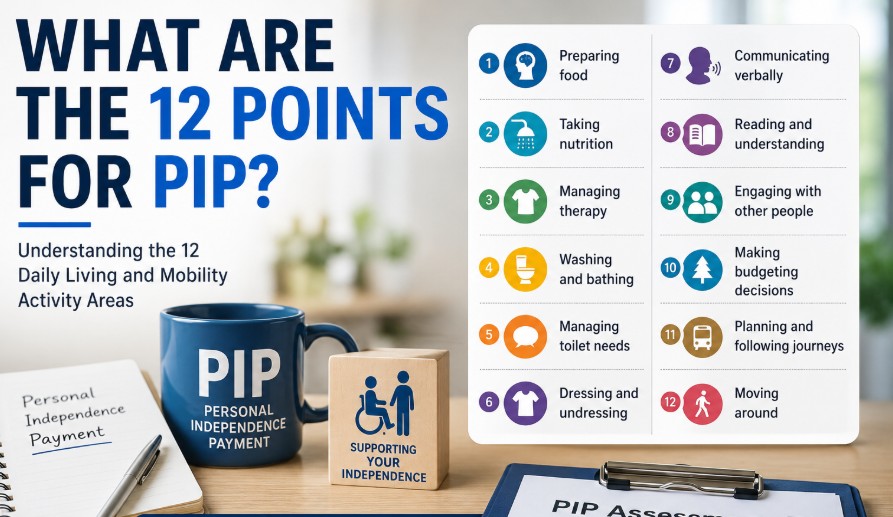
The Personal Independence Payment (PIP) is a benefit designed to assist individuals with the extra costs of a long-term health condition or disability. When asking what are the 12 points for PIP, claimants are referring to the scoring threshold needed to get the enhanced rate of the benefit.
You must score at least 12 points in either the daily living or mobility categories to qualify for this highest level of weekly financial support.
Key Takeaways
- Claimants need 8 to 11 points for the standard rate of PIP and 12 points or more for the enhanced rate of either the daily living or mobility components.
- The DWP assesses individual needs based on 10 daily living and 2 mobility activities rather than a specific medical diagnosis or a list of 12 static questions.
- To score points, claimants must meet the reliability criteria by proving they cannot perform activities safely, repeatedly, or in a reasonable time frame.
- As of 2026, documentation must demonstrate that needs are met for at least 50 percent of the days in 12 months to satisfy the threshold requirements.
What Is the PIP Points System?
The PIP points system is how the Department for Work and Pensions (DWP) works out what help you need with daily tasks. Instead of focusing on your medical diagnosis, it looks at how your illness or disability actually affects your day-to-day independence.
Rather than paying out based on a medical diagnosis or disease label, the DWP looks at what you can and cannot do. The entire system is split into two independent parts:
- Daily Living Component: Focuses on your ability to complete regular household and personal tasks.
- Mobility Component: Focuses on your ability to physically move around and navigate trips outside the house.
How Does the 12 Point Accumulation Work?
The DWP evaluates your abilities across 12 distinct activities (10 for Daily Living and 2 for Mobility). Each activity features a tiered list of statements called descriptors, which range from needing zero assistance to being completely unable to perform the task.
It is vital to prepare for how these descriptors are evaluated to avoid common pitfalls during the review process, especially regarding PIP assessment trick questions designed to gauge your functional consistency.
- Scoring the Highest Descriptor: Within each individual activity, you are only awarded points for the single highest descriptor that fits your circumstances; you cannot stack multiple scores within the same task.
- Adding It All Up: Your final scores for the Daily Living and Mobility sections are calculated entirely separately. They are never added together to form one master score.
- The 50% Rule: To qualify for points under a specific descriptor, the restriction must impact you for at least 50% of the days across a rolling 12-month period.
What Are the 12 Points for PIP?
Scoring 12 points or more in either the Daily Living or Mobility component automatically qualifies a claimant for the Enhanced Rate, which represents the highest financial support tier available for that category.
| Component | Standard Rate (8–11 Points) | Enhanced Rate (12+ Points) |
| Daily Living | Requires scoring between 8 and 11 points across the 10 daily living activities. | Requires scoring 12 points or more across the 10 daily living activities. |
| Mobility | Requires scoring between 8 and 11 points across the 2 mobility activities. | Requires scoring 12 points or more across the 2 mobility activities. |
Daily Living Component
The Daily Living Component contains 10 specific personal care activities with points ranging from 0 to 12 based on the level of human physical assistance, prompting, or specialized aids you require to function at home.
Activity 1: Preparing Food
Preparing Food tests your ability to safely cook a simple, fresh meal for one on a standard cooker hob, awarding points if you require perching stools, microwaves, prompting, or physical supervision.
- 0 Points: You can safely cook a simple meal completely unaided.
- 2 Points: You require a specialized aid or appliance (like a perching stool, lightweight pans, or textured grips), or you cannot use a conventional cooker but can heat food using a microwave. Alternatively, you need verbal prompting or reminders to cook.
- 4 Points: You require active physical assistance or continuous supervision from another person to safely handle hot pans or knives.
- 8 Points: You are completely unable to prepare or cook food under any circumstances, even with help.
Activity 2: Eating and Drinking
Eating and Drinking assesses your capacity to cut food, move it to your mouth, and swallow, tracking dependencies on heavy cutlery, tube feeding, or active spoon-feeding.
- 0 Points: You can feed yourself and swallow food completely unaided.
- 2 Points: You need a specific eating aid (like adapted heavy cutlery), require supervision to avoid choking, or need another person to cut up the food on your plate. Alternatively, you rely on a basic therapeutic source (like a feeding tube) to get nutrition.
- 4 Points: You need regular verbal prompting or encouragement to eat enough food (common with severe depression or eating disorders). If your claim involves psychological or cognitive conditions, checking specific guidelines regarding PIP rates for mental health can reveal how points stack up for these specific challenges.
- 6 Points: You require another person to actively help you manage a therapeutic feeding setup.
- 10 Points: You cannot physically bring food or drink to your mouth at all and rely entirely on another person to spoon-feed you.
Activity 3: Managing Treatments and Monitoring Health Conditions
This activity calculates points based on the total hours per week spent receiving assistance for vital home therapies or managing medication pillboxes and health tracking alarms.
- 0 Points: You can manage your health, pills, and therapies perfectly on your own.
- 1 Point: You require an aid (like a dossette box or phone alarm), or you need someone to remind, prompt, or supervise you to take your medication or check your vitals.
- 2 Points: You need physical help or supervision to perform home therapies (like specialized exercises or dressing changes) that take up to 3.5 hours per week.
- 4 Points: You need help with home health therapies that take between 3.5 and 7 hours per week.
- 6 Points: You need help with home health therapies that take between 7 and 14 hours per week.
- 8 Points: You need help with home health therapies that accumulate to more than 14 hours per week.
Activity 4: Washing and Bathing
Washing and Bathing checks your physical capacity to use an unadapted bath or shower, scoring restrictions involving grab rails, shower seats, or assistance washing below the waist.
- 0 Points: You can wash, bathe, and clean your hair completely unaided.
- 2 Points: You need to use an aid (like a shower seat, grab rail, or long-handled sponge) to wash. Alternatively, you need someone to verbally prompt you to bathe, or you need physical help specifically to wash your hair or clean your body below the waist.
- 3 Points: You cannot step over the lip of a standard tub or shower cubicle and require physical help to get in or out.
- 4 Points: You need someone to physically wash your torso (the area between your neck and your waist).
- 8 Points: You cannot wash yourself at all and require someone else to clean your entire body.
Activity 5: Managing Toilet Needs or Incontinence
Managing Toilet Needs scores your ability to use a toilet seat and manage bladder or bowel issues, scaling up if you require raised frames, commodes, or direct human cleanup.
- 0 Points: You handle all toilet and hygiene needs independently without assistance.
- 2 Points: You rely on an aid (such as a raised toilet seat, freestanding frame, or commode), or you need someone standing by to prompt or supervise you.
- 4 Points: You require another person to physically help you get on/off the toilet or physically wipe you.
- 6 Points: You experience incontinence and need physical assistance to manage bladder or bowel cleaning/appliances.
- 8 Points: You face total incontinence of both bladder and bowel and require full physical management from another person.
Activity 6: Dressing and Undressing
Dressing and Undressing tracks how well you select appropriate clothing and secure fastenings, evaluating dependencies on shoehorns, adaptations, or physical dressing assistance.
- 0 Points: You can dress and undress your full body entirely unaided.
- 2 Points: You require dressing aids (like a shoehorn, sock aid, or velcro adaptations). Alternatively, you need mental prompting to choose weather-appropriate clothes, or you need physical help to dress your lower body (socks, shoes, trousers).
- 4 Points: You require physical assistance to pull clothes over your head, manage sleeves, or dress your upper body.
- 8 Points: You are physically or mentally unable to dress yourself at all and require someone to dress you completely.
Activity 7: Communicating Verbally
Communicating Verbally grades your ability to speak and hear native speech, providing maximum points if you rely continuously on sign language interpreters or communication partners.
- 0 Points: You can speak and hear clearly without any assistance.
- 2 Points: You require a specific aid or appliance (such as a prescription hearing aid or an electronic voice amplifier) to communicate.
- 4 Points: You need specialized communication support (like a sign language interpreter or communication partner) to understand or express complex verbal ideas.
- 8 Points: You need a communication partner or interpreter just to handle basic, simple daily conversations.
- 12 Points: You cannot express or understand even basic verbal information at all, even when support is provided.
Activity 8: Reading and Understanding Signs, Symbols, and Words
This category measures visual and cognitive reading issues, assessing whether you require non-standard magnifiers, line trackers, or a person to explain basic sentences.
- 0 Points: You can read and understand books, letters, and basic signs without any trouble.
- 2 Points: You require a specialized non-standard reading aid (such as a high-powered handheld magnifier or line trackers) to read. Alternatively, you need someone to prompt or explain complex written documents to you.
- 4 Points: You require someone to sit with you and actively read or explain basic, simple sentences and signs.
- 8 Points: You cannot read or understand any written words, signs, or simple symbols at all.
Activity 9: Engaging with Other People Face-to-Face
Engaging with People scales social anxieties and psychological distress, scoring whether you need prompting, a trained companion for social support, or experience total interaction isolation.
- 0 Points: You can interact socially and attend appointments without distress.
- 2 Points: You need prompting, continuous encouragement, or prior reassurance from someone else to engage in social settings.
- 4 Points: You require active social support (a trained friend, family member, or advocate who knows how to de-escalate your anxiety) present to help you interact.
- 8 Points: Severe mental illness prevents any interaction because it causes overwhelming psychological distress or causes you to behave in a way that risks physical harm to yourself or others.
Activity 10: Making Budgeting Decisions
Making Budgeting Decisions scales cognitive and mental health limitations regarding cash calculations, from managing complex household billing to basic grocery store transactions.
- 0 Points: You can manage complex bills, banking, and small cash transactions unaided.
- 2 Points: You can manage simple cash transactions but need someone to prompt or assist you with complex bills, banking, or contracts.
- 4 Points: You require someone to actively prompt or assist you just to calculate change or make basic daily shopping purchases.
- 6 Points: Cognitive or mental health issues leave you entirely unable to make any basic financial or budgeting choices.
Mobility Component
The Mobility Component isolates physical and mental boundaries affecting travel outside the home, split into Activity 1 for route planning/anxiety and Activity 2 for exact physical walking distance metrics.
Understanding how both components interact during a PIP daily living mobility review ensures you build a comprehensive claims portfolio rather than focusing on just one side of your condition.
Activity 1: Planning and Following Journeys
This category maps cognitive issues, agoraphobia, panic disorders, and visual impairments, scoring up to 12 points if you cannot follow a familiar route without human assistance.
- 0 Points: You can plan a route and navigate to completely unfamiliar locations by yourself.
- 4 Points: You cannot plan the route of an unfamiliar journey independently (requires someone else to map it out for you).
- 8 Points: You cannot navigate to an unfamiliar place unless you have another person, a trained guide dog, or a specific orientation aid with you at all times.
- 10 Points: Severe anxiety or psychological distress leaves you unable to undertake any journey outside your front door unless accompanied by another person.
- 12 Points: Your cognitive impairment or mental health condition is so severe that you cannot follow the route of a familiar, everyday journey (like going to your local shop) unless accompanied by another person or a guide dog.
Activity 2: Moving Around
Moving Around scores exact physical restrictions, measuring the flat distance in metres you can stand and walk before pain or exhaustion halts you, with the highest points for under 20 metres.
- 0 Points: You can stand and walk for a distance of more than 200 metres without stopping.
- 4 Points: You can stand and walk for more than 50 metres, but you cannot cover more than 200 metres before stopping.
- 8 Points: You can physically walk between 20 and 50 metres, but only if you do not use a walking aid.
- 10 Points: You can physically walk between 20 and 50 metres, but you are reliant on a walking aid (like crutches or a frame) to do so.
- 12 Points: Severe mobility problems restrict you so much that you can only walk between 1 and 20 metres (even when using sticks), OR you cannot stand up and take a single step.
How Do the 12 Points Impact the PIP Payment?
Reaching the 12-point threshold triggers a direct shift from the standard benefit rate to the enhanced benefit rate. This significantly alters the weekly and monthly financial support you receive.
According to the official Department for Work and Pensions (DWP) benefit rates for 2026/2027, the weekly payment breakdown is structured as follows:
- Daily Living: Reaching 12 points increases your weekly payment from the Standard Rate of £76.70 to the Enhanced Rate of £114.60.
- Mobility: Reaching 12 points increases your weekly payment from the Standard Rate of £30.30 to the Enhanced Rate of £80.00.
Maximum Award: If you score 12 or more points in both independent categories, you receive the full combined enhanced award, providing a total of £194.60 per week to help offset disability-related living expenses.
Claimants who apply later in life should note that specific eligibility variations apply to older groups, such as special provisions governing UK pensioners’ PIP backdated payments for historical claims periods.

How to Pass a PIP Assessment?
Passing the assessment and securing the correct point tier relies on demonstrating functional limitation through the Reliability Criteria. The DWP legal framework states that you are considered unable to complete an activity unless you can do it reliably.
When filling out your forms and answering an assessor’s questions, you must filter every answer through these four pillars:
- Safely: Can you complete the task without a realistic risk of injury, falls, burns, or harm to yourself or others?
- To an Acceptable Standard: Can you finish the task effectively? (e.g., if you can wash your clothes but cannot wash them thoroughly enough to be clean, it is not an acceptable standard).
- Repeatedly: Can you perform this activity as many times as reasonably required throughout the day? If doing it once leaves you too exhausted or in too much pain to do it again, you cannot do it repeatedly.
- In a Reasonable Time: Does it take you less than twice as long as a person without your condition to complete the task? If a simple meal takes you over an hour due to necessary breaks, it fails this test.
Evidencing Your Needs Effectively
To construct a highly resilient PIP application, gather evidence detailing your functional limitations during your worst days rather than focusing on temporary good days.
- Focus on your worst days rather than your good days to provide an accurate picture.
- Do not minimise your difficulties to the assessor; be blunt about what happens when you attempt tasks.
- Use specific examples of how your condition, such as nerve damage or anxiety, forces you to rely on aids or human intervention.
Final Summary
Securing the right level of support requires precision. Review the DWP descriptors, gather robust evidence that speaks to your worst days, and ensure you clearly explain why your daily activities fail the reliability test.
If you are unsure about your claim, consult Citizens Advice or a professional welfare advisor to review your submission before sending it to the DWP.
FAQ
Is 12 points on PIP good?
Yes. Scoring 12 points or more is the highest possible outcome because it instantly qualifies you for the enhanced rate of that specific component, unlocking the maximum weekly payment.
How to answer PIP question 12?
There is no specific question 12 on the form. The 12 points refer to the scoring threshold. Always answer the questions on your form by focusing on how you struggle with the reliability criteria.
How many points to get full mobility?
Twelve points. You must score at least 12 points in the mobility component of the assessment to qualify for the enhanced mobility rate, which gives you access to the highest travel support tier and the Motability scheme.
How long after PIP assessment for a decision 2026?
Decision timelines vary based on DWP capacity. While some claimants receive a decision within a few weeks, others may wait several months. You will receive a letter via post once a decision is made.
What are the 8 points for PIP mobility?
The 8 points threshold is the minimum required to qualify for the standard mobility rate. This is awarded to those who have limited ability to move around or navigate journeys independently.
How hard is it to get accepted for PIP?
Acceptance is not about hardness but about evidence. Providing detailed, consistent evidence that maps your daily struggles to the official descriptors significantly increases the chances of a successful claim.
What is 1 PIP?
1 PIP is not a recognized term. Points are units used to calculate your rate. You earn points by meeting specific descriptors within the 10 daily living and 2 mobility activities.
Disclaimer: This guide is for informational purposes only and does not constitute official legal or financial advice; always check official DWP guidelines or consult a certified welfare advisor before submitting your claim.
