
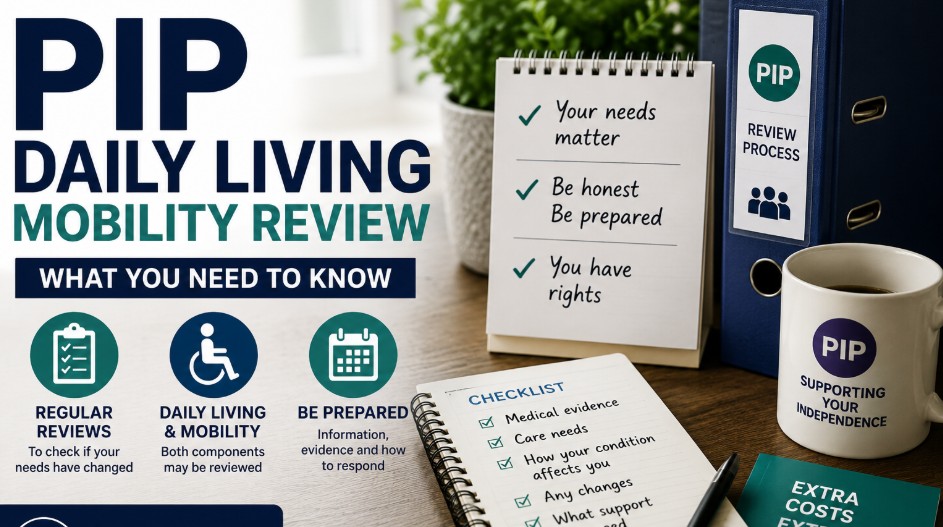
Navigating a PIP daily living mobility review can feel overwhelming, but understanding the criteria, point structures, and statutory regulations ensures your claim accurately reflects your daily care and mobility needs.
As of 2026, the Department for Work and Pensions (DWP) continues to evaluate claimants using specific functional descriptors, even as broader structural benefit changes loom on the horizon.
This comprehensive guide provides the clear baseline metrics, application rules, and assessment strategies required to complete your documentation accurately.
Key Takeaways
- The Department for Work and Pensions implements a strict points-based matrix across twelve statutory activities to determine personal independence payment rates.
- Claimants require a minimum score of eight points for standard rate awards and twelve points for enhanced financial tiers within each separate component.
- The landmark July 2026 Timms Review interim report officially declared the current assessment system unfit for modern fluctuating or mental health conditions.
- Legal assessment rules mandate that health professionals evaluate whether you can complete tasks safely, repeatedly, and within a reasonable timeframe.
What is Daily Living PIP?
Daily Living PIP is a non-means-tested financial benefit designed to help with the extra costs of living with a long-term physical or mental health condition. Rather than focusing on your medical diagnosis, it specifically assesses your ability to perform ten everyday personal care and household tasks safely and independently.
The benefit is strictly split into two independent parts: Daily Living and Mobility. When asking what is daily living PIP, it is essential to remember that you are being judged on your real-world functional capacity, such as dressing, cooking, or managing treatments, not just the name of your illness.
What is a PIP Daily Living Mobility Review?
A PIP daily living mobility review is a formal reassessment process by the DWP using the AR1 Award Review form to check if your medical condition still qualifies you for financial support.
The review checks whether your daily care or mobility needs have improved, worsened, or stayed the same, scoring your answers against strict statutory guidelines. A review is a normal legal checkpoint for most PIP awards. If you need to request an extension or ask questions about your AR1 form, check the PIP enquiry line opening times before calling the DWP.
Unless you have a light-touch ongoing award with no end date, the DWP will periodically check your file to ensure public funds are correctly matched to your real-world functional struggles, especially as certain claimants look for a PIP benefit cuts exemption from the DWP amidst changing welfare rules.

Will the DWP Review PIP Eligibility for the Mobility Component and Daily Living?
Yes, the DWP will actively review your eligibility for both the mobility and daily living components during a scheduled reassessment. Unless you hold a rare ongoing award, a case manager will re-evaluate your points across all 12 benefit activities using your updated AR1 review form.
When an official review begins, your entire award is re-examined. The DWP uses specific legal standards to judge whether you can still complete tasks reliably.
The Four Pillars of Legal Reliability
The four pillars of legal reliability require health assessors to check if you can perform an activity safely, to an acceptable standard, repeatedly throughout the day, and within a reasonable time (taking no more than twice as long as a non-disabled person).
If your condition prevents you from meeting even one of these pillars, the law states you cannot complete that activity. This means you should be awarded the relevant descriptor points on your review form.
- Safely: Can you complete the activity without risking falls, cuts, burns, or psychological distress?
- To an Acceptable Standard: Can you complete the task effectively? (e.g., is your washing thorough enough to maintain basic hygiene?)
- Repeatedly: Can you perform the activity as many times as reasonably required throughout a normal day?
- In a Reasonable Time: Does completing the activity take you more than twice as long as an individual without your medical condition?
How Will the 2026 Timms Review Affect Your Daily Living and Mobility Eligibility?
The July 2026 Timms Review interim report will not immediately change your current PIP payments, but it officially highlights plans to overhaul the assessment rules. The review aims to replace quick contractor consultations with a system focused on deeper clinical medical evidence.
Published on 9 July 2026 and co-chaired by Sir Stephen Timms, Minister for Social Security and Disability, this major review concluded that the current 2013 assessment model is completely outdated.
The review looks closely at how the current points system routinely fails individuals with fluctuating, neurodivergent, or invisible conditions.
- Public Call for Evidence: Over 38,000 public and organizational submissions are collected, logging immense negative friction regarding physical/mental health snapshots.
- Interim Report Published: The DWP releases the official interim findings declaring the existing points-based matrix unfit for fluctuating and modern mental health conditions.
- Final Policy Recommendations: The framework is delivered to the Secretary of State, steering toward an overhaul focused on deep clinical evidence over short assessment consultations.
The findings show that 90% of the 40,000 respondents found the current review framework highly stressful. While immediate rules stay the same, any review you submit in late 2026 or 2027 will land right as these policy changes begin to take shape.

What are the 12 points for PIP daily living?
The 12 points for PIP daily living refer to the highest scoring threshold required to qualify for the enhanced financial tier of the benefit. Claimants must accumulate a minimum of 8 points for a standard award or 12 points for an enhanced award across ten specific daily living activities evaluated by the DWP.
- Preparing food and taking nutrition
- Managing therapy or monitoring a health condition
- Washing, bathing, and managing toilet needs
- Dressing and undressing
- Communicating verbally and reading
- Engaging face-to-face with other people
- Making independent budgeting decisions
Is it hard to get daily living PIP?
Getting daily living PIP can be difficult because awards are based entirely on objective functional evidence rather than a doctor’s diagnosis.
To score points, you must prove your condition severely restricts your ability to complete daily activities reliably on more than 50% of the days over 12 months. Case managers do not award points easily.
You must clearly document how you struggle. For example, you might be physically able to peel a vegetable, but if doing so causes severe pain, takes three times longer than normal, or risks injury, the law states you cannot do it reliably.
How Much is the Daily Living Component of PIP for 2026/2027?
The financial support provided by PIP increases annually to keep pace with inflation benchmarks. When calculating exactly how much PIP is going up in April, the current payment schedule for the 2026/2027 financial year reflects an uprating tied directly to the Consumer Prices Index (CPI) baseline.
If your assessment confirms that your functional capacity is limited, you will qualify for the standard award. If your capacity is determined to be severely limited, you will be awarded the PIP daily living enhanced rate.
| PIP Component Tier | Weekly Payment Rate | Monthly Financial Equivalent (4 Weeks) |
| Standard Daily Living | £73.90 | £295.60 |
| Enhanced Daily Living | £110.40 | £441.60 |
| Standard Mobility | £29.20 | £116.80 |
| Enhanced Mobility | £77.05 | £308.20 |
How much is basic daily living PIP?
Basic daily living PIP, officially known as the standard tier, is £76.70 per week for the 2026/2027 financial year. It is awarded to claimants who score between 8 and 11 points on the DWP’s daily living functional assessment matrix.
This standard cash rate acts as an absolute baseline to help cover basic care and accessibility costs. Because PIP is completely unlinked to your household income, you can receive this basic tier even if you work full-time or have significant personal savings.
Can You Get Daily Living and Mobility PIP Together?
Yes, the statutory rules explicitly allow you to qualify for the PIP mobility component even if you score zero points on the daily living section. Mobility awards depend entirely on your capability to plan journeys and physically move around outside.
The system is designed so that a person can qualify for mobility support even if they live independently at home without daily care needs. If you are looking into whether you can get mobility without daily living, the statutory rules permit this completely.
For example, a claimant with severe physical locomotion issues who can cook, bathe, and manage their finances independently may score zero points on daily living activities but easily achieve twelve points on physical mobility, unlocking the enhanced mobility tier.
What Can You Get on Standard Mobility PIP?
Standard mobility PIP provides a cash payment of £30.30 per week (£121.20 monthly) in 2026/2027 for tracking mental health, cognitive, or mild physical travel issues. Securing this award also unlocks valuable external discounts like local bus passes and vehicle tax reductions.
The mobility component measures your outdoor independent navigation across two specific areas: planning and following journeys (covering anxiety, cognitive problems, and sight issues) and moving around (measuring physical walking distance).
Passported Benefits Linked to Standard Mobility
- Blue Badge Eligibility: In many local jurisdictions, a standard mobility award simplifies the application process for an official disabled parking permit.
- Vehicle Tax Concessions: Claimants scoring at least 8 points in the “moving around” activity frequently qualify for a 50% reduction in annual vehicle excise duty (road tax).
- Concessionary Travel Passes: This award allows you to apply for free or heavily discounted local bus travel through your local authority.
When exploring the broader question, What free stuff can I get on PIP, the financial passporting system provides vital structural relief. Claimants who receive either component may also unlock severe disability premiums on other legacy benefits, access Council Tax discounts, or obtain a WaterSure cap to reduce utility bills.
What free stuff can I get on PIP?
Claimants receiving PIP can access free or heavily discounted help including Council Tax reductions, the WaterSure utility bill cap, disabled person’s railcards, free local bus travel, and extra severe disability premiums added onto legacy means-tested benefits.
These extra concessions exist to lower everyday living costs for disabled individuals. Eligibility rules vary by local council and specific award tiers, so checking directly with your local authority or Citizens Advice using your PIP award letter is essential.

How to Pass a PIP Assessment Review?
To pass a PIP assessment review, you must focus entirely on documenting the functional, real-world limitations caused by your condition on your worst days. Success requires linking your daily struggles directly to the four reliability criteria and backing them up with fresh medical evidence.
- Obtain the AR1 Award Review Form from the DWP
- Collate updated medical evidence (prescriptions, specialist letters)
- Complete the form by describing your functional limitations on your worst days
- Explicitly reference safety risks, pain levels, and time delays
- Keep copies of all documentation before submitting via signed delivery
- Attend the consultation and give consistent, real-world examples
It helps to be prepared for informal observations or common PIP assessment trick questions designed to test your physical capabilities against your form.
Always write your answers based on how you cope on your bad days; if you gloss over the pain or fatigue caused by basic chores, the assessor may assume you can complete them easily without help.
Summary
Successfully navigating a benefit review requires a clear understanding of the statutory descriptors and a commitment to gathering detailed supporting evidence.
As welfare systems adapt to the findings of the 2026 Timms Review, keeping thorough records of your care and mobility needs remains your best defense against an incorrect decision.
If you are currently completing your review documents, consider reaching out to specialized local advice centers, Citizens Advice, or an independent benefits practitioner to review your paperwork before submission.
Disclaimer: This guide is for informational purposes only and does not constitute formal legal or welfare benefits advice; always verify your specific circumstances with a qualified professional or Citizens Advice.
FAQ
How long after PIP assessment for a decision?
In 2026, claimants generally receive an official DWP decision letter within 4 to 8 weeks after their assessment consultation. However, processing queues fluctuate based on regional backlogs and localized assessment provider resources.
What are the disadvantages of using PIP?
The main disadvantages center on the complex application process, the administrative stress of reviews, and navigating a rigid points-based system that often struggles to accurately reflect fluctuating or invisible conditions.
Does PIP mean you are disabled?
Receiving PIP confirms that you meet the statutory functional definition of disability under benefit regulations. However, it is an independent financial assessment and is processed separately from workplace adjustments under the Equality Act 2010.
What happens if my review results in a disallowance?
If your award is reduced or stopped, you have one calendar month from the decision date to file a Mandatory Reconsideration. If the DWP upholds their decision, you can appeal to an independent tribunal.
Can a doctor’s letter guarantee a successful review?
No letter guarantees an award because the DWP assesses daily functional impact rather than diagnoses alone. A supportive letter must clearly explain how your illness stops you from completing daily living activities safely.
Are my PIP payments protected during a lengthy review?
Yes, if your scheduled award review encounters DWP delays, your existing daily living and mobility payments are automatically extended via an official protection letter to ensure you do not experience a gap in support.
Can the DWP look at both components during a review?
Yes, when a review is triggered, case managers look closely at your entire file. They will re-evaluate your scores across both daily living and mobility activities, regardless of which component originally prompted the review.
