
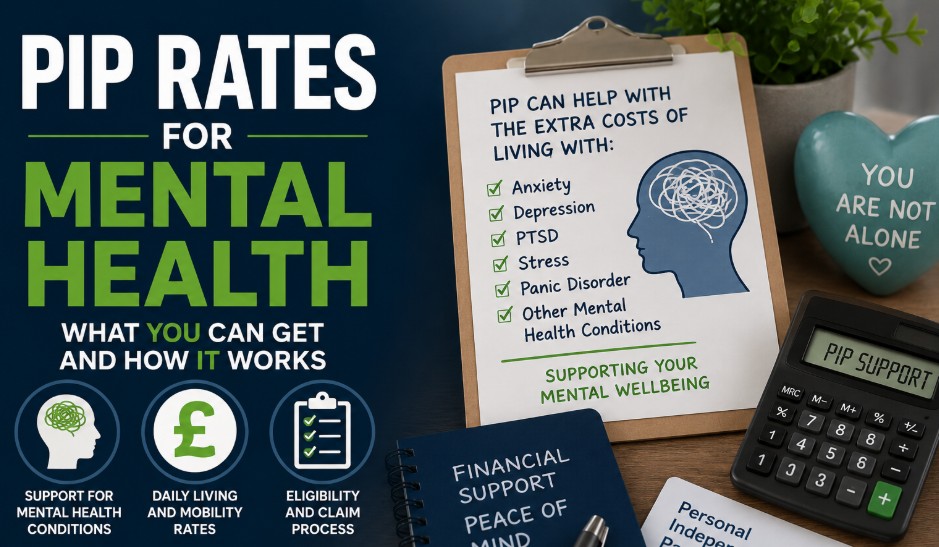
Personal Independence Payment PIP rates for mental health conditions provide up to £114.60 per week for daily living and up to £80.00 per week for mobility needs. These tax-free DWP payments are awarded based on how your psychological condition impacts daily functionality rather than your specific clinical diagnosis.
Key Takeaways
- The Department for Work and Pensions implemented a statutory three point eight percent benefit uprating that legally took effect on Monday, April six two thousand twenty-six.
- You can check the details regarding how much PIP is going up in April to see the exact adjustments across all bands.
- Psychiatric disorders represent thirty-nine percent of the national caseload, making psychological conditions the single largest claim category in the United Kingdom.
- The maximum possible financial award combining enhanced daily living and enhanced mobility components sits at seven hundred seventy-eight pounds and forty pence.
- Claimants must satisfy the DWP criteria across at least fifty percent of days over a rolling twelve-month window to qualify for ongoing financial support.
What Is the PIP Payment for Mental Health?
The Department for Work and Pensions structures the Personal Independence Payment into two distinct structural elements: the Daily Living component and the Mobility component. Claimants can be awarded either one or both sections depending entirely on the severity of their functional limitations.
This seasonal adjustment follows a wider Personal Independence Payment rise across the social security infrastructure. Unlike means-tested social welfare programs, these amounts are completely tax-free and are paid regardless of an individual’s employment status, personal savings, or National Insurance contribution history.
In practice, when reviewing decisions across the wider welfare sector, confusion frequently arises regarding the frequency of distributions. The DWP calculates awards using strict weekly rates, but standard administrative procedures dictate that regular payments are issued in arrears every four weeks on a designated weekday.
The table below outlines the precise baseline weekly and four-weekly monetary allocations for the 2026/2027 financial year, demonstrating the exact baseline figures for individuals seeking clear information on PIP monthly rates for mental health:
| Component and Award Tier | Weekly Rate (2026/2027) | 4-Weekly Payment Cycle | Annualised Total Equivalent |
| Daily Living: Standard Rate | £76.70 | £306.80 | £3,988.40 |
| Daily Living: Enhanced Rate | £114.60 | £458.40 | £5,959.20 |
| Mobility: Standard Rate | £30.30 | £121.20 | £1,575.60 |
| Mobility: Enhanced Rate | £80.00 | £320.00 | £4,160.00 |
Source: Department for Work and Pensions Statutory Benefit Rates Guidance 2026/2027
Consider the case of a person with clinical depression who is awarded the standard Daily Living component because they cannot safely manage their nutrition or medication without constant prompting.
They will see exactly £306.80 transferred into their account every 4 weeks. If their conditions worsen over time or require additional external care interventions, they reserve the legal right to request a formal change of circumstances review to adjust their structural payment tier.

Can I Get High Rate PIP for Mental Health?
Securing the maximum possible allocation, often colloquially termed full PIP or high rate PIP, is entirely possible for individuals experiencing profound psychiatric, emotional, or cognitive barriers.
Achieving the absolute highest financial designation requires a claimant to accumulate 12 or more points across both the Daily Living and Mobility assessment frameworks during their independent health evaluation.
When these dual thresholds are reached, the DWP combines the enhanced rates of both components, generating a maximum weekly award of £194.60, which translates to an overall payment of £778.40 per four-week cycle.
To illustrate how points stack up to unlock higher award levels, the absolute amounts derived from specific award combinations are broken down in the matrix below:
| Combined Award Composition Matrix | Total Weekly Payout | Total 4-Weekly Payout | Net Annual Support Value |
| Standard DL + Standard Mobility | £107.00 | £428.00 | £5,564.00 |
| Standard DL + Enhanced Mobility | £156.70 | £626.80 | £8,148.40 |
| Enhanced DL + Standard Mobility | £144.90 | £579.60 | £7,534.80 |
| Enhanced DL + Enhanced Mobility (Maximum) | £194.60 | £778.40 | £10,119.20 |
Data compiled from official DWP 2026 benefit schedule allocations
How Does the DWP Evaluate Specific Mental Health Conditions?
A common pattern observed during independent appeal tribunals is that applicants focus exclusively on their clinical diagnosis rather than their dynamic functional limitations.
The DWP does not award points based on the name of a medical condition; instead, the assessment focuses on how a condition limits your ability to complete daily tasks and navigate the community safely.
Can PIP be given for depression?
Yes. When assessing severe clinical depression, the DWP evaluates chronic deficits in executive function, profound motivation loss, and the cognitive fatigue that impedes basic self-care.
Points are frequently accumulated under Activity 1 (Preparing food) and Activity 4 (Washing and bathing) if the individual requires continuous prompting or physical supervision to maintain personal hygiene and basic nutrition.
Is PIP available for all anxiety disorders?
Entitlement extends to all recognized manifestations of anxiety, including Generalized Anxiety Disorder (GAD), Agoraphobia, Panic Disorder, and Social Anxiety.
The evaluation centers heavily on whether the panic episodes trigger physiological or psychological paralysis, preventing the individual from interacting with others or stepping outside their immediate domestic environment without substantial interpersonal backing.
How to win PIP for bipolar?
Successfully navigating a claim for bipolar disorder requires providing comprehensive historical tracking of the fluctuating shifts between severe depressive episodes and manic cycles.
Because the condition is highly variable, evidence must clearly show how the individual’s judgment, financial safety, and self-preservation become deeply compromised during periods of mania, alongside the self-neglect that characterizes their low phases.
PIP rates for mental health PTSD
Claimants presenting with Post-Traumatic Stress Disorder or Complex PTSD are assessed on structural barriers stemming from chronic hypervigilance, nocturnal panic, flashbacks, and cognitive dissociation.
These profound symptoms regularly trigger high scores in social engagement descriptors and the planning of physical journeys, where unexpected external stimuli can cause immediate psychological decompensation.
PIP rates for mental health adhd adults
For adults managing Attention Deficit Hyperactivity Disorder, the DWP focuses on executive dysfunction, severe emotional dysregulation, memory gaps, and sensory overload.
Evaluators assess the individual’s ability to plan, initiate, and complete complex multi-stage tasks, such as managing household budgets or following unfamiliar geographic routes, without losing focus or experiencing severe psychological distress.
What Are the Mobility PIP Rates for Mental Health?
The mobility component remains one of the most under-claimed elements within psychiatric applications, largely because of the lingering misconception that it requires physical or locomotive impairment. For mental health claimants, the evaluation centers primarily on Activity 11: Planning and following journeys.
Depending on the severity of the psychological distress experienced when attempting to navigate the outdoor environment, an individual can secure either the standard mobility rate (£30.30/week) or the enhanced mobility rate (£80.00/week).
Activity 11 Points System Breakdown
- 0 Points: Can plan and follow the route of a journey unaided.
- 4 Points: Needs prompting to undertake a journey due to distress.
- 8 Points: Cannot follow the route of an unfamiliar journey unaided.
- 12 Points: Cannot follow the route of a familiar journey without another person.
An individual diagnosed with severe agoraphobia might experience overwhelming panic attacks that induce disorientation and physical nausea whenever they cross their threshold alone.
If they require a trained support worker or an immediate family member to accompany them on every local trip to ensure they remain safe and grounded, they meet the threshold for 12 points under the DWP descriptors.
This automatically qualifies them for the enhanced mobility allowance, translating to £320.00 every four weeks, completely independent of physical walking capacity.
How Difficult Is It to Get PIP for Mental Health?
Securing an entitlement can be a challenging process. The DWP’s official quarterly statistics report indicates that only 37% of completely new claims processed under standard rules culminate in a positive initial award.
The remaining percentage face initial disallowance, often due to insufficient documentation regarding functional limitations rather than a lack of genuine illness.
To protect claimants with fluctuating mental health profiles, the DWP is legally bound by the 50% Rule. This statutory framework mandates that if a symptom restricts your ability to complete a task on more than 50% of the days within a rolling 12-month window, you must be scored as if that restriction is constantly present.
Furthermore, the DWP must evaluate whether you can execute a descriptor according to four legal pillars:
- Safely: Without causing a realistic risk of physical injury or emotional harm.
- Reliably: Achieving the same outcome consistently throughout the day.
- Repeatedly: Able to do the activity as many times as reasonably required.
- Reasonable Timeframe: Taking no more than twice the duration of an ordinary non-disabled peer.
How long is PIP awarded for mental health?
Once an award is finalized, the DWP determines a set timeline based on the likelihood of clinical recovery or stabilization.
According to the same DWP experimental statistics publication, 58% of new claims receive short-term designations lasting between 0 and 2 years, while longer-term awards extend further before requiring a formal award review to confirm ongoing care needs.
For older claimants navigating these awards, special rules apply, including specific mechanisms governing UK pensioners’ PIP backdated payments following successful appeals.
The Step-by-Step Claim Process for Mental Health Benefits
Initiating a claim requires adhering to a strict administrative pathway managed by the Department for Work and Pensions.
Missing deadlines or failing to complete forms thoroughly often leads to applications being closed prematurely. Follow these essential steps to navigate the process effectively:
- Initiate Contact: Telephone the DWP new claims line on 0800 917 2222 to verify basic identity details and start your application.
- Receive the PIP1 Form: Complete and return the initial basic eligibility form containing your National Insurance number and medical contact details.
- Complete the PIP2 Questionnaire: Fill out the detailed How Your Disability Affects You form, meticulously documenting every functional restriction across the 12 daily living and mobility activities.
- Map Symptoms to Descriptors: Frame every answer around the legal pillars, explaining clearly why you cannot complete tasks safely, reliably, or repeatedly.
- Compile Corroborative Evidence: Gather external clinical validation, including psychiatric assessments, prescription histories, and letters from support workers.
- Attend the Health Assessment: Participate in an interview with an independent health professional, ensuring you accurately describe your functional capacity on your worst days.
- Await the Final Decision: Review the formal determination letter outlining your point breakdown, weekly payment rates, and scheduled review dates.
What Medical Evidence Is Needed for PIP ADHD and Psychiatric Claims?
When compiling an application for neurodivergent conditions or severe psychiatric illnesses, providing basic diagnostic letters is rarely sufficient to secure an award. The DWP requires objective evidence illustrating the continuous real-world impact of your symptoms.
The layout below outlines the hierarchy of evidence most valued by DWP decision-makers:
Evidence Priority Hierarchy
- High Weight: Community Psychiatric Nurse (CPN) functional logs
- High Weight: Occupational Therapy (OT) cognitive assessments
- Medium Weight: Consultant psychiatrist diagnostic reviews & treatment plans
- Medium Weight: Structured detailed diaries tracking fluctuating bad days
For instance, a claimant submitting an adult ADHD claim should include detailed workplace adjustment plans, Access to Work assessments, or cognitive behavioral therapy session logs.
These documents carry significant weight because they record the actual adjustments required to manage daily life, providing clear proof that goes beyond a basic clinical diagnosis.

What Are the Disadvantages of Using PIP?
While the financial security provided by a successful claim can be life-changing, applicants should be aware of several systemic drawbacks. The primary disadvantage centers on the significant psychological toll of the application and assessment process.
Many claimants report experiencing heightened anxiety, stress, and vulnerability during the months spent compiling detailed records of their personal difficulties.
Furthermore, continuous compliance is required even after approval, meaning claimants must carefully follow complex administrative parameters such as the PIP claimants’ DWP holiday rules when planning travel outside the country.
Additionally, the process requires regular re-evaluations. Unless an individual is awarded an ongoing designation, they will face scheduled award reviews that introduce recurring uncertainty and the risk of their payment tier being adjusted or discontinued if their health shows signs of stabilization.
Summary
Managing a long-term mental health condition or neurodivergence involves significant challenges that extend well beyond clinical symptoms.
Securing a Personal Independence Payment can provide essential financial support to help cover the practical costs of daily living.
With the 2026/2027 rates now legally active, individuals should focus on compiling detailed, practical evidence that clearly demonstrates how their conditions impact their everyday safety, reliability, and Independence.
If you are preparing an application or challenging a recent DWP decision, gathering functional health reports and keeping a consistent diary of your symptoms are vital steps toward building a strong, clear claim.
Disclaimer: This article provides informational guidance only and does not constitute formal legal or financial advice; please consult the DWP or a qualified specialist for personal claims support.
FAQ
What are the official PIP rates for mental health UK for the 2026/2027 tax year?
The standard daily living rate is £76.70, and the enhanced rate is £114.60. The mobility component provides an additional £30.30 standard or £80.00 enhanced per week.
Does my employment status affect my PIP rates for mental health adhd adults?
No, PIP is completely non-means-tested. You can work full-time or study while receiving the full financial award, provided you satisfy the core functional disability criteria.
What are the maximum weekly or monthly PIP rates for mental health ptsd?
The absolute maximum combined award sits at £194.60 per week, which translates to a four-weekly payment of £778.40 into your account.
How long is PIP awarded for before a review is required?
Most initial normal rules claims receive short-term awards lasting between 1 and 2 years, though more severe, enduring psychiatric presentations can secure longer timelines.
What should I do if my mental health PIP claim is denied by the DWP?
You must formally request a Mandatory Reconsideration within one calendar month of the date printed on your decision letter to challenge the DWP’s points allocation.
Can I claim PIP for anxiety if I do not have a formal psychiatric diagnosis?
Yes, you can apply based on your symptoms, but you must provide comprehensive evidence showing the long-term functional impact of your condition to secure an award.
Can PIP be paid weekly instead of every four weeks?
The DWP calculates the benefit using weekly rates, but standard administrative procedures distribute the funds as a lump sum every four weeks in arrears.
