
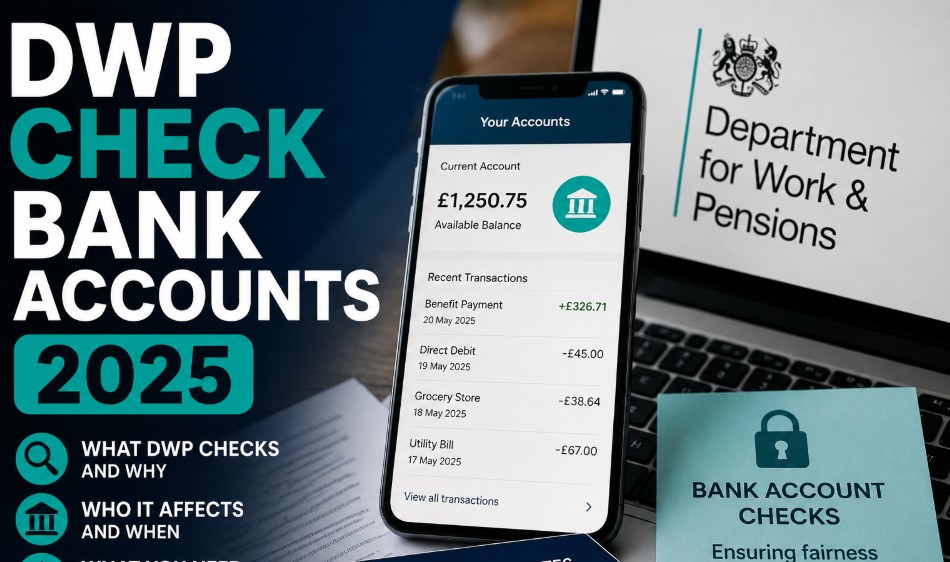
The question of how and when the Department for Work and Pensions (DWP) monitors financial data remains a significant point of public discussion.
The legislative framework surrounding DWP checking bank accounts 2025 has evolved, leading to new measures designed to maintain the integrity of the social security system.
The DWP is implementing enhanced data-sharing measures to identify discrepancies in benefit claims, specifically targeting cases where individuals may hold savings above the permitted threshold or fail to declare income through DWP Universal Credit Bank Account Checks.
These powers allow the department to request information from financial institutions to verify eligibility for various social security payments.
Why is DWP Checking Bank Accounts 2025?
The Department for Work and Pensions (DWP) has significantly increased its use of data-matching and automated oversight to tackle the rising levels of fraud and error within the welfare system.
The DWP is under pressure to address the fact that benefit expenditure fraud and error have remained a persistent issue for over three decades.
The primary objectives for these intensified checks are:
- Verification of Eligibility: To ensure that claimants meet the specific criteria for the benefits they receive, particularly regarding capital (savings) and income thresholds.
- Prevention of Overpayments: To identify discrepancies early, preventing the build-up of large debts for claimants that occur when errors are not caught in real-time.
- System Integrity: To reduce the multi-billion pound annual loss to the taxpayer caused by fraudulent claims and administrative errors.
- Automation: By using Eligibility Verification Measures (EVM), the DWP shifts from manual, reactive investigations to a more systemic, automated cross-referencing of financial data, making it more difficult for undeclared income or excess savings to go unnoticed.
How does the DWP check bank accounts 2025 process work?
The DWP utilizes a targeted Eligibility Verification Measure (EVM) to detect potential fraud and error by cross-referencing claimant data with financial institutions.
This system does not provide the DWP with continuous, live, or unrestricted access to an individual’s private spending habits, daily transactions, or specific purchase history.
The Truth of Financial Monitoring
In practice, the DWP operates under strict data protection protocols governed by the UK General Data Protection Regulation (UK GDPR).
When the department identifies a potential anomaly, such as a mismatch between declared savings and actual account balances, it triggers a formal request for information.
This is not mass surveillance, but rather a focused verification process aimed at ensuring that public funds are distributed only to those who meet the legal criteria.
| Feature | Current Reality | Common Misconception |
| Account Access | Triggered by data mismatches | Real-time live streaming of all spending |
| Scope | Targeted eligibility verification | Universal surveillance of every citizen |
| Data Usage | Restricted to fraud/error detection | Monitoring of personal shopping habits |
| Privacy | Subject to UK GDPR and oversight | Unregulated access to private data |
How does the DWP check bank accounts 2025 for potential fraud?
The mechanism relies on automated data matching to highlight discrepancies. When a claimant applies for or receives means-tested benefits, they must meet specific capital and income requirements.
- The DWP receives electronic data feeds from participating financial institutions.
- Automated systems flag accounts where the balance consistently exceeds benefit limits.
- Departmental caseworkers review the flagged data to determine if a formal inquiry is necessary.
- If a potential error is identified, the claimant is contacted for clarification.
- The claimant is provided an opportunity to explain the discrepancy before any decision is made.
- If fraud is suspected, a formal investigation is launched under established legislative powers.
- The final decision on benefit entitlement is reviewed, potentially leading to adjustments or recovery of overpaid funds.

What will DWP be checking bank accounts for during investigations?
Investigations are primarily focused on identifying undeclared capital or income that would disqualify a person from receiving specific benefits, including HMRC Bank Account Deductions, which may occur if overpayments are identified.
- Savings Thresholds: The most common trigger is exceeding the £16,000 capital limit for Universal Credit.
- Undisclosed Income: Ongoing checks seek to identify regular payments into accounts that suggest employment or self-employment not reported to the DWP.
- Residency Verification: Data is sometimes reviewed to establish if a claimant is living abroad, which would affect their eligibility for UK-based support.
In practice, when the DWP identifies a potential issue, they often request statements covering a specific period.
A common pattern is for caseworkers to request evidence of all accounts held by an individual, not just the one currently flagged, to gain a full picture of the claimant’s financial position.
How to Know if DWP is Checking Your Bank Account?
There is no single alert or notification sent to a claimant the moment a bank check begins. However, the process typically follows a clear path:
- Automated Flagging: You will not know if your account is being scanned by the automated system. These systems match your National Insurance number against financial data to look for indicators like balances exceeding the £16,000 threshold.
- Formal Inquiry: If the system identifies a discrepancy, the DWP will contact you directly to request clarification or evidence. This is the most common way a claimant becomes aware that their finances are being scrutinized.
- Request for Information: You may receive a formal request for bank statements or documentation regarding specific accounts. If you are contacted by a DWP compliance officer or receive a letter regarding a review of your circumstances, it is an indication that your claim is being verified.
- Stay Informed via Your Portal: Regularly check your online benefit dashboard (such as your Universal Credit account). If there is an issue with your entitlement, official notifications and requests for further information will appear there.
Can the DWP Look at Your Bank Account Without Notice?
Under the current legislative framework, the DWP does not require your individual permission for each check, nor are they required to provide notice before an automated data-matching system performs a routine verification of eligibility indicators.
- No Live Surveillance: It is a common misconception that the DWP has a live, real-time window into your daily spending. They cannot log in to your account, see what you purchase at the grocery store, or monitor your private habits.
- Statutory Powers: The DWP has legal authority to issue Eligibility Verification Notices to financial institutions. These powers compel banks to provide specific, limited data (like account balances or evidence of regular income) to confirm you meet the criteria for your benefits.
- Proportionality: These checks are meant to be proportionate. The DWP is restricted by UK GDPR and strict data-sharing protocols, meaning they only receive the information necessary to determine if you are entitled to the benefit.
How Much Savings Can You Have on Account?
The impact of your savings on your benefit entitlement depends on the specific benefit, but for Universal Credit, the rules are as follows:
| Savings Amount | Impact on Universal Credit |
| £6,000 or less | No impact on your claim. |
| £6,001 – £16,000 | Your monthly payment is reduced. Every £250 (or part thereof) over £6,000 is treated as providing £4.35 in monthly income. |
| Over £16,000 | You are generally ineligible for Universal Credit, and your claim will be stopped. |
Important Note: These rules apply to the total capital held by you and your partner, including current accounts, savings accounts, ISAs, stocks, shares, cryptocurrency, and property you do not live in. Always report any changes to your savings balance immediately to avoid overpayment recovery.
Disclaimer: Benefit rules can be complex and subject to change. For specific advice regarding your claim, please log in to your official government portal or contact the DWP directly.

Summary
Staying informed and maintaining transparency is the most secure approach for any benefit claimant. The DWP’s focus in 2025 remains on identifying fraud and error through data matching.
If you are ever contacted regarding a review of your financial information, the most important step is to respond clearly, provide all requested documents, and address any discrepancies immediately.
For the most accurate and up-to-date guidance, always rely on the official information available via the GOV.UK portal.
FAQ
Can DWP look at your bank account without permission?
The DWP acts under statutory powers to prevent fraud. They do not require individual, case-by-case permission to request financial information from banks once the legislative criteria for a fraud investigation or eligibility check are met.
Does the DWP know how many bank accounts I have?
Through automated data-sharing arrangements with major financial institutions, the DWP can identify accounts linked to a claimant’s National Insurance number. It is inaccurate to assume they cannot track multiple accounts.
Can the DWP find out how many bank accounts you have?
Yes. When investigating a claim, the DWP can use data-matching tools that query financial records across the banking sector to identify all accounts associated with a specific individual’s identity.
What happens if you have more than 16k in your bank account?
If you have more than £16,000 in capital, you are generally ineligible for Universal Credit. Failing to declare these savings while receiving benefits is treated as a serious matter, potentially resulting in overpayment recovery and prosecution.
Can I black out things on my bank statement?
Generally, you should not redact or black out information on requested statements. Providing incomplete documents can lead to delays in your review or the assumption that you are attempting to hide relevant financial evidence.
How long does a DWP investigation take?
The duration of an investigation varies significantly based on the complexity of the case. While some checks are concluded within weeks, more complex cases involving undeclared assets may take several months to resolve.
Can DWP check my passport?
The DWP has access to various government databases, including those shared with the Home Office, to verify residency and identity, which may include checking information related to passport records during eligibility investigations.
Does DWP check bank accounts for PIP?
Personal Independence Payment (PIP) is not a means-tested benefit, meaning capital and savings are generally not taken into account. However, checks may still occur if there is suspicion regarding residency or other eligibility criteria.
