
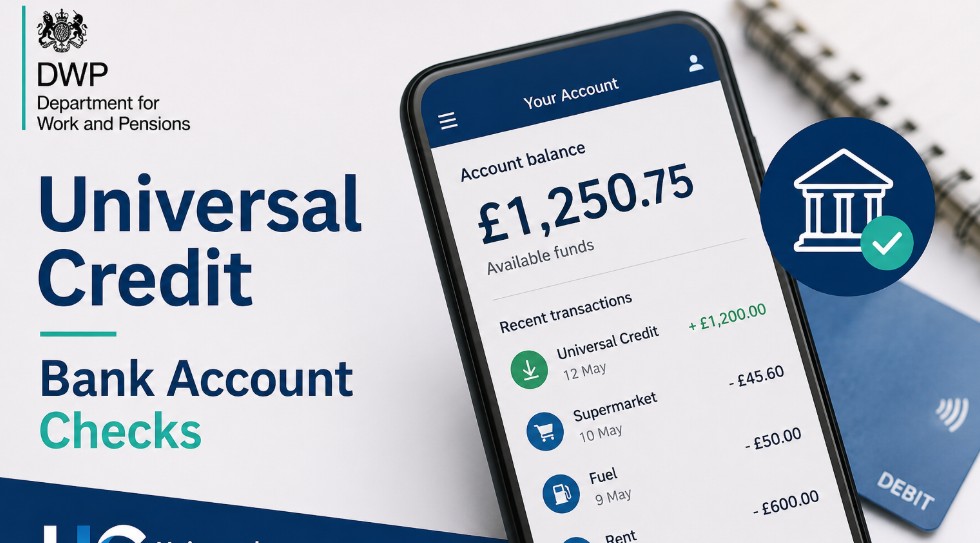
Under the Public Authorities (Fraud, Error and Recovery) Act 2025, the DWP now utilizes enhanced data-sharing powers to conduct automated checks on benefit claimants’ bank accounts. These checks use Eligibility Verification Notices (EVNs) to identify discrepancies in savings, income, or residency.
The DWP does not have live access to your daily transactions; instead, banks flag accounts that deviate from statutory eligibility criteria for further DWP review.
What do DWP Universal Credit Bank Account Checks involve?
The DWP does not have direct, real-time access to browse your private bank account activity. Instead, they use a process called Eligibility Verification Measures (EVMs).
Under this system, the DWP issues Eligibility Verification Notices (EVNs) to major UK financial institutions, requiring them to check their own data for specific eligibility indicators.
If a bank’s internal systems identify that a claimant’s account matches these indicators (such as exceeding savings limits or suggesting long-term residence abroad), they provide the DWP with limited information, such as the account holder’s name, balance, and account number.
The DWP then reviews this information to determine if a formal inquiry or further evidence from the claimant is necessary.

Why does DWP conduct Universal Credit Bank Account Checks?
The primary objective is to safeguard public funds and maintain the integrity of the welfare system.
By automating the verification of self-reported financial data, the DWP aims to prevent overpayments, identify errors early, and reduce the billions lost to fraud and error, a persistent issue that has led to qualified audit opinions on DWP accounts for over 35 years.
- Prevent overpayments: Ensuring claimants do not receive funds they are not entitled to.
- Identify discrepancies: Matching self-reported data against actual financial records to catch errors early.
- Protect public funds: Ensuring taxpayers’ money is distributed only to those who meet the strict statutory eligibility criteria.
- Prevent debt accrual: Correcting issues quickly before a claimant inadvertently builds up a large, unmanageable debt.
How do DWP Universal Credit Bank Account Checks work?
The DWP uses an automated Eligibility Verification Measure (EVM). They issue an Eligibility Verification Notice (EVN) to banks, requiring them to scan datasets for specific eligibility indicators (e.g., savings over £16,000).
If a match is found, the bank notifies the DWP, who then reviews the data to decide if a formal inquiry or further evidence from the claimant is required.
- Indicator Setup: The DWP provides financial institutions with specific criteria (e.g., savings exceeding £16,000).
- Automated Scanning: Banks scan their datasets for accounts linked to benefit recipients that trigger these indicators.
- Data Notification: If a match is found, the bank notifies the DWP of the account holder’s identity and relevant financial data point.
- Case Review: A DWP officer reviews the flagged information. No automated decisions on benefit entitlement are made based on this information alone.
- Claimant Interaction: If a discrepancy is confirmed, the DWP will contact the claimant to provide an explanation or documentation before any changes are made to the claim.
How much money can you have in the bank and still claim Universal Credit?
Financial assets are a significant factor in determining eligibility. The DWP mandates that capital, which includes savings, investments, and property (excluding your primary residence), must be declared.
- Under £6,000: Savings below this threshold do not affect your Universal Credit payment amount. Keep in mind that capital rules vary across benefits, so if you are planning for the future, it is worth understanding how much you can have for Pension Credit as well.
- £6,000 to £16,000: Every £250 (or part thereof) over the £6,000 limit is treated as generating £4.35 of monthly income. This reduces your benefit payment accordingly.
- Over £16,000: You are generally ineligible for Universal Credit if your capital exceeds this amount, regardless of your other circumstances.
Capital Verification Standards
Claimants are expected to maintain accurate records of their finances. It is common for the DWP to request bank statements when verifying capital, especially during the initial application or following a change of circumstances report.
As of 2026, claimants should be prepared to explain significant fluctuations in their account balances.
Can DWP check bank accounts without any notice or permission?
While the DWP can legally compel banks to share data under the Public Authorities (Fraud, Error and Recovery) Act 2024, it is important to note this does not grant them unrestricted access to your private, day-to-day transaction history.
- Notice and Oversight: Banks are required to act on specific notices (EVNs) issued by the DWP. There is independent oversight and a code of practice governing how these powers are used to ensure they are proportionate.
- Scope Limitation: They are prohibited by law from requesting transaction-level data (such as what you purchased at a store) or sensitive personal categories like your religion or political beliefs.
- Communication: If the DWP takes action based on findings, you will be notified, and you will have the opportunity to challenge decisions or provide clarifying evidence.

What causes a DWP Universal Credit Bank Account check?
Checks are typically triggered by red flags that occur when your financial situation doesn’t align with your declarations:
- Exceeding Capital Limits: Consistently holding more than £6,000 (which affects payments) or £16,000 (which renders a claimant ineligible) in savings or investments.
- Undeclared Income: Regular credits or deposits that don’t match the income reported in your claim.
- Residency Inconsistencies: Data suggesting the account is being used abroad for longer than the allowed period (typically 4 weeks).
- Unexplained Financial Patterns: Significant, one-off large deposits or lifestyle indicators that appear inconsistent with the reported financial status. Claimants should be wary of advice circulating online regarding a Universal Credit loophole for £1500; attempting to exploit such methods will almost certainly trigger an immediatefraud investigation.
Disclaimer: This information is for educational purposes and reflects current UK welfare policy frameworks as of July 2026. If you are concerned about your specific circumstances, you should always consult your DWP work coach or seek independent financial advice.
Summary
Staying compliant with Universal Credit requirements requires transparency. Ensure your reported savings are accurate, update the DWP immediately regarding any changes to your financial status, and keep detailed records of your income sources.
If you receive a request for information, respond promptly and honestly to prevent unnecessary complications.
FAQ
Can I black out things on my bank statement?
You should not obscure financial transactions. While you can remove non-financial information, the DWP requires full access to your income and expenditure history to verify your capital status and ensure accurate benefit calculations.
How do you know if your bank account is being monitored?
You will not receive a notification that your account is being monitored. If an investigation is triggered, the DWP will contact you directly to request information, verify your circumstances, or invite you to an interview under caution.
How far back can DWP ask for bank statements?
The DWP can request bank statements covering any period relevant to your claim. In practice, this is typically the last 3 to 6 months, but if they suspect long-term fraud, they may request history spanning several years.
Who can legally freeze your bank account?
Only the bank itself can freeze an account, often due to fraud prevention protocols or court orders. The DWP does not have the power to freeze your account directly, though they may pursue recovery of overpayments via deduction or court action.
How much cash can you deposit without being suspicious?
There is no fixed limit for cash deposits, but any money paid into your account is considered capital or income. If you deposit large sums, you must be prepared to provide evidence of the source to avoid a fraud investigation.
What are red flags on bank statements?
Red flags include unexplained large deposits, consistent patterns of undeclared income, gambling activity that suggests hidden funds, or large transfers to third parties that imply hidden assets or lifestyle discrepancies.
What records must be kept forever?
While there is no forever rule, it is advisable to keep documentation related to significant capital changes, such as property sales, inheritance, or legal settlements, for at least six years to support your financial history.
How does DWP know you’re abroad?
The DWP uses cross-border data sharing, travel information from airlines, and internal systems to identify if a claimant has been outside the UK for longer than the permitted period, which affects eligibility.
