
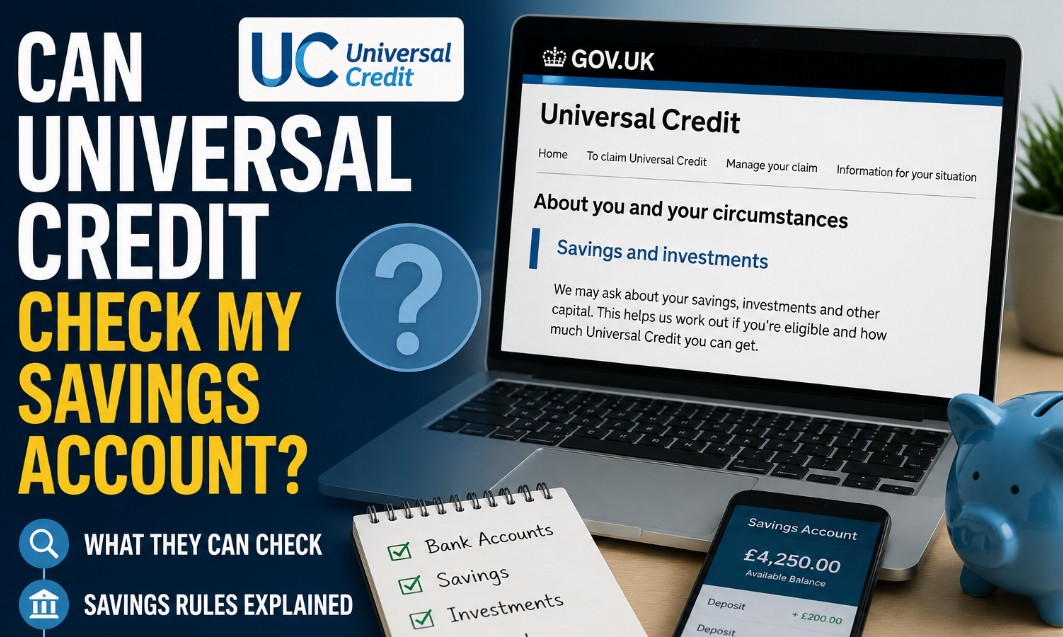
Yes, the Department for Work and Pensions (DWP) has the legal power to verify your financial details.
While the DWP does not have a live feed or continuous window into your private bank account, they use advanced data-matching technology under the Public Authorities (Fraud, Error and Recovery) Act 2025 to flag accounts that breach capital thresholds.
If your savings consistently exceed the £16,000 limit, or if external data suggests a mismatch between your reported assets and your actual balance, the DWP can issue an Eligibility Verification Notice (EVN) to compel financial institutions to provide specific information. For a deeper look at these protocols, you can review DWP bank check details.
Can Universal Credit Check My Savings Account Online?
The DWP does not have a live feed into your personal online banking. They are not monitoring your daily supermarket shopping, Netflix subscriptions, or your daily spending habits in real-time.
Instead, the system uses automated data-matching to flag discrepancies. When a claim is processed, the system integrates data from various sources to verify eligibility.
Under the 2026 fraud-prevention frameworks, banks may be required to share data that highlights key eligibility indicators.
These automated alerts notify the DWP if your savings balance consistently sits above the £16,000 threshold or if there are sudden, unexplained fluctuations that do not tally with the income you have logged in your Universal Credit journal.
You may also want to stay updated on any UK benefit changes that could impact your assessment.
The Logic of Capital Thresholds
To understand why these checks occur, you must look at how the government calculates benefit entitlement.
Your capital includes all liquid assets, such as bank accounts, savings, ISAs, stocks, shares, cryptocurrency, and property you do not live in.
| Capital Amount | Impact on Universal Credit |
| Below £6,000 | No impact on your benefit payment. |
| £6,000 – £16,000 | Treated as generating £4.35 of tariff income for every £250. |
| Above £16,000 | You are not eligible for Universal Credit. |

Can the DWP Check Your Bank Account Without Permission?
The DWP does not require a claimant’s explicit permission to investigate financial records if they suspect an overpayment or fraudulent activity.
Under the Social Security Administration Act, the department is empowered to gather information to ensure that public money is correctly allocated.
When an investigation is launched, the DWP operates through formal legal channels. They do not need to notify a claimant before requesting information from a bank, especially in cases where there is evidence of non-disclosure regarding significant assets.
However, this is distinct from access. They are purely requesting data to verify the details of a specific claim, rather than poking around in your personal spending habits.
How Often Do Universal Credit Check Bank Accounts?
The DWP does not review bank accounts every month for every claimant, as the sheer volume of claims makes constant manual monitoring impossible. Instead, the department employs a risk-based approach.
Checks generally occur during these specific stages:
- Initial Application: Verification of capital is mandatory when first applying for support.
- Periodic Reviews: Standard compliance checks performed randomly or when data suggests a change in circumstances.
- Data Mismatch Triggers: If information from HMRC or other government departments conflicts with a claimant’s declared income or savings.
- Targeted Fraud Investigations: When the DWP receives a tip-off or detects suspicious account activity.
- Change of Circumstances: When a claimant reports a change that requires a recalculation of their award.
- Annual Verification: Regular administrative updates to confirm ongoing eligibility.
What Information Can the DWP See?
There is a common fear that the DWP might see every intimate detail of a claimant’s life. However, legal safeguards limit what financial institutions share.
The DWP focuses specifically on the capital element of the account, the balance, rather than the itemized list of how that money was spent.
They are not interested in, and generally do not receive, sensitive personal data such as religious, political, or trade union affiliations that might be inferred from transaction descriptions. The focus remains strictly on financial assets that directly impact your eligibility.
How does DWP know if you have savings?
The DWP does not rely on a single source of information; instead, it uses a multi-layered verification system that cross-references the details you provide in your journal against external data.
- Data Matching and Automated Alerts: As of 2026, the DWP utilizes advanced data-matching technology to compare your declared capital against information held by financial institutions. When you apply for or receive Universal Credit, the system checks for eligibility indicators. These are automated flags triggered when an account shows activity inconsistent with the income and capital you have reported.
- Direct Information Requests: Under current legislation, the DWP has the power to compel banks and financial institutions to provide information. While they do not have a live window into your daily banking, they can request specific data to verify your eligibility if a discrepancy is detected. This may include, but is not limited to, account balances and history.
- Cross-Government Intelligence: The DWP integrates information from various government departments, including HMRC. This allows them to identify undeclared income, property ownership, and significant financial transitions, such as inheritances, redundancy payments, or large lump sums, that should have been reported as capital.
- Targeted Investigations: If a mismatch is identified between your declared circumstances and the data received from external sources, the DWP may launch a formal compliance check. This process is not a general audit of your spending habits but a targeted inquiry into whether your total assets remain within the permitted thresholds.
How Much Savings Can I Have in My Bank Account?
Your entitlement to Universal Credit is directly tied to the total value of your capital, which includes all money in your bank accounts, savings, ISAs, stocks, shares, and property you do not live in. The government applies a sliding scale to your benefits based on these assets:
- The Tariff Income Rule: For every £250 (or part of £250) you have above the £6,000 threshold, the DWP assumes you are earning £4.35 in monthly income. This amount is automatically deducted from your monthly Universal Credit payment.
- Joint Capital: If you live with a partner, the DWP considers your household capital. This means your savings and your partner’s savings are combined. If the total exceeds £16,000, neither of you will qualify for Universal Credit.
- What counts as capital: The DWP includes almost all liquid assets, including PayPal balances, cryptocurrency, premium bonds, and money held in building societies or credit unions.
- Reporting Requirements: You must declare your savings at the start of your claim and report any changes to your circumstances, such as receiving an inheritance, a divorce settlement, or a significant redundancy payment, as soon as they occur. Failure to do so is treated as a change of circumstances and can lead to overpayment recovery and potential penalties.
The Reality of Deprivation of Assets
A frequent cause of DWP intervention is the deprivation of assets. This occurs when a claimant intentionally reduces their capital, such as by transferring money to family members or making large, unnecessary purchases, specifically to drop below the £16,000 threshold to remain eligible for benefits.
If the DWP determines that capital was disposed of for the purpose of qualifying for benefits, they will treat that money as notional capital.
This means they will assess your eligibility as if that money never left your account, often resulting in a reduction or termination of benefits and potential recovery of overpayments.
Summary
The DWP maintains robust powers to verify your financial information, particularly regarding savings and whether Universal Credit is going up. The most effective way to protect your claim is to maintain total transparency:
- Audit your accounts: Before applying, confirm exactly how much is in all your accounts, including ISAs and foreign savings.
- Keep records: Maintain a file of your financial statements.
- Update the journal: If your savings increase or decrease, report it in your Universal Credit journal immediately.
- Consult official guidance: Always rely on GOV.UK for the most current rules on capital and income.
FAQ
Can I black out things on my bank statement?
No. Providing redacted or blacked out statements is considered non-cooperation. The DWP requires clear, unaltered evidence to verify financial circumstances. Altering documents can trigger a deeper fraud investigation.
How do you know if Universal Credit is investigating you?
You will typically be contacted by a DWP compliance officer via your Universal Credit journal, telephone, or letter. They will ask for clarification on specific financial entries or request updated bank statements.
Can Universal Credit be paid into a savings account?
Yes, Universal Credit can be paid into a savings account, provided the account is in your name and you can access the funds. However, the balance will still count toward your total capital.
Can the government look at my bank account if I have nothing to hide?
Yes, the DWP has the legal authority to request financial data from banks if there is a reason to verify a claim, regardless of whether a claimant believes they have nothing to hide.
How long can DWP check your bank account without permission?
There is no fixed time limit on a DWP investigation. It continues until they have sufficient evidence to determine if an overpayment has occurred or if eligibility criteria are being met.
What happens if I don’t tell Universal Credit about savings?
Failure to disclose savings is treated as a change of circumstances that could lead to an overpayment. This may result in financial penalties, a fraud marker on your file, and repayment of benefits received while ineligible.
Does my partner’s savings count toward my claim?
Yes, if you are a member of a couple, the DWP considers your joint capital. Any savings held by your partner are combined with your own when determining if you exceed the £6,000 or £16,000 thresholds.
