
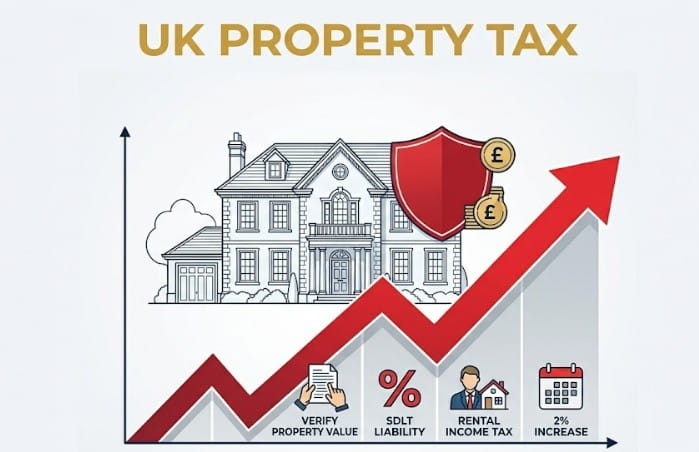
Under Chancellor Rachel Reeves, UK property tax in 2026 refers to a new fiscal framework including the High-Value Council Tax Surcharge for homes over £2m, a permanent 5% Stamp Duty surcharge on additional dwellings, and a 2% increase in property income tax effective from April 2027.
In effect, the Treasury is pivoting away from broad-based income taxes, choosing instead to tap into the UK’s vast property wealth to plug the public spending gap.
For the average homeowner, the landscape remains stable, but for those at the higher end of the market or with multiple holdings, 2026 represents a significant turning point in fiscal liability.
What Are the New Property Taxes in the UK for 2026?
The core changes to property tax under Rachel Reeves for 2026 involve a new High-Value Council Tax Surcharge on properties exceeding £2 million, the structural expiration of temporary Stamp Duty Land Tax (SDLT) relief thresholds, and a permanent baseline increase of the Additional Dwelling Surcharge (ADS) to 5%.
Key 2026 Policy Changes
- High-Value Surcharge: Valuations above £2 million trigger an annual structural fee.
- SDLT Baseline Shift: The baseline nil-rate threshold resets permanently to £125,000.
- First-Time Buyer Compression: The specialized maximum relief threshold drops back to £300,000.
The 2026 fiscal landscape marks a departure from the status quo, with the Treasury introducing a multi-layered approach to property wealth that reaches far beyond simple Council Tax.
Following the reversion of temporary reliefs outlined in previous autumn statements, the nil-rate band for move-in buyers has settled at £125,000, while first-time buyers see a reduced relief threshold of £300,000.
In practice, this means a significant portion of buyers across the Greater London Authority and the South East are once again facing upfront tax bills that were previously mitigated.

Comparison: Property Tax Rates 2025 vs. 2026/27
| Tax Type | 2025 Rate/Threshold | 2026/27 Rate/Threshold | Key Deadline |
| Mansion Tax (£2m-£5m) | N/A | £2,500 per year | April 2028 (Collection) |
| Mansion Tax (>£5m) | N/A | £7,500 per year | April 2028 (Collection) |
| Property Income (Basic) | 20% | 22% | April 2027 |
| Stamp Duty (Additional) | 5% Surcharge | 5% Surcharge (Permanent) | Active Now |
| Capital Gains (Residential) | 18% / 24% | 18% / 24% | Active Now |
Is a Mansion Tax Actually Happening?
Yes, the value-based surcharge framework is a legislated reality via the Finance Act. According to official data from the Office for National Statistics (ONS), the High-Value Council Tax Surcharge directly impacts approximately 165,000 premium households across the United Kingdom based on updated 2026 physical and desktop market valuations.
This distinction is vital in legal disputes; for instance, many ask if I leave the marital home, what are my rights regarding such tax liabilities during a separation?
A critical point of difference matters here for landlords: standard council tax remains an occupier’s cost, but this high-value surcharge rests solely on the legal deed holder.
When domestic partnerships dissolve, this structural divide shifts legal strategies, prompting people to ask their attorneys how their separation terms handle ongoing luxury tax liabilities once a partner exits the marital home.
Market data already shows a clear ‘cliff-edge’ effect at the £2 million mark. Independent estate agencies across London are reporting a surge in deals agreed at £1.99 million specifically to dodge the initial surcharge trigger.
A common pattern is for sellers to offer separate agreements for furniture or fittings to keep the official property price below the threshold.
What is the Targeted Revaluation for High-Value Homes?
The Valuation Office Agency (VOA) is conducting a Targeted Revaluation throughout 2026, using desktop modelling and EPC data to identify homes exceeding the £2 million threshold.
This exercise targets the top 1% of the market, re-banding properties based on added value features like home offices or period restorations, even without a physical inspection.
How Do Rachel Reeves Tax Changes Affect Landlords and Second Homeowners?
Landlords face a compounding structural shift under the 2026 property tax updates. The updated rules mandate a permanent 5% Stamp Duty surcharge on secondary purchases, an incremental 2% increase across individual property income tax bands taking effect in April 2027, and lowered thresholds for personal allowance clawbacks.
For the UK’s buy-to-let sector, the environment is shifting rapidly. The 2% increase in property income tax rates starting in April 2027 means higher-rate taxpayers will pay 42% on their rental profits.
Understanding the 60% Tax Trap
The 60% Tax Trap is an effective tax rate that hits landlords whose total taxable income, including rental profits, climbs between £100,000 and £125,140.
Due to fiscal drag and the tapering of the Personal Allowance, for every £2 earned in this bracket, £1 of tax-free allowance is clawed back, making it a critical blind spot for UK investors in 2026.
The Impact of the 2026 Capital Gains Tax (CGT) Hike
While residential CGT rates remain at 18% and 24%, the rate for Business Asset Disposal Relief (BADR) has increased to 18% in 2026, narrowing margins for property developers and professional landlords.
HMRC has also tightened the reporting window, requiring full CGT payment within 60 days of completion. For those selling buy-to-let properties, this creates an immediate cash-flow burden that must be factored into the 2026 disposal process.
Will Rachel Reeves Reduce the Tax-Free Lump Sum?
No, official Treasury guidance has confirmed the pension tax-free lump sum (PCLS) will remain at 25% (capped at £268,275) for the remainder of this Parliament, despite 2026 budget rumours suggesting a reduction to £100,000.
This provides some relief to asset-rich, cash-poor pensioners worried about the impact of the new Mansion Tax. However, for retirees, the interaction between property value and Inheritance Tax (IHT) remains the primary concern.
With the IHT nil-rate band frozen, more family homes are being pulled into the tax net due to house price inflation.
A pensioner in a £2.2 million home faces an annual £2,500 surcharge while their estate faces a 40% IHT bill on value exceeding the thresholds.
The 2026 Property Tax Checklist
- Verify Property Value: Check if your home exceeds the £2m Mansion Tax threshold.
- Review Income Bands: Prepare for the 2% property income tax hike. You should also verify when the new tax year starts to ensure your filings for April 2027 are accurate.
- Assess SDLT Liability: Calculate new costs if purchasing a home above £125,000.
- Check Mansion Tax Liability: Note that owners, not tenants, are liable for the surcharge.
- Evaluate EPC Ratings: Look for Green Tax Credits available for energy upgrades.
- Plan for IHT Changes: Review the £1m cap on combined APR and BPR reliefs.
- Monitor the 60% Trap: Track if rental income pushes total earnings over £100,000.
How to Navigate the 2026 Property Tax Shift?
The shift in policy means the era of ‘passive’ property investment is over; homeowners and investors now need to look at the granular details of their holdings to avoid unnecessary tax leakage.
For those near the £2 million threshold, the VOA’s use of desktop valuations means that features like home offices, double garages, and period restorations are now high-stakes assets.
- The 7-Year Rule: To mitigate IHT, gifting property or shares in a property company remains a viable strategy, provided the donor survives seven years.
- Green Tax Credits: The government has introduced EPC Incentives, where landlords can offset the costs of heat pumps or insulation against their 2027 property income tax bills.
- Portfolio Rebalancing: Some investors are selling high-value single assets in the South East to buy multiple lower-value properties in the North, avoiding the Mansion Tax surcharge while maintaining yield.
Will Non-Dom Tax Changes Affect the UK Property Market?
The abolition of the non-domicile tax regime from April 2025 has matured in 2026, pulling overseas property holdings into the UK Inheritance Tax (IHT) net.
Overseas investors holding UK property through offshore entities no longer enjoy IHT protection. This transparency drive has triggered a wave of de-enveloping, with international owners moving property into personal names to simplify their 2026 UK tax liabilities.
Why Do UK Citizens Pay Property Taxes?
Historically, the UK has relied on Council Tax, which is a service-based tax linked to 1991 property values. The shift toward a value-based surcharge brings the UK closer to international models.
While past political movements like the petition to revoke Article 50 highlighted shifts in UK-EU alignment, the current focus remains on domestic fiscal stability, where property wealth has outstripped income growth, making it a more stable target for the Treasury.
Critics argue this is a wealth tax by the back door, as it taxes the value of an asset regardless of the owner’s liquid income. However, proponents suggest it is a fairer way to fund national infrastructure than further taxing working-age salaries.

Summary and Next Steps
Ultimately, the Property Tax Rachel Reeves plan redraws the map for property ownership in Britain, placing the heaviest burden on those with high-value primary residences and extensive rental portfolios. To prepare:
- Valuation: Get a professional RICS valuation if your property is near the £2 million mark to clarify your liability.
- Incorporation: Evaluate whether moving property into a Limited Company structure offsets the 2027 income tax hikes.
- Efficiency: Utilise available Green Tax Credits before the 2026 deadlines to improve your property’s tax standing.
FAQ about Property Tax Rachel Reeves
Is there a national wealth tax on UK homes?
No. There is no broad-based wealth tax on all homes. The only value-based surcharge is the High-Value Council Tax Surcharge, which specifically targets properties worth over £2 million.
Do I have to pay property tax on my main home?
Yes, in the form of Council Tax. If your primary residence is valued above £2 million, you will also be liable for the new High-Value Surcharge from 2026.
What is the tax rate for rental income in the UK for 2026/27?
Currently, it follows your income tax band (20%, 40%, or 45%). However, from April 2027, these rates will rise to 22%, 42%, and 47%, respectively.
Will Rachel Reeves change the Right to Buy tax rules?
Current policy has focused on reducing the discounts available to tenants, effectively increasing the cost of purchasing social housing to preserve housing stock.
Can I retire at 60 with a £300k property portfolio?
While possible, the 2026 tax changes make it harder. With higher income tax rates on rent and the removal of various mortgage interest reliefs, a £300k portfolio may not generate sufficient net income without other savings.
What is the 60% trap for landlords?
It is an effective tax rate of 60% that occurs when your total income (including rent) is between £100,000 and £125,140, caused by the withdrawal of the Personal Allowance.
