
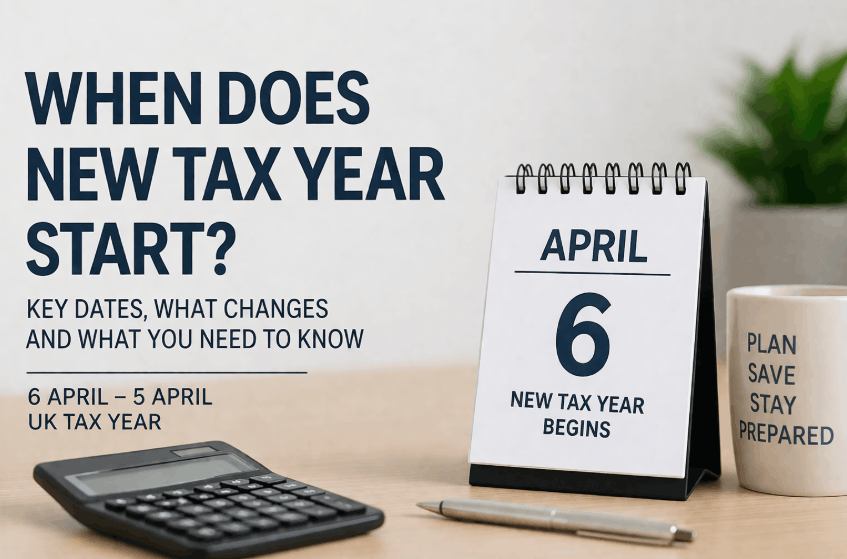
The UK tax year starts on 6 April every year and finishes on 5 April the following year. For the upcoming cycle, the 2026/27 tax year begins on Monday, 6 April 2026.
This date marks the hard reset for your £12,570 personal allowance and the £20,000 ISA limit, determining exactly when your tax-free thresholds refresh.
When does new tax year start for UK taxpayers?
The new tax year begins on 6 April 2026 and concludes on 5 April 2027. This specific date applies to personal income, capital gains tax, and inheritance tax.
While most international tax systems align with the calendar year, the UK maintains this April date due to historical shifts in the British calendar during the 18th century.
The distinction between tax and financial years
It is a common point of confusion, but the Tax Year and the Financial Year are not always the same. While the tax year for individuals starts on 6 April, the financial year used by the government for various economic purposes and by many companies for Corporation Tax usually starts on 1 April.
If you are a limited company director, you must track both: 1 April for your business tax rates and 6 April for your personal dividends and salary.
Why does the tax year start on April 6?
The UK’s unusual start date is a remnant of 1752, when Britain switched from the Julian to the Gregorian calendar.
To ensure no tax revenue was lost during the 11-day calendar correction, the Treasury moved the end of the tax year from 25 March (Lady Day) to 5 April.
While the history behind the April date is unusual, its consistency allows for reliable long-term fiscal planning without the mid-winter disruption of a January 1st reset.
Historical milestones of the fiscal calendar
- 1752: The shift from the Julian to the Gregorian calendar.
- 1800: A leap year discrepancy added an extra day, moving the date from 5 April to 6 April.
- Present Day: HMRC maintains 6 April to avoid complicating centuries of tax legislation.
A frequent piece of misinformation is that the personal tax year aligns with the government’s financial year on April 1st. While business Corporation Tax often follows the April 1st reset, personal income tax and ISAs never do.
Missing this five-day window is a costly mistake I often see savers make when they realise their ISA allowance hasn’t reset as early as they thought.
What changes for you on 6 April 2026?
The transition into a new tax year acts as a hard reset for your financial allowances. On this date, the following limits are refreshed:
- Personal Allowance: The amount you can earn before paying Income Tax (currently £12,570).
- ISA Allowance: Your £20,000 annual limit for tax-free savings resets.
- Dividend Allowance: The tax-free threshold for investment income.
- Capital Gains Tax (CGT) Exemption: The profit limit you can make on asset sales before tax is due.
- Pension Annual Allowance: The total amount you can contribute to pensions with tax relief.
Beyond these standard resets, you should account for shifts in retirement legislation. For instance, recent discussions regarding the pension tax-free lump sum to be scrapped suggest that long-term withdrawal strategies may need to be front-loaded before the new cycle begins.
| Allowance Type | 2025/26 Limit | 2026/27 Limit (Est.) | Impact on Taxpayer |
| Personal Allowance | £12,570 | £12,570 | Stays frozen; Fiscal Drag may increase tax. |
| ISA Subscription | £20,000 | £20,000 | Reset; use it or lose it. |
| Dividend Allowance | £500 | £500 | High earners pay more on investments. |
| CGT Exemption | £3,000 | £3,000 | Profit over this is taxable. |
In my experience, the real danger of a frozen allowance is ‘Fiscal Drag.’ If your salary rises by 5% to match inflation but the £12,570 threshold stays static, you effectively lose a larger portion of your take-home pay to the 20% bracket.
For a typical earner moving from £25,000 to £27,000, this ‘hidden’ tax increase can cost an extra £400 annually compared to an inflation-linked system.
How to prepare for the new tax year start?
Effective preparation involves a detailed year-end review, balancing the closing year’s obligations against the new year’s opportunities. A common pattern among proactive taxpayers is the ‘March Rush’ to maximise ISA contributions.
- Review your most recent P60 to estimate your 2026 earnings; for healthcare professionals, assessing how these figures align with the latest NHS pension scheme changes is essential for accurate take-home pay projections.
- Check your tax code on your March payslip to ensure HMRC has the correct data for April.
- Calculate your remaining ISA headroom and move funds before the 5 April midnight deadline.
- Consolidate your gift aid receipts to claim higher-rate tax relief if applicable.
- Update your bookkeeping software for the new National Insurance rates.
- Distribute assets between spouses to utilise two sets of tax-free allowances.
- Submit your 2025/26 Self Assessment early to understand your Payments on Account for the new year.
When does new tax year start for self employed workers?
For those who work for themselves, the transition on 6 April carries additional weight due to the Basis Period Reform.
As of 2026, most sole traders must report profits based on the actual tax year (6 April to 5 April), regardless of their specific accounting year-end.
This alignment simplifies the crossover with PAYE income but can create a temporary overlap of profits that requires careful calculation.
One common edge case involves starting a new job right at the finish line, for example, on April 4th. In this scenario, you must ensure your new employer processes your P45 immediately; otherwise, you risk being placed on an emergency tax code for the entire first month of the new year, which can lead to a significant, though temporary, dip in your first 2026/27 paycheck.
Key deadlines for the 2026/27 cycle
- 31 July 2026: Second payment on account for the 2025/26 year.
- 5 October 2026: Deadline to register for Self Assessment if you started a business in the previous tax year.
- 31 January 2027: Deadline for online tax returns and the first payment on account for the 2026/27 year.
Essential steps for business owners in April
If you run a limited company, your Personal Tax Year (starting 6 April) is when you should reconsider your salary-to-dividend ratio.
For instance, in a recent case I assisted with, a director saved nearly £1,200 by slightly increasing their salary to stay above the National Insurance Lower Earnings Limit while staying below the Primary Threshold.
- Update Payroll: Ensure your software reflects the new 2026/27 tax codes for all employees.
- P60 Issuance: You must provide your employees with their P60 by 31 May 2026.
- Benefit Reviews: April is the time to review P11D benefits-in-kind, like company cars or health insurance.
Summary of Next Steps
To hit the ground running for the 2026/27 tax year, your immediate priority should be a tax code verification via your Personal Tax Account.
Savers may find value in ‘front-loading’ ISA contributions as soon as the clock strikes midnight on 6 April to maximise tax-free growth.
Ultimately, keeping your 2025/26 records organised now will significantly reduce the pressure when the next Self Assessment deadline approaches.

FAQ about when does new tax year start
Why does the tax year end on 5 April?
The UK tax year ends on 5 April to ensure a full 365-day cycle following the 1752 calendar shift. Originally ending on 25 March, the date was moved forward to 5 April, and then to 6 April in 1800, to prevent the Treasury from losing 11 days of tax revenue during the transition to the Gregorian calendar.
Does the tax year start on April 1st or April 6th?
Personal tax starts on 6 April. However, the government’s financial year and Corporation Tax changes usually start on 1 April. Most individuals only need to worry about the 6 April date.
When do I get my new tax code for 2026?
HMRC usually issues P2 Notice of Coding letters between January and March. Your employer will apply the new code to your first paycheck issued on or after 6 April 2026.
Can I carry over my ISA allowance to the new tax year?
No. The £20,000 ISA allowance is a use it or lose it limit. If you haven’t used it by midnight on 5 April, you lose that year’s tax-free contribution capacity.
What is the 2026/27 Personal Allowance?
The standard Personal Allowance is currently frozen at £12,570. This means you can earn up to this amount before you start paying 20% Income Tax.
When is the deadline for the 2025/26 tax return?
The online deadline is 31 January 2027. However, the new tax year starting in April 2026 is when you should begin collecting the documents needed for that filing.
Does the tax year start date change on weekends?
No. Even if 6 April falls on a Saturday or Sunday, the tax year officially begins. However, bank processing times for ISA contributions may be affected, so it’s best to act earlier.
