
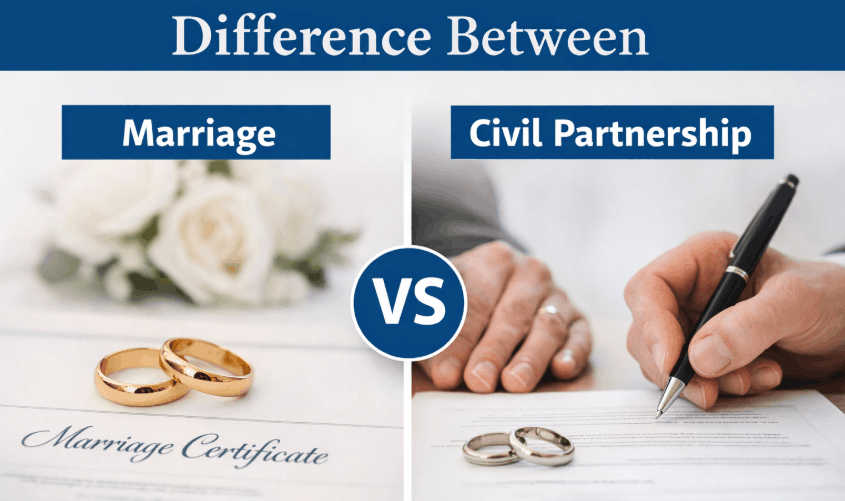
In the United Kingdom, the primary difference between marriage and civil partnership lies in the formation of the union and its historical origins. Marriage is established through the exchange of specific spoken vows, whereas a civil partnership is formed by signing a civil partnership schedule.
While both provide near-identical legal rights regarding tax, inheritance, and next-of-kin status, marriage can be religious or civil, while civil partnerships are strictly secular.
What is the difference between marriage and civil partnership in 2026?
Deciding between these two paths often comes down to how you prefer to formalise your legal bond, whether through the traditional weight of a ceremony or a modern, contract-based registration.
Marriage is an ancient institution often associated with religious or traditional ceremonies involving verbal vows.
A civil partnership is a modern legal alternative, created in 2004 and expanded in 2019, which focuses on a written contract rather than spoken words or religious context.
Global recognition and the 2026 conversion gap
Beyond the ceremony, the distinction is largely symbolic for many couples, yet legally nuanced. Marriage is recognised globally, whereas a civil partnership may not be recognised in every country.
There is also a notable distinction in conversion rights; while same-sex couples can convert a civil partnership into a marriage, the UK government has not yet extended this same conversion right to mixed-sex couples as of 2026.

How do you form a legal union in England and Wales?
The procedure for entering these unions varies significantly in terms of what is required during the ceremony itself.
For those seeking a low-key or entirely non-traditional union, the civil partnership offers a streamlined administrative process that marriage does not.
- Submit your notice: You must visit your local register office at least 28 days before the date to declare your intent.
- Confirm your status: Be prepared to provide proof of identity and age, ensuring both parties are at least 18 years old.
- Select an approved premises: This can range from a local town hall to any venue licensed for civil ceremonies.
- The Marriage Path: Exchange prescribed words or vows in front of two witnesses and a registrar or official.
- The Civil Partnership Path: Sign the civil partnership schedule; no spoken words or vows are legally required.
- Certification: Receive the marriage certificate or civil partnership certificate via post or digital record.
- Witness Requirements: Ensure two witnesses are present to sign the register or schedule for either union.
Is the legal protection the same for both?
We often find that couples worry they are ‘missing out’ on protections by choosing one over the other. In reality, while the social experience differs, the statutory protections regarding debt, tax, and property are effectively identical in the eyes of the court.
| Feature | Marriage | Civil Partnership |
| Formation | Spoken vows and signature | Signing the legal schedule |
| Ceremony Type | Religious or Civil | Strictly Secular |
| Public Record | Marriage Certificate | Civil Partnership Certificate |
| Ending the Union | Divorce (No-fault) | Dissolution (No-fault) |
| State Pension | Full survivor benefits | Full survivor benefits |
| Inheritance Tax | 100% Spouse exemption | 100% Partner exemption |
| International | Universally recognised | Recognition varies by country |
Can you have a religious civil partnership?
One frequent question involves the atmosphere of the ceremony, specifically, whether any religious elements can be included in a civil partnership.
One frequent question involves the atmosphere of the ceremony, specifically, whether any religious elements can be included in a civil partnership. Under the Civil Partnership Act 2004, a civil partnership ceremony must be entirely secular.
This means no religious readings, hymns, or even instrumental music with religious connotations are permitted during the legal signing.
- No religious venues: Unlike marriage, which can take place in a church or chapel, civil partnerships are restricted to secular licensed venues.
- No religious words: The ceremony cannot include any phrasing that implies a religious blessing or context.
- Administrative nature: Many couples choose a civil partnership specifically because they view marriage as a patriarchal or religious institution they wish to avoid.
Many couples I work with opt for a civil partnership specifically to bypass the historical or religious connotations of marriage, favouring a purely administrative alternative.
This decoupling of the legal contract from the social celebration is becoming a hallmark of modern relationship planning in the current legal climate

What are the financial implications for your future?
The financial framework for both unions is designed to provide security. If you were to separate, the courts in England and Wales use the same criteria to determine the division of assets, regardless of whether you are spouses or civil partners.
For those navigating a separation, it is vital to understand if i leave marital home what are my rights UK to ensure immediate housing security. These protections apply equally to both legal unions to prevent one partner from being unfairly disadvantaged.
Tax and Inheritance Benefits
Both statuses grant you the Marriage Allowance (if eligible), allowing the transfer of a portion of your personal tax allowance to a higher-earning partner. Crucially, the spousal exemption for Inheritance Tax applies to both.
This means you can leave your entire estate to your partner without a tax bill, a protection not afforded to common law cohabiting couples.
Parental Responsibility
If a child is born to a married couple or civil partners, both individuals generally obtain automatic Parental Responsibility.
This ensures that in emergency medical or educational scenarios, both parents have equal legal standing without needing to apply for additional court orders.
However, questions often arise regarding the permanence of these statuses, specifically when does a father lose parental rights UK and how the courts protect the child’s best interests. In both marriage and civil partnership, these rights are robust and difficult to terminate without serious cause.
How does international travel affect your choice?
While the domestic rights are identical, the international perspective is where the difference between marriage and civil partnership becomes most apparent.
Marriage is a globally understood concept. If you move to a country that does not recognise civil partnerships, you may be treated as single for visa purposes, healthcare access, or inheritance laws.
A common pattern we observe involves couples who plan to work in the Middle East or parts of Asia. In these jurisdictions, a civil partnership certificate may not be sufficient to secure a spouse visa.
Couples must meticulously review the current UK spouse visa requirements if they are planning to bring a partner into the country under a specific legal status. If you are preparing for a significant international relocation in the near future, the portability of marriage is a distinct advantage.
Is it possible to convert a civil partnership to a marriage?
As of 2026, the law remains asymmetrical regarding conversions. Same-sex couples who entered into a civil partnership before same-sex marriage was legalised in 2014 have the right to convert their partnership into a marriage. This process is administrative and does not require a new ceremony.
However, mixed-sex couples do not currently have the legal right to convert a civil partnership into a marriage.
If a mixed-sex couple in a civil partnership decides they would rather be married, they must legally dissolve their partnership first, which requires being separated or meeting dissolution criteria, and then marry. This is a significant consideration for couples who are undecided.

Final considerations for your future
The choice between marriage and civil partnership in 2026 is largely a matter of personal and philosophical preference.
Both paths offer comprehensive safeguarding for your assets, ensuring your partnership is governed by a firm and recognised legal framework.
If you prefer a traditional, potentially religious ceremony, marriage is your path; however, if you seek a modern, secular, and purely contractual union, a civil partnership is ideal.
Before you book your date:
- Check with your local register office for venue availability.
- If you plan to live abroad, verify the recognition of civil partnerships in your destination country.
- Update your Will and pension beneficiaries immediately after your ceremony.
FAQ about difference between marriage and civil partnership
Is a civil partnership cheaper than a marriage?
No. The statutory fees for giving notice and the cost of the registrar are generally the same. The total cost usually depends on your choice of venue and the scale of your celebration.
Can I call myself married if I am in a civil partnership?
Legally, you are a civil partner. While you may use the term married socially, on formal documents (passports, tax returns, insurance), you must tick the box for civil partner.
Do I need a new Will after a civil partnership?
Yes. Just like marriage, entering into a civil partnership automatically revokes any existing Will in England and Wales unless the Will was specifically made in expectation of that union.
Is there a common law marriage in the UK?
No. This is a widespread myth. Regardless of how long you live together, you do not gain the legal protections of marriage or civil partnership without a formal ceremony or registration.
Can we have a civil partnership if we are already married?
No. You cannot enter a civil partnership with your current spouse or anyone else while a marriage is legally active. You must be single, divorced, or widowed.
How do we end a civil partnership?
You apply for a dissolution. Under the no-fault laws active in 2026, you simply state that the partnership has broken down irretrievably.
The process mirrors the divorce process exactly, and couples should prepare for the financial aspect by researching how much does a divorce cost UK to manage legal and court fees effectively.
Do civil partners get the same pension rights?
Yes, in most cases. Since 2017, the law has moved toward equalising survivor benefits for civil partners in both public and private sector pension schemes.
