
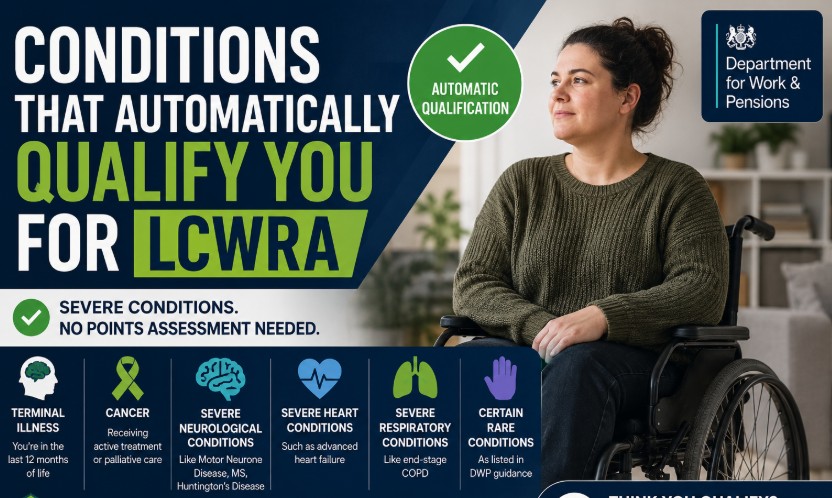
Wondering about what are the conditions that automatically qualify you for LCWRA? Under Department for Work and Pensions regulations, no standard medical condition automatically awards Limited Capability for Work and Related Activity status without an assessment.
Instead, eligibility depends strictly on how a health condition or disability affects an individual’s functional capability through specific statutory criteria, fast-track exemptions, or high-threshold descriptors.
Key Takeaways
- There is no official Department for Work and Pensions list where a specific medical diagnosis instantly awards LCWRA status.
- Fast-track exemptions apply automatically under special rules for terminal illnesses and specific ongoing cancer treatments.
- Meeting certain high-threshold functional descriptors during a Work Capability Assessment secures the highest welfare tier.
- Evidence from healthcare professionals detailing daily functional impacts remains essential for a successful claim outcome.
What is LCWRA?
LCWRA stands for Limited Capability for Work and Related Activity. It is the highest support tier within the UK welfare system (primarily part of Universal Credit) for individuals whose health condition or disability severely restricts their ability to work or prepare for future work.
Being placed in the LCWRA group means you:
- Are completely exempt from all mandatory work-related interviews and job search requirements.
- Receive a higher monthly financial addition added to your standard Universal Credit allowance.
- Face no pressure from work coaches to look for employment, allowing you to focus entirely on managing your health.
What are the conditions that automatically qualify you for LCWRA?
There is no official medical diagnosis list that instantly grants LCWRA status. In practice, the Department for Work and Pensions does not base eligibility purely on the label of an illness. Every claimant must undergo a Work Capability Assessment.
However, fast-track exemptions bypass the standard points-based assessment entirely for specific critical circumstances:
- Terminal Illness (Special Rules): Claimants with a progressive disease where death is reasonably expected within 12 months (accelerated via Form SR1).
- Active Cancer Treatment: Individuals receiving or recovering from cytotoxic chemotherapy or radiotherapy.
- Pregnancy Risks: Severe pregnancy complications where a medical professional advises that work poses a serious risk to health or the unborn child.
| Assessment Factor | Work-Related Activity Group (LCW) | Support Group (LCWRA) |
| Primary Focus | Managing preparation for future work | Unconditional support with no work-related requirements |
| Financial Element | Standard health addition included | Higher monthly financial addition included |
| Mandatory Interviews | Required to attend regular reviews with work coaches | Exempt from all mandatory work-related interviews |

What Are the Legitimate Fast-Track Routes and Exemptions for LCWRA?
Legitimate fast-track routes for LCWRA include special rules for terminal illnesses, active cancer treatments, and severe pregnancy complications that bypass standard points.
While standard medical diagnoses do not trigger automatic awards, specific exceptional circumstances bypass the standard functional assessment scoring system entirely.
These legislative exemptions exist to protect vulnerable individuals from undergoing unnecessary administrative burdens during critical life events.
Terminal Illness
Claimants diagnosed with a progressive disease where death can reasonably be expected within twelve months fall under special rules provisions.
Form SR1, completed by a doctor or healthcare professional, accelerates the application. This route grants immediate access to the highest rate without requiring a standard Work Capability Assessment interview.
Active Cancer Treatment or Recovery
Individuals undergoing specific aggressive medical interventions receive distinct consideration. Under current Department for Work and Pensions guidelines, anyone receiving cytotoxic chemotherapy, radiotherapy, or recovering from these treatments is treated as having limited capability for work and work-related activity.
This specific rule ensures that individuals battling severe oncological treatments are protected from mandatory work search requirements.
Pregnancy Risks
Severe medical complications arising during pregnancy can also trigger an exemption. If a medical professional advises that working or undertaking work-related activity would pose a serious risk to health or to the unborn child, the individual bypasses standard scoring thresholds.
What Evidence Helps Qualify for LCWRA?
Robust medical evidence detailing real-world limitations in daily activities and worst-day fluctuations is essential to successfully qualify for LCWRA.
Essential supporting documentation includes:
- Detailed Medical Letters: Reports from GPs, psychiatrists, community psychiatric nurses, or social workers that clearly explain real-world limitations.
- Focus on Daily Activities: Evidence must outline struggles with tasks like preparing a meal, managing personal hygiene, navigating unfamiliar places, or coping with social engagement.
- Highlighting Worst Days: Form responses (like the UC50 health questionnaire) should accurately reflect how symptoms fluctuate and detail the impact of exhaustion, pain, or psychological distress on repeatable tasks.

Does getting PIP automatically qualify you for LCWRA?
No. Personal Independence Payment (PIP) and Universal Credit health assessments use completely different statutory criteria, especially in light of recent PIP benefit exemptions.
PIP evaluates personal care and mobility needs, whereas the Work Capability Assessment measures workplace functionality. Many claimants receive high-rate PIP without automatically qualifying for the LCWRA tier.
How to claim LCWRA?
Claiming LCWRA involves reporting your health condition online, submitting ongoing fit notes, completing the UC50 form, and attending a Work Capability Assessment.
- Report Your Health Condition: Declare your health condition or disability straight through your online Universal Credit account.
- Submit Fit Notes: Continually provide medical statements (fit notes) from your GP to cover your ongoing period of incapacity.
- Complete the UC50 Form: Fill out the Capability for Work questionnaire detailing precisely how your condition affects daily life and employment capability.
- Attend the Work Capability Assessment: Complete a functional assessment (whether face-to-face, via video, or telephone) with a DWP-appointed healthcare professional.
- Receive Your Decision: The DWP reviews the assessment report alongside your medical evidence to determine qualification for LCW, LCWRA, or neither.
How Long Does It Take to Get LCWRA?
LCWRA decisions typically take four to eight weeks following your health assessment, subject to a three-month waiting period for standard financial awards.
- Decision Timelines: Following your health assessment appointment, decisions typically take anywhere from four to eight weeks, depending on regional workloads and evidence complexity.
- The Waiting Period: For standard claims, the extra financial element usually becomes payable after a three-month waiting period starting from when you first provided continuous fit notes, though fast-track terminal illness claims are exempt from this wait.
- Review Periods: Awards are rarely permanent; the DWP schedules periodic reassessments anywhere from six months to several years down the line to check if functional capabilities have changed.
Why Did I Get LCW and Not LCWRA?
Receiving LCW instead of LCWRA means you are assessed as capable of preparing for future work rather than being entirely exempt from work-related activities.
The lower tier indicates that while the individual cannot work currently, they are considered capable of preparing for future employment with appropriate support.
In contrast, the higher tier requires meeting descriptors that demonstrate an inability to engage in any work-related activity whatsoever due to exceptional severity.
Missing out on the higher tier usually means the assessment profile showed some capacity to occasionally manage specific lower-level tasks or engage with a work coach under minimal pressure.
What Is the Substantial Risk Rule in LCWRA Assessments?
An essential safety valve within the assessment framework is the substantial risk provision. Even if a claimant does not strictly meet the standard points-based descriptors, regulations dictate that they must be treated as having limited capability for work and work-related activity if failing to do so would risk severe harm to their physical or mental health.
When reviewing decisions, healthcare professionals look closely at whether work-related pressure could trigger a severe relapse of a mental health condition or cause acute physical deterioration. Presenting clear medical evidence outlining this risk remains vital for invoking this rule successfully.
Conclusion
Qualifying for the highest welfare tier depends entirely on the functional impact of a health condition rather than its title.
Claimants should focus on gathering detailed evidence that clearly outlines their daily limitations, ensuring that questionnaire responses reflect realistic, unassisted capabilities.
Reviewing official guidelines via the government welfare portal provides precise clarity before submitting documentation.
Disclaimer: This article is for informational purposes only and does not constitute official legal or financial advice; please consult gov.uk or a professional welfare advisor for guidance on your specific claim.
FAQ
Do I still need to fill out a capability for work questionnaire if I have a severe condition?
Yes. The form, known as the UC50, provides the foundational evidence required by health professionals. Even individuals with severe conditions must complete this paperwork, though fast-track rules can streamline subsequent steps.
What is the financial difference between LCW and LCWRA?
The higher tier provides a significantly larger monthly financial addition to a Universal Credit standard allowance compared to the lower tier, which currently receives no additional monetary amount for claims made after April 2017.
Can chronic fatigue syndrome qualify for LCWRA?
Yes. Conditions like ME or chronic fatigue qualify if symptoms severely restrict physical movement, cognitive processing, and sustained daily energy levels to the point of meeting the high-threshold descriptors.
What happens if my health condition worsens after a decision?
Claimants can request a mandatory reconsideration or submit a change of circumstances report accompanied by updated medical evidence if their condition deteriorates significantly following an initial assessment outcome.
Are terminal cancer patients required to attend assessments?
No. Claimants qualifying under special rules due to a terminal diagnosis are entirely exempt from attending face-to-face assessments, and their claims receive priority handling.
How many points do you need to qualify for LCWRA?
Unlike the lower tier, which requires scoring 15 points across specific descriptors, the higher tier is achieved by meeting any single high-threshold descriptor or qualifying via specific regulatory exemptions and risk rules.
