
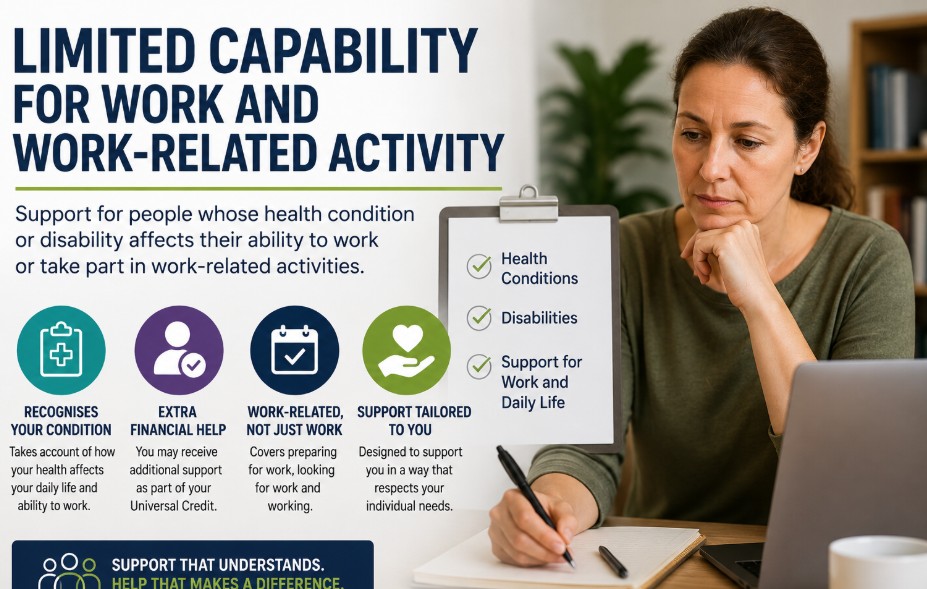
Individuals navigating the welfare system often seek clarity on limited capability for work and work-related activity (LCWRA), a classification within Universal Credit for claimants with health conditions that restrict their ability to work.
This status acknowledges that a person’s health or disability significantly impacts their capacity to engage in employment-related activities.
Key Takeaways
- The LCWRA element provides an additional monthly payment of £416.19 on top of the standard Universal Credit allowance for those found to have severe restrictions.
- Claimants must undergo a Work Capability Assessment to determine their eligibility based on evidence of functional limitations provided by medical professionals.
- Universal Credit payments for the LCWRA element generally begin following a three-month assessment period, provided that fit notes are submitted continuously.
- Receiving this status does not permanently exempt a claimant from future reviews, as the DWP periodically reassesses health conditions and work capacity.
What does limited capability for work and work-related activity mean?
Limited Capability for Work and Work-Related Activity (LCWRA) is a specific legal classification within the UK Universal Credit system. It means the Department for Work and Pensions (DWP) has formally recognized that a long-term physical or mental health condition severely restricts your functional capacity.
Rather than just looking at a medical diagnosis, it focuses on what your condition prevents you from doing. Being placed in this group means you face two distinct legal realities:
- Limited Capability for Work (LCW): The DWP agrees that your health condition means you cannot currently work or hold down a standard job.
- Limited Capability for Work-Related Activity (LCWRA): The DWP agrees that your limitations are severe enough that it is unreasonable to ask you to even prepare for a future job.
What changes when you have this status?
Getting LCWRA status removes all your Universal Credit work search requirements, adds an extra monthly financial health element to your claim, and awards you a work allowance to keep more of your earnings if you decide to work.
When you are awarded LCWRA status, your Universal Credit claim changes fundamentally in three major ways:
- Exemptions from Mandating: You are completely exempt from all work search and work preparation requirements. There is no obligation to look for employment, apply for jobs, write a CV, or attend regular mandatory interviews at a Jobcentre. Your claimant commitment is effectively set to zero requirements.
- Financial Support: Because you face severe barriers to employment, an extra health element is added to your standard Universal Credit monthly allowance. For new claimants, this standard rate is £217.26 per month (though those with lifelong severe conditions or legacy claims pre-dating April 2026 may receive a protected higher rate of £429.80 per month).
- The Work Allowance: You automatically qualify for a Universal Credit Work Allowance. This means if you ever decide you want to try working a few hours, you can earn up to a set threshold each month before the standard Universal Credit taper begins to reduce your benefit payments.
| Status | Work Requirements | Financial Impact |
| LCWRA | No work-related requirements | Receives extra monthly element (£217.26 or £429.80) |
| LCW | Must prepare for work (training, CVs) | No additional payment component (unless transitional) |
| Fit for Work | Full work-seeking obligations | Standard allowance only |

How does limited capability for work and work-related activity work?
The LCWRA process is a step-by-step evaluation where you report a health condition, submit medical fit notes, fill out a UC50 capability questionnaire, and attend a physical or virtual Work Capability Assessment (WCA).
The LCWRA process functions as a legal mechanism within Universal Credit to assess how a health condition impacts your daily functional capacity.
- Reporting: You log a health condition or disability via your online Universal Credit journal and submit continuous fit notes from a medical professional.
- The Questionnaire: The DWP issues a Capability for Work questionnaire (Form UC50) for you to detail exactly how your daily functions, both physical and mental, are limited.
- Assessment: A healthcare professional reviews your written evidence and usually conducts a formal Work Capability Assessment (WCA) to score your functional limitations against specific legal descriptors.
- Classification: If the assessment determines you cannot work and cannot reasonably perform work-preparation activities, you are placed in the LCWRA group. This removes your job-seeking obligations and adds a financial health element to your monthly Universal Credit statement.
How much is limited capability for work and work-related activity?
The LCWRA payment is structured on a two-tier system: a standard rate of £217.26 per month for most new claimants, and a protected higher rate of £429.80 per month for legacy or severely disabled claimants.
- The Standard (Lower) Rate: £217.26 per month. This applies to most new claimants who are awarded LCWRA status. This rate is frozen until at least 2029/30.
- The Protected (Higher) Rate: £429.80 per month. You receive this higher amount if you were already continuously receiving LCWRA before April 6, 2026. New claimants can only access this higher tier if they are terminally ill or meet the strict Severe Conditions Criteria (a lifelong condition with zero prospect of improvement).
Who is eligible for limited capability for work and work-related activity?
To be eligible for LCWRA, you must have an active Universal Credit claim, provide continuous medical fit notes, and score the required points under the Work Capability Assessment criteria.
- You must have an active claim for Universal Credit.
- You must have provided continuous medical evidence (fit notes) documenting a long-term illness, physical disability, or mental health condition.
- You must score the required points or meet a severe descriptor during a formal Work Capability Assessment, proving that you have no capability for work and no capability to prepare for work.
- Age Rules: Under updated policy frameworks, young people aged 18–21 who are placed in the LCWRA group may be expected to participate in tailored employment support or training programs under the Youth Guarantee scheme.
What conditions qualify you for limited capability for work and work-related activity?
There is no definitive master list of medical diagnoses (such as specific diseases or conditions) that automatically qualify a person for LCWRA. Instead, the assessment measures the functional severity of how a condition impacts your day-to-day life.
Under the strict rules, new claimants qualify for the status based on severe functional thresholds. Examples of qualifying criteria include:
- Severe Physical Limitations: Being unable to move more than 50 meters safely and reliably unaided.
- Severe Sensory or Cognitive Issues: Being unable to navigate or travel safely due to overwhelming cognitive, mental health, or sensory impairments.
- Substantial Risk: Situations where being found fit for work or work-preparation would pose a substantial risk to your physical or mental health.
- Terminal Illness: A progressive disease where death can reasonably be expected within 12 months.
Am I entitled to LCWRA back pay if my assessment was delayed?
Yes. If your Work Capability Assessment takes longer than standard guidelines due to administrative backlogs, you are legally entitled to backdated payments.
Universal Credit rules dictate a strict three-month relevant (assessment) period that starts from the date you first submit continuous fit notes or declare your health condition. The extra LCWRA element is officially payable from your fourth monthly assessment period.
If your final decision takes five, six, or more months to process, the DWP must calculate the amount owed to you from the start of that fourth assessment period and issue it as a lump-sum back payment.
What are the rules while working on LCWRA?
You can work while receiving LCWRA. Your earnings are protected by a monthly Work Allowance before Universal Credit begins tapering, provided your job tasks do not contradict your medical evidence.
The DWP encourages claimants to test their capacity under specific Right to Try rules without fear of losing their status immediately:
- The Work Allowance: As an LCWRA recipient, you get a monthly Work Allowance. This means you can earn up to a specific threshold (depending on whether your Universal Credit includes housing support) before the standard Universal Credit taper rate begins to reduce your benefit payment.
- No Automatic Reassessment: Working does not automatically strip you of your LCWRA status.
- The Contradiction Rule: The work you perform must not directly contradict the medical evidence you provided to get LCWRA. For instance, if you qualified because you cannot physically move 50 meters, taking a job that requires intense physical labor or prolonged walking will trigger a swift reassessment and potential loss of status.
How long does LCWRA exist?
LCWRA awards are rarely permanent; standard awards last between 6 and 36 months before a reassessment is scheduled, unless you meet the severe conditions criteria for a lifetime exemption.
The lifespan of an award depends entirely on the nature of your health condition:
- Standard Reviews: For most claimants, the DWP schedules standard reassessments every 6 to 36 months to see if your health or capability has changed.
- The Lifetime Award Exemption: Claimants who meet the strict Severe Conditions Criteria, meaning an NHS practitioner confirms the condition is lifelong, severe, and has no realistic prospect of recovery, can be granted a lifetime award. This completely exempts them from routine future reassessments.
- Future System Revisions: The broader welfare system is currently transitioning; the Work Capability Assessment itself is projected to be phased out by 2028/29, eventually linking the Universal Credit health element directly to Personal Independence Payment (PIP) descriptors.
What is the difference between LCW and LCWRA?
The distinction between Limited Capability for Work (LCW) and LCWRA lies in the severity of the limitations identified during the assessment.
Those categorized under LCW are deemed capable of preparing for work, meaning they must participate in regular interviews or training. In contrast, LCWRA acknowledges that the claimant is not currently able to engage in such activity.
| Feature / Criteria | Limited Capability for Work (LCW) | Limited Capability for Work & Work-Related Activity (LCWRA) |
| Work Expectations | You are not expected to look for a job right now, but you must prepare for future work. | You have no obligations to look for work or prepare for employment. |
| Mandatory Activities | Must attend work-focused interviews, update CVs, and participate in training or regular check-ins with a coach. | Exempt from all work-related activities, mandatory interviews, and coaching sessions. |
| Extra Financial Payment | £0 per month extra (No additional component is added to the standard Universal Credit allowance). | £217.26 per month (Standard Lower Rate for new claimants) or £429.80 per month (Protected Higher Rate). |
| Work Allowance Eligibility | Yes. You receive a Work Allowance, meaning you can earn a specific amount of money from a job before your UC is tapered. | Yes. You receive the same Work Allowance benefit, letting you keep more of your earnings if you choose to work. |
| Ongoing Fit Notes | You must keep submitting fit notes until the DWP confirms they are no longer required. | You are completely exempt from providing ongoing fit notes once the status is awarded. |
Note on Historical Claims: If you were awarded LCW before April 3, 2017, and have had an unbroken claim ever since, you may still receive a legacy transitional payment of £160.05 per month. However, all new LCW decisions carry no financial top-up.
How to apply and claim limited capability for work and work-related activity?
To apply for LCWRA, report your health condition through your online UC journal, submit continuous fit notes, fill out the UC50 form, provide medical reports, and attend the scheduled assessment.
Securing this status requires a structured approach to evidence and ongoing communication with the Department for Work and Pensions (DWP).
- Report your health condition via your Universal Credit online journal.
- Obtain and submit regular fit notes from your GP or hospital consultant.
- Complete the Capability for Work Questionnaire (UC50) with detailed accounts of daily limitations.
- Gather supporting medical evidence, such as hospital letters, care plans, or occupational therapy reports.
- Attend the Work Capability Assessment conducted by a healthcare professional.
- Await the written decision letter from the DWP regarding your status.
- If necessary, request a Mandatory Reconsideration within one month of the decision.

Summary
Understanding limited capability for work and work-related activity is essential for maintaining financial stability.
Key steps include maintaining a rigorous record of medical evidence, ensuring fit notes remain up to date until a formal decision is reached, and preparing thoroughly for the assessment.
If a decision is received that does not appear to align with your health limitations, consult the DWP guidance on Mandatory Reconsideration promptly.
FAQ
Is my mental health a disability?
Mental health conditions are recognized as disabilities under the Equality Act 2010 if they are long-term and have a substantial adverse effect on daily life. They are assessed identically to physical health conditions in the WCA.
How long after a WCA do you get a decision?
Decisions usually arrive via the online journal or by post within four to eight weeks following the assessment, though seasonal demand or administrative volume can cause fluctuations.
Do I need to keep providing fit notes after being awarded LCWRA?
Once a final decision is made and the LCWRA element is active on the account, claimants are generally no longer required to submit ongoing fit notes for that specific claim.
What happens if I get limited capability for work and my health improves?
Claimants have a legal duty to report any change of circumstances to the DWP. If health improves to the point of being able to work, the status may be removed upon review.
Can I claim PIP and LCWRA simultaneously?
Yes. PIP and the LCWRA element are separate benefits with different eligibility criteria, and receiving one does not preclude receiving the other.
How hard is it to get LCWRA?
It is a stringent process requiring detailed evidence. While many qualify, a high number of claims are decided upon review or appeal, making detailed, evidence-based applications essential.
Will I lose my LCWRA if I start working?
Not automatically. However, if the work performed suggests that the original health limitations are no longer present, the DWP will likely conduct a reassessment of the status.
Disclaimer: This guide is for informational purposes only and does not constitute formal legal or financial advice; always check official DWP updates for your specific circumstances.
