
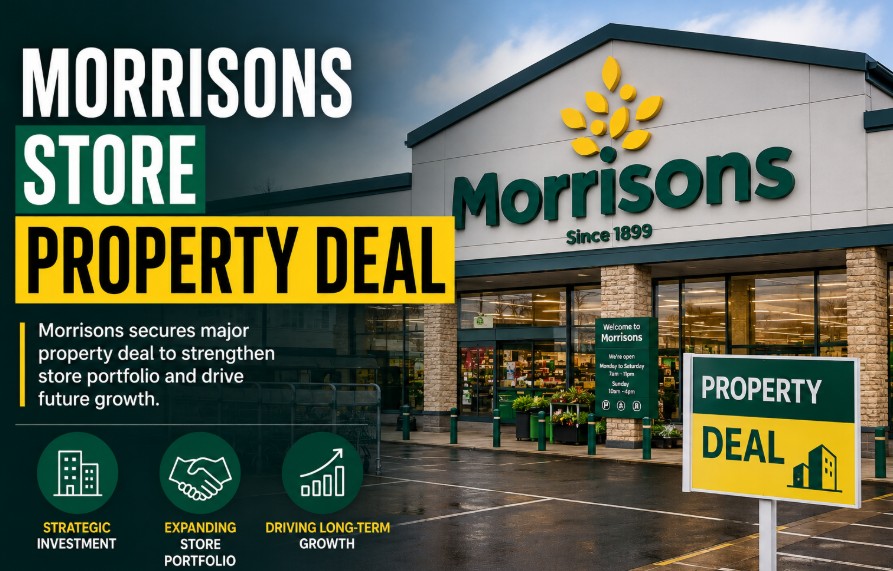
The Morrisons store property deal is a financial strategy where the supermarket uses its freehold real estate as security for loans to improve liquidity. This move helps the chain manage debt from its 2021 takeover while funding store refurbishments and pricing efficiency to stay competitive in the UK grocery sector.
Key Takeaways
- The current Morrisons property strategy focuses on raising capital through financing structures to reduce debt obligations incurred during the 2021 takeover.
- These property-backed financing moves enable the retailer to maintain operational continuity while addressing competitive pressures from the discount sector.
- Despite shifts in asset ownership models, Morrisons remains a core part of the UK grocery market, prioritising store refurbishments and pricing efficiency.
- Financial data for 2026 indicates that while debt reduction remains a primary objective, the company continues to invest in its core retail estate portfolio.
What is a Morrisons store property deal?
A Morrisons store property deal is a strategic financial mechanism where the supermarket chain uses its owned (freehold) real estate assets as security for loans rather than selling the buildings entirely.
As of July 2026, these discussions focus on a £600 million infusion, which provides liquidity to manage the debt burden resulting from the 2021 CD&R takeover.
By leveraging the 80% of stores it owns, Morrisons gains cash flow to invest in store refurbishments and pricing strategies without relinquishing control of its physical sites.
Is Morrisons in financial difficulties?
While the business remains profitable, it is operating under a heavy debt load inherited from the 2021 Leveraged Buyout by Clayton, Dubilier & Rice (CD&R).
Management is currently executing a multi-year turnaround plan to restore profit margins and improve deleveraging.
Although Fitch Ratings has affirmed a ‘B’ rating with a stable outlook in 2026, the company continues to face pressure from rising operating costs and a highly competitive UK retail environment.
Financial Strategy Overview (2026)
| Financial Metric | Strategic Focus | Objective |
| Debt Management | Refinancing legacy loans | Reduce interest burdens |
| Property Assets | Property-backed financing | Enhance liquidity/working capital |
| Market Share | Price matching initiatives | Retain core customer base |
Why is Morrisons pursuing these property deals?
The primary driver is the need to navigate the high-debt environment following the 2021 acquisition by private equity firm Clayton, Dubilier & Rice (CD&R). By monetizing roughly 80% of its freehold assets, Morrisons can reduce interest burdens.
This secures the financial firepower needed to invest in store refurbishments, supply chain technology, and aggressive pricing.
How does the deal differ from a classic sale-and-leaseback?
A classic sale-and-leaseback involves selling a property to an investor and then paying rent to occupy it, often under long-term, index-linked leases.
In contrast, the current Morrisons approach, property-backed financing, uses the estate as security for a loan.
This structure allows Morrisons to obtain the necessary capital infusion while maintaining significantly more operational independence compared to a traditional leaseback arrangement.
Economic impact and strategic turnaround
The proposed financing is a vital component of the company’s efforts to navigate the current high-cost environment, which includes energy price inflation and rising labor costs.
This financial engineering is essentially a balance sheet activity; it is designed to be invisible to the average shopper, ensuring that the daily service, product quality, and store environment remain unaffected while the company addresses its financial structure.
How does the property strategy affect UK shoppers?
There is no direct link between corporate property financing deals and the shopper’s daily experience. A store’s legal titleholder does not dictate the quality of goods or prices at the checkout.
While Morrisons has recently moved to close some unprofitable convenience stores as part of its wider efficiency drive, these decisions are based on individual site trading performance rather than corporate property financing activity.
Concerns regarding whether Morrisons is closing down often arise when news of property deals circulates. However, there is a clear distinction between internal financial engineering and the external customer experience.
- Strategic reviews may identify non-core assets for disposal.
- Leaseback arrangements ensure the store remains open as a tenant.
- Capital raised is frequently redirected toward store refurbishments.
- Pricing strategy remains the primary tool for customer retention.
- Operational focus remains on the Big 4 competitive standard.
- Convenience store portfolios are adjusted to suit local demand.

Who is the new owner of Morrisons?
Morrisons is owned by Clayton, Dubilier & Rice (CD&R), a U.S.-based private equity firm that acquired the supermarket chain in October 2021 for £7 billion.
Since the acquisition, the firm has focused on driving operational changes, reducing the company’s debt pile, and implementing a Fix, Rebuild, Grow management approach to maintain Morrisons’ position as one of the UK’s Big 4 supermarkets.
How does this ownership impact Morrisons’ strategy?
The move to private equity has fundamentally changed how Morrisons manages its capital and business operations. Strategic shifts are now visible across three primary areas:
Debt Management and Deleveraging
The 2021 acquisition significantly increased the company’s debt burden. Under CD&R, the priority has shifted toward aggressive debt reduction.
This drives current financial moves, such as the proposed £600 million property-backed financing deal, which aims to pay down legacy loans and improve the balance sheet.
Operational Streamlining
CD&R focuses on operational effectiveness to keep the business competitive against the rapid growth of Aldi and Lidl. This involves disciplined cost control and simplified supply chains.
Each store location is now optimized to ensure it contributes directly to overall profitability.
Strategic Investment in Core Areas
Despite cost-cutting, the ownership model supports targeted growth in areas like the wholesale business and the Morrisons Daily convenience brand.
By tapping into a network of retail veterans, CD&R aims to bolster the company’s online presence. Their goal is to maintain Morrisons’ heritage as a fresh-food retailer while adapting to a digital-first market.

The Competitive Landscape
The following list outlines the current standing of the UK’s major grocery players, which influences Morrisons’ property and pricing decisions:
- Tesco: Market leader with a vast, diverse property portfolio.
- Sainsbury’s: Focuses on a balanced model of retail and banking services.
- Asda: Undergone significant changes in ownership and property structure recently.
- Morrisons: Currently navigating a high-debt legacy while investing in store-based fresh food production.
Final Summary
The property strategy at Morrisons is a technical financial necessity rather than a reflection of the company’s daily operational viability. By managing its assets more effectively, the business aims to create the stability needed to compete in a crowded market.
For the average consumer, the retail experience remains largely independent of these corporate financing activities. Investors and stakeholders should focus on the company’s progress in debt reduction and market share maintenance over the coming quarters.
Disclaimer: This article is for informational purposes only and does not constitute financial, legal, or investment advice.
FAQ
Is Morrisons still British-owned?
Morrisons is owned by Clayton, Dubilier & Rice, a US-based private equity firm. While the ownership is international, the company operates as a UK-focused entity with a British management team and a supply chain rooted in British farming.
Who is the CEO of Morrisons?
As of 2026, the company continues to focus on operational leadership under the guidance of its executive team, tasked with executing the firm’s strategic turnaround and financial restructuring goals.
Are there any plans for Morrisons to close stores?
Store closures occur periodically based on individual store profitability and changing local market dynamics. This is a standard operational practice and is rarely the direct result of broader corporate property financing deals.
How does debt affect Morrisons’ ability to compete?
High debt levels necessitate strict cost controls. To remain competitive, the company focuses on price-matching and operational efficiencies to ensure that shoppers do not experience a decline in service or product quality.
Is Morrisons considered a good company?
Sentiment toward Morrisons remains mixed, balancing its reputation for quality fresh produce with the pressures of its current financial restructuring. Employee feedback often reflects the challenges of operating within a lean, fast-paced retail environment.
Do property deals affect the quality of goods?
No, property-backed financing is a balance sheet activity. It does not alter the procurement process, the quality of fresh food, or the day-to-day services provided within the supermarket environment for consumers.
What is the difference between the Big 4 and other supermarkets?
The Big 4 historically refers to the four largest UK supermarkets by market share. This grouping is often used to compare scale, property footprint, and their collective influence on UK food pricing.
