
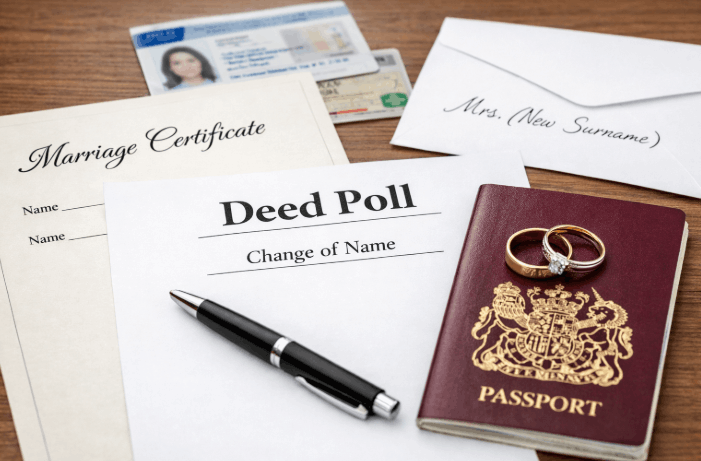
To complete a changing name after marriage process in the UK, you must notify various government bodies and private organisations.
While a marriage certificate is usually sufficient for a straightforward surname change or double-barrelling, more complex changes require a deed poll.
You should update your passport, driving licence, and HMRC records as a priority to establish your new legal identity.
How does changing name after marriage work in the UK?
In the UK, changing name after marriage is a common practice but not a legal requirement. You can choose to adopt your spouse’s surname, create a double-barrelled name, or keep your original name.
Most organisations accept your original marriage certificate as evidence of this change, allowing you to update your records without a deed poll.
Before starting the paperwork, it is useful to understand what is the difference between marriage and civil partnership as the documentation provided for name changes remains essentially identical for both.
Understanding your legal identity options
A common point of confusion during this transition is the distinction between a legal name change and a social name change.
In England, Wales, and Northern Ireland, you generally do not require a deed poll to adopt a spouse’s surname for official purposes.
Instead, the marriage certificate serves as the primary bridge between your past and present identities, allowing for a seamless update across most government and financial databases.
However, if you are meshing names (creating a brand-new surname from parts of both) or if a husband is taking a wife’s name in a way that the certificate doesn’t clearly reflect, some financial institutions may request a deed poll as additional security.
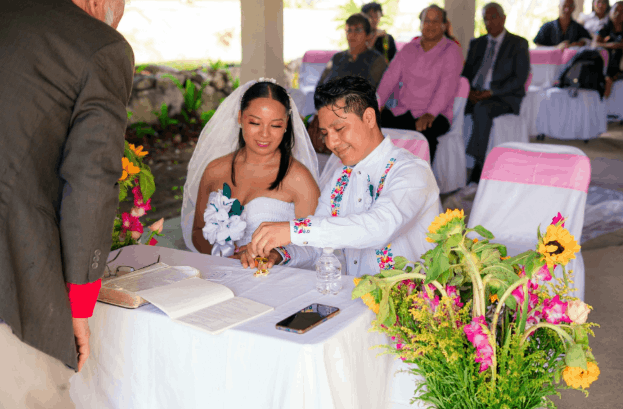
Do you need a deed poll for changing name after marriage?
Whether you require a deed poll depends entirely on the format of your new name. Most newlyweds can navigate the entire process using only their government-issued marriage certificate.
- Standard Surname Change: Taking your partner’s last name. (Certificate only)
- Double-Barrelling: Joining both surnames with or without a hyphen. (Certificate usually suffices)
- Middle Names: Moving your maiden name to a middle name. (Often requires a deed poll)
- Meshing/Crowning: Creating a new name entirely. (Deed poll mandatory)
Comparison of Name Change Methods
| Feature | Marriage Certificate | Deed Poll (Unenrolled) | Deed Poll (Enrolled) |
| Cost | Included in wedding fees | Free / Low cost | £49.32 (Current fee) |
| Best for | Simple surname changes | Most UK organisations | Permanent public record |
| Complexity | Low | Medium | High (Requires High Court) |
| Timeframe | Immediate | Same day | 4–8 weeks |
What is the correct sequence for changing name after marriage?
The order in which you contact organisations is critical. Updating your primary identity documents first makes every subsequent notification significantly smoother.
- Order Certified Copies: Obtain at least 3–5 certified copies of your marriage certificate.
- Update Passport: Apply to HM Passport Office to ensure your travel document matches your new identity.
- Notify the DVLA: Update your driving licence and vehicle logbook (V5C) to avoid potential fines.
- Contact HMRC: Update your National Insurance and tax records via your Personal Tax Account.
- Alert Financial Institutions: Visit your bank with your original certificate and new ID.
- Employer and Payroll: Notify HR to ensure your P60 and pension contributions are accurate.
- Utilities and Local Council: Update your name on the Electoral Roll and utility bills.
- Professional Bodies: Inform any regulatory groups (GMC, SRA, etc.) if you hold professional registrations.
How to update your UK passport after the wedding
Updating your passport is often the most time-consuming step. As of 2026, HM Passport Office encourages digital applications, which are processed faster than paper forms.
If you have honeymoon plans, you must decide whether to travel in your maiden name or post-date your new passport.
In practice, many couples choose to travel on their existing passport for their honeymoon and handle the paperwork upon return.
If you want your new name on your honeymoon tickets, you can apply for a post-dated passport up to three months before the ceremony using form PD2. However, be aware that your old passport will be cancelled immediately, meaning you cannot travel abroad until after the wedding day.
Updating the DVLA and vehicle records
The DVLA requires you to update both your driving licence and your vehicle registration document (V5C). Failure to update the V5C is a common mistake that can result in a fine of up to £1,000, as the registered keeper’s details must be current for insurance and tax purposes.
- Driving Licence: Complete the changes section on your photocard or use the D1 Application for a driving licence form, available at larger Post Offices. This is a free service.
- V5C Logbook: You must sign and send your V5C to the DVLA in Swansea. Do not wait for your new licence to arrive; these can be done simultaneously.
Notifying HMRC and the Department for Work and Pensions
Your National Insurance (NI) record must match your legal name to ensure your state pension and tax contributions are correctly allocated.
A common pattern I observe is individuals forgetting to update the Electoral Roll, which can negatively impact your credit score because lenders use it to verify your identity.
- HMRC: The easiest way is through the Government Gateway. Your name change will automatically propagate to the DWP for benefits or state pension records.
- Electoral Roll: You must re-register on the Register of Electors at your local council. This is essential for maintaining your Trust Score with credit agencies.
Why professional identity matters during a name change
For many professionals, a name change involves more than just government forms; it involves a career’s worth of branding.
Sarah, a senior project manager I spoke with recently, decided to keep her maiden name professionally while using her married name for legal documents. This dual identity is perfectly legal in the UK, provided you are not doing it for fraudulent purposes.
If you choose this route, ensure your HR department knows you’re known as name versus your legal name for payroll and HMRC RTI (Real Time Information) submissions.
Checklist: Who to notify in 2026
- Health: GP Surgery, Dentist, and Private Health Insurance.
- Finance: Banks, Building Societies, Credit Cards, and Mortgages.
- Services: Broadband, Mobile Phone, Water, Gas, and Electricity.
- Insurance: Car, Home, Life, and Travel Insurance (Crucial for claims).
- Digital: Email accounts, LinkedIn, and Netflix/Streaming subscriptions.
Name changes for non-UK citizens and eVisas
As of 2026, the UK has fully transitioned to digital immigration records. If you are in the UK on a visa, you must update your UKVI account and your eVisa immediately after changing name after marriage, ensuring your details still align with the current UK spouse visa requirements to avoid compliance issues.
Discrepancies between your passport name and your digital status can cause significant delays at the border. You must usually update your home country’s passport first before the Home Office will amend your UK digital record.
Summary and Next Steps
The process of changing name after marriage is a marathon, not a sprint. Start by securing multiple certified copies of your marriage certificate immediately after the ceremony.
Prioritise your Passport and Driving Licence, as these provide the gold standard proof of identity that banks and other institutions will demand.
In 2026, take advantage of digital portals for HMRC and UKVI to speed up the process. Create a dedicated folder for your correspondence and keep a log of when each organisation confirms the update.
FAQ about changing name after marriage
Do I have to pay to change my name on my passport?
Yes. You must pay the standard renewal fee for a new 10-year passport. Even if your current passport has years remaining, HM Passport Office does not offer a discount for name changes due to marriage.
Can I still travel if my ticket name doesn’t match my passport?
No. Your airline ticket must match the name on your passport exactly. If you booked your honeymoon in your maiden name, you must travel using your maiden name passport to avoid being denied boarding.
How many certified copies of the certificate should I buy?
It is advisable to order at least three certified copies. Many organisations require you to post the original or a certified copy, and having multiples allows you to notify several companies at once.
Does my name change automatically with my bank?
No. Banks are highly regulated and require physical proof. You usually need to take your original marriage certificate and your new photo ID (licence or passport) to a local branch to update your accounts.
Can I use a double-barrelled name without a deed poll?
In most cases, yes. Most UK organisations, including the DVLA and Passport Office, will accept your marriage certificate as evidence to double-barrel your name, provided it uses both surnames shown on the certificate.
Is there a time limit for changing my name?
There is no legal deadline. You can choose to change your name immediately after the ceremony or several years later. The process remains the same regardless of how much time has passed.
While focusing on your new identity is a priority, many individuals also seek to understand their long-term security regarding property, often asking if i leave marital home what my rights in the UK are should their living situation change.
How do I change my name on my mortgage?
You must contact your lender directly. They will require a certified copy of your marriage certificate. It is vital to do this to ensure your property’s title at the Land Registry eventually matches your ID.
Just as name changes involve specific fees, it is worth noting that other major life transitions have financial impacts; for instance, many people are surprised by how much does a divorce cost in the UK when considering legal fees and asset division.
