
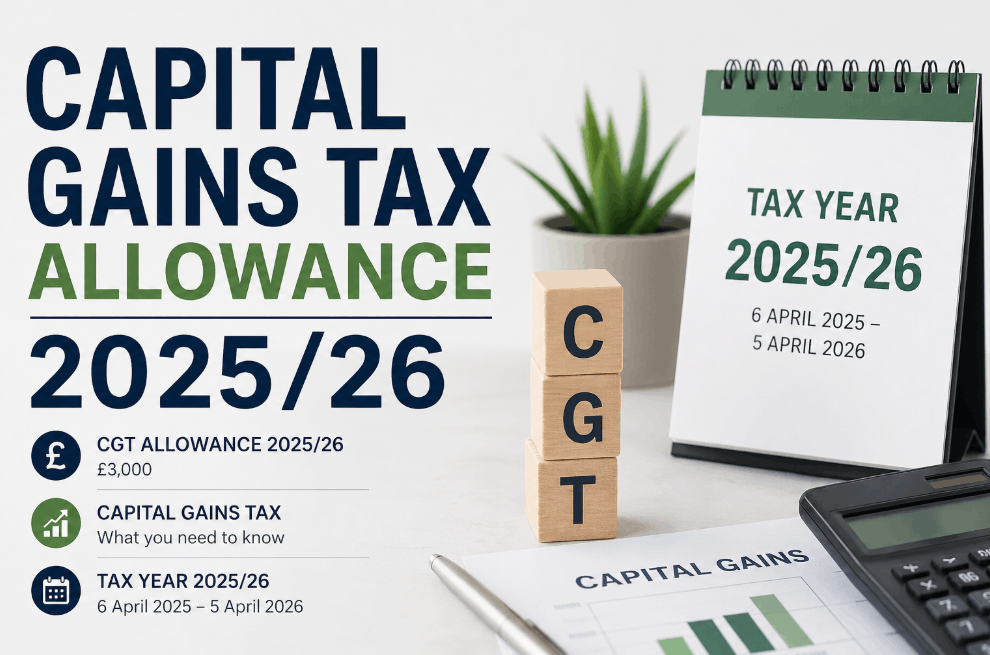
The capital gains tax allowance 2025/26 remains at £3,000 for individuals and £1,500 for most trustees.
This Annual Exempt Amount is the profit a taxpayer can realise from selling assets before tax becomes due. Following recent legislative changes, all gains exceeding this threshold are subject to revised main rates of 18% and 24%.
What is the capital gains tax allowance 2025/26?
For the 2025/26 tax year, the capital gains tax allowance, formally known as the Annual Exempt Amount (AEA), is set at £3,000.
This tax-free threshold applies to the total net gains across all eligible assets sold within the year, including shares, second homes, and business assets.
Any profits below this figure do not require a tax payment or formal reporting to HMRC.
The Legislative Shift in Tax-Free Thresholds
Historically, the AEA was significantly higher, peaking at £12,300 in the 2022/23 tax year. The current £3,000 limit represents the conclusion of a multi-year fiscal strategy to broaden the tax base.
In practice, this means far more casual investors and property owners will find themselves crossing the taxable threshold for the first time in 2025.
This fixed allowance effectively acts as a use it or lose it benefit; it cannot be carried forward to the 2026/27 tax year if it remains unused.

How have Capital Gains Tax rates changed for the 2025/26 tax year?
The 2025/26 tax year marks a significant alignment of tax rates. Previously, residential property gains were taxed at higher rates (18% and 28%) than other assets like shares (10% and 20%). As of the current rules, these rates have been unified.
| Taxpayer Band | Rate for All Assets (Shares, Property, etc.) | Business Asset Disposal Relief (BADR) |
| Basic Rate | 18% | 14% |
| Higher / Additional Rate | 24% | 14% |
| Trusts / Personal Reps | 24% | N/A |
This unification simplifies the calculation process but results in a higher tax burden for those selling non-property assets.
For instance, a higher-rate taxpayer selling a stock portfolio will now face a 24% charge on gains above the £3,000 allowance, whereas they would have paid 20% in previous years.
What are the 2025/26 rules for Business Asset Disposal Relief?
Business Asset Disposal Relief (BADR), formerly known as Entrepreneurs’ Relief, remains a vital tool for business owners, though the cost of disposal is rising.
While the lifetime limit of £1 million in qualifying gains remains, the rate of tax is transitioning.
- Verify the two-year qualifying period for shares or business assets.
- Calculate the total gain after deducting the initial purchase cost and eligible expenses.
- Apply the capital gains tax allowance 2025/26 of £3,000 to the profit.
- Assess the remaining gain against the 14% BADR rate effective from April 2025.
- Ensure the lifetime limit of £1 million has not been previously exceeded.
- Report the gain through a Self Assessment tax return by the following January.
- Retain all documentation regarding the sale for at least five years for HMRC compliance.
A common pattern observed during this transition is the acceleration of business sales. Owners who may have waited years to exit are now weighing the 14% rate against the potential for further increases in future Finance Acts.

Is the capital gains tax allowance 2025/26 different for property?
The allowance remains a flat £3,000 regardless of the asset type. However, the reporting requirements for residential property are significantly more stringent than for other assets.
While your primary residence is usually exempt via Private Residence Relief (PRR), buy-to-let properties and second homes are fully taxable.
Understanding the 60-Day Rule
When selling a taxable UK residential property, the 60-day rule applies. This requires taxpayers to report the gain and pay the estimated tax due within 60 days of the completion date.
This is a separate process from the annual Self Assessment. Failure to meet this deadline results in immediate penalties and interest charges.
How to calculate your taxable gain in 2025/26?
Calculating liability requires a clear distinction between the sale price and the taxable gain. The tax is levied only on the profit (the increase in value).
- Disposal Proceeds: The amount you sold the asset for (or market value if gifted).
- Allowable Costs: The original purchase price, stamp duty, legal fees, and improvement costs (not maintenance).
- Net Gain: Disposal proceeds minus allowable costs.
- Taxable Amount: Net gain minus the £3,000 capital gains tax allowance 2025/26.
For example, an investor selling shares in 2025 for £15,000 that were originally bought for £10,000 would have a £5,000 gain. After applying the £3,000 allowance, only £2,000 is taxable. At the higher rate of 24%, the tax bill would be £480.
Can you still reduce your CGT bill with a £3,000 allowance?
While the allowance is lower than in previous decades, several legitimate methods exist to manage the tax burden. These strategies focus on crystallising gains or losses effectively.
- Spousal Transfers: Assets can be transferred between spouses or civil partners at no gain/no loss. This allows a couple to combine their allowances, effectively creating a £6,000 tax-free threshold for the 2025/26 year.
- Loss Harvesting: If you sell an asset at a loss, that loss can be offset against gains made in the same tax year or carried forward to future years.
- ISA and SIPP Contributions: Assets held within an Individual Savings Account (ISA) or a pension are entirely exempt from Capital Gains Tax. Investors often prioritize these vehicles not just for capital growth, but also because learning how to avoid paying tax on your pension remains a cornerstone of efficient long-term wealth extraction.
- Phased Disposals: Instead of selling a large holding all at once, investors often sell portions over multiple tax years to utilise the allowance annually.
When reviewing decisions made by high-net-worth investors, the use of Bed and ISA transactions, where assets are sold to use the allowance and immediately repurchased within a tax-free wrapper, remains a standard procedure for long-term wealth preservation.

What are the reporting deadlines for HMRC in 2026?
The method of reporting depends entirely on what was sold. For most assets, such as shares or personal possessions worth more than £6,000, reporting occurs via the 2025/26 Self Assessment tax return, due by 31 January 2027.
| Asset Type | Reporting Method | Payment Deadline |
| Residential Property | Capital Gains on Property Account | 60 Days from Completion |
| Listed Shares | Self Assessment (SA108) | 31 January 2027 |
| Business Assets | Self Assessment (SA108) | 31 January 2027 |
| Cryptoassets | Self Assessment or Real-Time Service | 31 January 2027 |
Summary of Next Steps
Navigating the capital gains tax allowance 2025/26 requires proactive timing. With the threshold now fixed at £3,000, the margin for error is slim. Individuals should begin by auditing their current portfolios to identify potential gains or losses.
If a disposal is necessary, consider the timing; selling before 5 April 2025 utilizes the previous year’s allowance, while waiting until 6 April 2025 triggers the new 2025/26 cycle.
Because precise timing is essential for year-end planning, understanding when does new tax year start is the first step in ensuring your disposal falls within the intended fiscal period.
For complex disposals, especially involving business assets or non-resident property sales, consulting the official HMRC guidance on the Finance Act 2024 updates is a critical step for compliance.
FAQ about Capital Gains Tax Allowance 2025/26
What is the CGT allowance for the 2025/26 tax year?
The allowance is £3,000 for individuals and £1,500 for trusts. This is the amount of profit you can make on asset sales before any tax becomes payable to HMRC.
Do I have to report gains under £3,000?
No, if your total gains are below the £3,000 threshold, you generally do not need to report them, unless the total proceeds from the sales are more than four times the allowance.
Can I carry forward an unused 2025/26 allowance?
No. The annual exempt amount is a use it or lose it allowance. If you do not realise gains in the tax year, the allowance expires on 5 April.
Is CGT higher for property than for shares in 2025/26?
No, the rates have been aligned. Both residential property and other assets like shares are now taxed at 18% for basic rate taxpayers and 24% for higher rate taxpayers.
Does the allowance apply to Bitcoin and Crypto?
Yes. HMRC treats cryptocurrency as an asset. The £3,000 allowance applies to the total profit made across all crypto disposals in the 2025/26 tax year.
How does the allowance work for joint owners?
If you own an asset jointly, such as with a spouse, you each have a £3,000 allowance. This means a couple can effectively realize £6,000 in profit tax-free.
Are there any assets exempt from CGT?
Yes. Your main home, private cars, ISAs, PEPs, and UK Government Gilts are typically exempt from Capital Gains Tax regardless of the profit made.
