
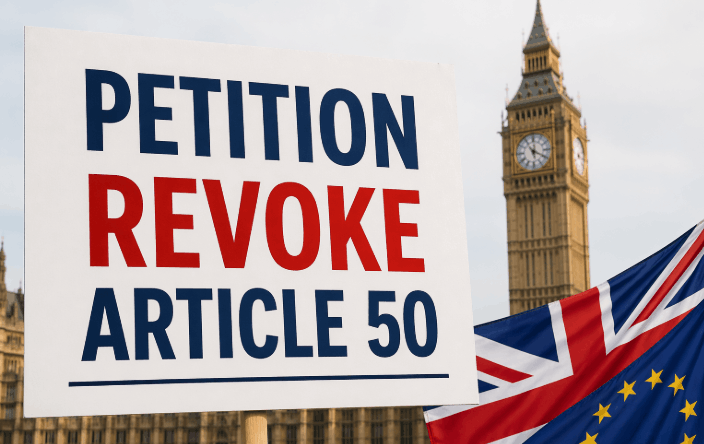
The petition revoke Article 50 represents the most significant instance of digital direct democracy in British history, gathering over 6.1 million signatures to demand the cancellation of the UK’s departure from the European Union.
Legally, while the petition forced a parliamentary debate, it was formally rejected by the Government, which maintained that revoking the notification would undermine the democratic mandate of the 2016 referendum.
Why the petition to revoke Article 50 became a legal milestone?
The petition to revoke Article 50 remains a benchmark for civic engagement because it tested the constitutional boundaries between public sentiment and executive power.
The petition functioned as a digital ’emergency brake’, designed to halt the Article 50 countdown before it reached its legal conclusion.
Article 50 is the official rule a country uses to tell the European Union (EU), “We are leaving.” Once you trigger it, a countdown begins.
This movement was a formal request from the public asking the UK Government to cancel that countdown and stay in the EU.
Immediately following the rise of this petition, the legal community focused on a specific “exit ramp” that many didn’t know existed.
A landmark court case known as Wightman v Secretary of State confirmed that the UK had the sovereign right to cancel Brexit unilaterally, meaning we didn’t need permission from the other 27 EU countries to stay.
The Conflict Between Law and Politics
While the law said the UK could stop Brexit with a simple letter, the Government argued they shouldn’t. This created a massive tug-of-war between two ideas:
- The Legal Path: The UK had the unilateral right to cancel the exit and keep its existing membership terms.
- The Political Path: The Government had promised to deliver the 2016 referendum result and felt that a petition, no matter how large, could not overrule a national vote.
In practice, a common pattern in UK politics is that even if a law makes something possible, political willpower usually decides the final outcome. Even though 6.1 million people signed the petition to revoke Article 50, the administration decided that the original referendum carried more weight.
What was the petition to revoke Article 50 and how did it start?
Launched by Margaret Anne Georgiadou, a retired teacher, the petition was a simple online form hosted on the official UK Parliament website.
It asked for one thing: “Revoke Article 50 and remain in the EU.” It wasn’t just a protest; it was an attempt to prove that the will of the people had shifted since 2016.
The movement exploded in March 2019 during a period of total deadlock in Parliament. At its peak, the website was so overwhelmed by people trying to sign—nearly 2,000 every minute, that the entire system crashed multiple times.
At the time, this represented the highest-supported proposal in the history of the UK’s e-petitions system, reflecting a level of public engagement rarely seen in digital campaigning.
| Feature | Details of the 2019 Petition |
| Primary Goal | Stop Brexit by cancelling the Article 50 notice. |
| Total Signatures | 6,103,056 (Verified). |
| Legal Power | Confirmed by the ECJ (Wightman Case). |
| Top Signing City | London (with high density in Bristol, Edinburgh, and Cambridge). |
| Final Result | Debated but not implemented. |
Why the petition to revoke Article 50 was the centre of national discussion?
The petition to revoke Article 50 was at the heart of the national conversation because it provided a real-time heat map of the country’s mood.
It broke the record previously held by a 1990 petition regarding the ambulance service, proving that digital activism had become a primary tool for political pressure.
Advantages and disadvantages of the petition revoke Article 50
Assessing the impact of such a constitutional pivot requires a look at the competing priorities that defined the 2019 landscape.
Advantages of the movement:
- Economic Certainty: Revoking would have instantly removed the “No-Deal” threat that was panicking businesses at the time.
- Protecting Rights: It would have saved the automatic right for Brits to live and work in Europe without new red tape.
- National Unity (for Remainers): It gave a voice to millions who felt ignored by the government’s “Leave” strategy.
This appetite for digital protest often extends beyond constitutional law into high-stakes public sector reforms; for example, current debates surrounding NHS pension scheme changes have seen a similar surge in organised professional pushback.
Disadvantages and Risks:
- Democratic Deficit: Overturning a referendum via an online petition was seen by many as a dangerous precedent.
- Social Unrest: Opponents warned that cancelling Brexit would lead to a “betrayal” narrative and potential civil disorder.
- The Double-Cross: It was argued that the UK would lose all future negotiating power with the EU if it simply stayed out of fear.
Timeline: Government Rejection and Parliamentary Hearings
The Government did not wait long to respond. Because the petition grew so fast, it forced the hands of ministers.
The Official Rejection
On 26 March 2019, the Government issued a formal statement. They acknowledged the considerable number of signatures but stood firm.
They argued that 17.4 million people had already voted to leave, and that was the biggest democratic mandate in UK history.
The Westminster Hall Debate
On 1 April 2019, MPs met in Westminster Hall (the secondary chamber of Parliament) to debate the petition.
- Opening: The debate was triggered because the petition passed the 100,000 signature threshold.
- Arguments for: MPs from the SNP and Liberal Democrats argued that 6 million signatures could not be ignored.
- Arguments against: Government MPs argued that the 2017 General Election (where both major parties promised to respect Brexit) reinforced the 2016 vote.
- Outcome: No vote was held to change the law. The debate ended with the Government reiterating its policy to leave the EU.
Who supported and who opposed the petition?
The petition to revoke Article 50 divided the country along familiar lines, but with new intensity.
- The Supporters: These included celebrities like Hugh Grant and Brian Cox, and politicians like Nicola Sturgeon and Caroline Lucas. They viewed the petition as a legitimate “second chance” for the country.
- The Opponents: Theresa May’s government and “Leave” campaigners like Nigel Farage. They framed the petition as an attempt by the elite to silence the working-class voters who backed Brexit.
Data from 2026 indicates that the geographic signature density remains remarkably consistent, with university cities and major tech hubs still serving as the primary engines for pro-European sentiment.
How to use the UK Petitions system in 2026
If you want to start a petition today, the process has become even more streamlined since the 2019 record-breaker.
- Draft Your Demand: Your petition must ask for a specific action that the Government or Parliament can actually do.
- Pass the Check: The Petitions Committee will check if your petition is a duplicate of an existing one.
- The 10,000 Mark: At this stage, the Government is legally required to give you a written response.
- The 100,000 Mark: Your petition is almost guaranteed to be considered for a debate by MPs.
- Verification: The system now uses advanced fraud detection to ensure signatures are from real UK residents.
- Six-Month Limit: All petitions have a six-month life before they are archived.
We see this dynamic today in the fiscal sector, where thousands have mobilised against proposals regarding the pension tax-free lump sum to be scrapped, using the petition portal as a primary shield for private retirement wealth.

Final Summary and Next Steps
The petition to revoke Article 50 was a landmark event that showed how technology can amplify the voices of millions. While it didn’t change the ultimate outcome of Brexit, it remains the most powerful example of digital protest in UK history.
Ultimately, the 2019 movement demonstrates that while digital petitions are formidable tools for shifting the national narrative, they rarely supersede established electoral mandates.
For those navigating the UK’s evolving relationship with the EU, the Petitions Committee remains a critical barometer for upcoming shifts in alignment or trade policy.
If you are passionate about UK-EU relations today, your next step should be to monitor the Petitions Committee website for active “Alignment” or “Trade” petitions, as these are the new battlegrounds for British diplomacy.
FAQ about petition revoke Article 50
How many signatures did the petition to revoke Article 50 get?
It reached a final, verified total of 6,103,056 signatures before it closed on 20 August 2019.
Did the petition actually stop Brexit?
No. Despite the record numbers, the Government refused to revoke Article 50, and the UK officially left the EU on 31 January 2020.
Can I still sign the petition to revoke Article 50?
No, the petition is archived. In 2026, the focus has shifted to “Rejoin” petitions under Article 49.
Who was the lead author of the petition?
The petition was started by Margaret Anne Georgiadou, who became a public figure overnight and even faced threats for her activism.
Why was the petition debated in Westminster Hall instead of the main Commons?
Under Parliament rules, most petitions are debated in Westminster Hall to allow for detailed discussion without taking up time for primary legislation in the main chamber.
Is there a new petition to rejoin the EU in 2026?
Yes, there are several active petitions in 2026 focusing on rejoining the Single Market or the Customs Union, often reaching the 100,000 signature mark.
What was the Wightman Case mentioned in the petition?
It was a European Court ruling that proved the UK could cancel Brexit unilaterally without needing permission from other EU countries.
