
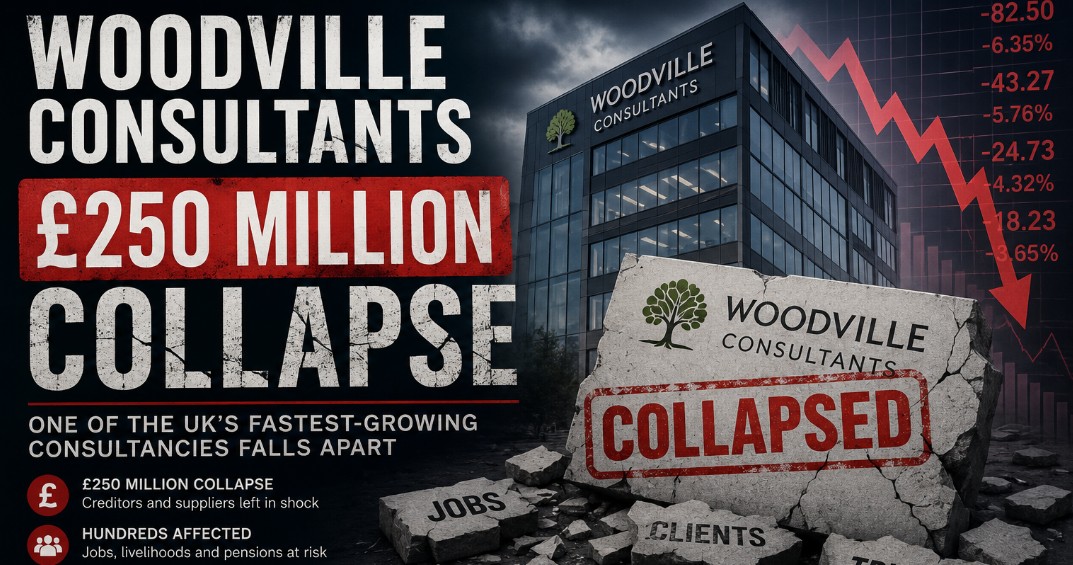
Key Takeaways
The Woodville Consultants 250 million collapse represents a significant financial failure within the UK litigation funding sector, currently involving high-stakes insolvency proceedings.
As of July 2026, the administration process remains active under the supervision of court-appointed insolvency practitioners, leaving thousands of private investors seeking clarity on the recovery of their capital.
- The High Court placed the firm into administration following concerns regarding liquidity and the delayed settlement of car finance litigation claims.
- Insolvency practitioners from Kroll now manage the firm, holding a legal mandate under the Insolvency Act 1986 to protect and realize remaining assets.
- Investors must monitor official communications from the administrators rather than relying on unverified social media discourse or speculation on Reddit.
- Creditors are advised to secure all original loan note agreements and communication logs to prepare for future claims processes as the liquidation proceeds.
Why Did the Woodville Consultants 250 million collapse Happen?
The Woodville Consultants collapse happened because the firm raised funds via unregulated, unquoted loan notes to issue bridge loans to law firms pursuing car finance litigation. When regulatory appeals delayed the car finance redress payouts, the cash flow vanished, causing a fatal liquidity gap.
The Woodville Consultants 250 million collapse serves as a stark case study in the risks associated with unquoted debt investments tied to litigation funding.
The firm’s business model relied on raising capital through bonds and loan notes to finance legal claims, specifically those related to the UK car finance redress schemes.
When these claims faced significant delays, the expected returns failed to materialize, triggering a liquidity crunch that ultimately led to court-ordered administration.
Truth of Litigation Fund Insolvency
Litigation fund insolvency occurs when immediate operational debt obligations collide with highly volatile, unpredictable court and regulatory timelines.
Even if the underlying legal cases hold intrinsic long-term value, an inability to rapidly convert assets into cash creates terminal insolvency.
When reviewing decisions made by directors, administrators must now determine whether the funds were deployed in alignment with initial underwriting rules or if governance failures occurred during the period of financial stress.

What Is the Latest Update on the Woodville Consultants 250 Million Collapse?
The latest update on the Woodville Consultants collapse confirms that independent administrators from Kroll are in the forensic discovery phase. They are actively auditing the £250 million loan book to evaluate which underlying car finance litigation cases remain viable for asset realization.
Recent updates indicate that the administrators are currently in the discovery phase. This involves auditing the Woodville Consultancy loan book to assess which litigation cases remain viable and which have been compromised by the firm’s insolvency.
Investors should be aware that this process is typically protracted, often spanning many months, as the administrators must navigate complex legal challenges associated with the underlying car finance claims.
Structural Breakdown of the Administration Matrix
| Stage of Administration | Objective | Investor Action |
| Initial Appointment | Stabilize firm assets and secure structural files. | Ensure contact details are current with Kroll. |
| Investigation | Forensic audit to trace the exact use of £250 million. | Collate all investment and subscription documents. |
| Asset Realization | Monetize and wind down the remaining litigation book. | Await formal proof of debt requests from administrators. |
| Distribution | Return available capital to verified creditors pro-rata. | Respond directly to official claim portals only. |
How do investors monitor the Woodville Consultants administration?
Investors monitor the administration by tracking the official Companies House registry and the dedicated Kroll insolvency portal. Creditors must systematically preserve all original subscription receipts and avoid unverified third-party recovery networks targeting public forums.
The winding-down process follows strict guidelines under the UK Insolvency Act 1986. This is the explicit step-by-step framework currently in motion:
- Forced Administration Rule: Verify your formal creditor status directly through the secure, official Kroll insolvency portal rather than third-party platforms.
- Subscription Evidence Gathering: Collate and digitise all original subscription agreements, loan note certificates, and past communications with Woodville directors or brokers.
- Companies House Monitoring: Track the Companies House filing history for official progress updates, statement of affairs records, and administrator proposals.
- Secondary Scam Isolation: Ignore unsolicited offers from third-party recovery or litigation support firms promising accelerated payouts for upfront fees.
- Proof of Debt Submission: Await formal, direct instructions from Kroll regarding the legal proof of debt submission process to claim your pro-rata asset share.
How to Interpret Woodville Consultants Reviews and Investor Sentiment?
Investor sentiment across UK financial forums is highly anxious due to missed repayments and lack of clarity. However, experts advise separating emotional forum speculation from official progress reports issued exclusively by Kroll.
A common pattern is the emergence of unverified recovery schemes in these forums, where opportunistic third parties promise to fast-track payouts for an upfront fee. Investors should be extremely cautious; reputable insolvency practitioners will never ask for payment to process a legitimate claim.
| Sentiment Type | Characteristics | Risk Level |
| Official Updates | Fact-based, issued by Kroll | Low |
| Forum Speculation | Anecdotal, emotional, unverified | High |
| Third-Party Offers | Promises of fast recovery for fees | Critical |

The Role of Woodville Consultants Limited in Litigation Funding
The firm functioned as a conduit, taking capital from private retail investors to provide bridge or litigation loans to law firms. This capital was intended to cover the costs of pursuing legal redress for consumers involved in car finance claims.
When these claims were delayed by regulatory appeals, the cash flow expected to repay investors vanished.
The collapse underscores the inherent risk in this sector: investors are often secondary to the law firms and the courts.
If the car finance litigation cases are successful, the proceeds may still form a pool of assets, but these are subject to administrative costs, legal fees, and senior creditor claims before retail investors see any return.
Why Does the Woodville Consultants 250 Million Collapse Matter?
The Woodville Consultants collapse is significant because it stands as one of the largest corporate failures in UK litigation finance history. It exposes the vulnerability of unregulated retail mini-bonds and could restrict future access to justice capital.
- Retail Investor Vulnerability: It highlights the profound dangers of unregulated, unquoted mini-bonds marketed to ordinary retail investors. Because these products fall outside the Financial Services Compensation Scheme (FSCS) protections, they leave investors with minimal fallback options.
- Chilling Effect on Litigation Funding: Litigation funding is essential for providing access to justice to consumers who cannot afford to battle large institutions. A collapse of this scale could dry up capital for future consumer redress claims, tilting the scales back in favor of large corporations.
- Precedent for Independent Audits: The court-mandated Kroll administration strips the power from corporate directors, ensuring a completely independent forensic review into how £250 million was handled, setting a high standard for transparency in future alternative finance defaults.
What Should Business Owners Learn from the Woodville Collapse?
First and foremost, corporate leaders must realise that protecting capital providers overrides protecting clients; asset liquidity must always match short-term liabilities, and absolute portfolio concentration in a single regulatory sector introduces existential operational risk.
For corporate leaders, directors, and operators in the alternative finance space, the downfall of Woodville offers vital operational hard truths:
- Fiduciary Duty First: Woodville chose to cushion the law firms it partnered with by granting payment extensions, inadvertently leaving its own investors holding the bag. Company directors must recognise that their ultimate fiduciary duty belongs to the stakeholders providing the capital, not the clients spending it.
- Liquidity is King: A business can have a highly profitable asset portfolio on paper, but if those assets cannot be converted to cash to meet immediate debt obligations, the company is technically insolvent. Never rely entirely on unpredictable, third-party timelines (like judicial or regulatory rulings) to fund short-term operational liabilities.
- Diversify Risk Corridors: Woodville heavily concentrated its portfolio in car finance redress schemes. When that single sector faced unexpected friction, the entire multi-million-pound infrastructure imploded. Business operators must diversify their income models so that a delay in one pipeline does not trigger terminal damage across the entire enterprise.

Conclusion
The Woodville Consultants 250 million collapse is a complex insolvency event that requires patience. Investors should prioritize gathering documentation, monitoring official portals for proof of debt requirements, and disregarding social media speculation.
No further action is required until the administrators issue a formal request for claims.
Disclaimer: This article provides information regarding corporate insolvency proceedings and does not constitute formal legal, investment, or financial advice.
FAQ
Will I get my money back?
Recovery depends on the value of the remaining loan book. Administrators must first pay insolvency costs and priority creditors. Retail investors often receive a pro-rata distribution only after these higher-ranking claims are settled.
Is my investment protected by FSCS?
Generally, no. Unquoted debt investments like loan notes are typically unregulated or outside the scope of the Financial Services Compensation Scheme (FSCS). Always check your original investment terms for explicit protection clauses.
Should I hire a lawyer to represent my claim?
No, not necessarily. For most individual investors, the cost of private legal representation will likely outweigh the potential recovery. The administration process is structured to be inclusive of all creditors without requiring individual legal counsel.
Why are there conflicting reports on Woodville reviews?
Much of the information on forums is anecdotal. Always cross-reference investor discussions with official reports published on the Companies House website or the Kroll portal to ensure you are acting on facts.
How long does a £250 million administration typically take?
Large-scale insolvencies can take several years. The complexity of managing litigation assets means that realizations occur in stages, often resulting in a series of interim distributions rather than a single payout.
Where can I find official updates?
Official updates are published via the insolvency practitioner’s portal or the UK Government’s Find and update company information service. This is the only source that carries legal weight regarding the firm’s status.
What is the difference between Woodville Consultants and Woodsville?
Investors often confuse these names due to typographical errors in forum discussions. Always verify the specific Company Registration Number (CRN) against your legal documents to ensure you are tracking the correct entity.
Can I sell my loan notes to someone else?
No, in a live administration, there is effectively no secondary market for these instruments. Be wary of anyone offering to buy your distressed debt, as this is often a precursor to a secondary scam.
