
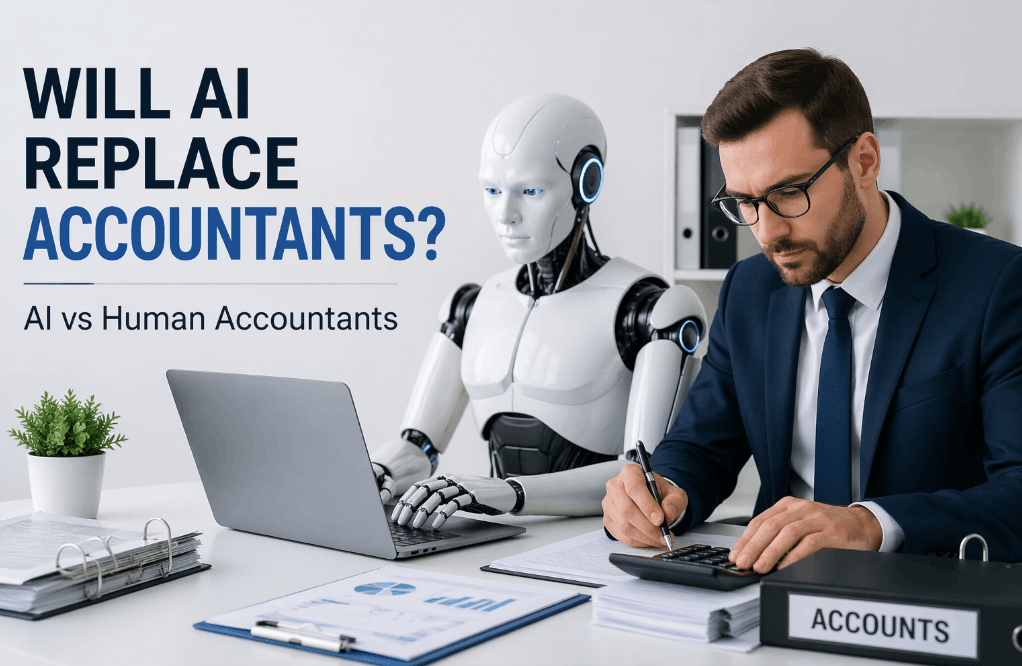
No, artificial intelligence will not replace accountants, but it is fundamentally redesigning the profession by automating routine compliance tasks. While the question of whether will AI replace accountants frequently dominates industry headlines, the reality is a fundamental shift in responsibilities rather than a total displacement.
The demand for accountants is not disappearing, but it is evolving into a consultative leadership role.
Will AI replace accountants in the evolving UK market?
A definitive no is the answer for those worried about total automation; the UK finance sector relies on human accountability and the specific rigour of professional scepticism that algorithms simply cannot replicate.
While automation has absorbed nearly 80% of clerical bookkeeping functions, the volume of qualified accounting roles in the UK continues to grow.
This trend confirms that businesses are not looking to eliminate accountants; rather, they are looking to leverage them as strategic partners who can interpret the insights generated by AI tools.
The End of Manual Compliance and the Rise of Real-Time Data
The accounting landscape has transitioned away from the reactive model. With the ongoing rollout of digital tax initiatives like HMRC’s Making Tax Digital (MTD), software now handles real-time submissions for VAT and Income Tax.
This technological shift has effectively removed the compliance burden associated with manual ledger entry. When reviewing financial decisions, firms that once dedicated their resources to basic data entry are now repurposing that time toward proactive tax planning and financial forecasting.

Will AI replace Chartered Accountants and senior professionals?
Chartered Accountants (ICAEW or ACCA) possess a level of legal and ethical responsibility that generative AI cannot replicate. In the UK, Qualified Person status acts as a critical legal safeguard for the public interest.
AI algorithms operate based on probability, whereas professional accounting requires certainty, professional scepticism, and a true and fair view of financial health.
Why Human Oversight Remains a Legal Requirement
In practice, firms are increasingly reporting instances where AI generates plausible-sounding but legally incorrect tax treatments, phenomena known as hallucinations, when faced with niche UK legislation.
While an AI might suggest a technically plausible tax treatment, it often overlooks the broader context of a client’s long-term business goals or specific HMRC tribunal outcomes.
A Chartered Accountant’s value lies in their ability to verify the why behind the data, ensuring that the final filings meet both the letter and the spirit of the law.
Summary of Human vs. AI Capabilities in Finance
| Core Task | AI Role (Automation) | Human Role (Expertise) |
| Transaction Processing | Automated matching and categorisation | Oversight of anomaly exceptions |
| Audit & Assurance | Analysis of 100% of data samples | Interpretation of fraudulent intent |
| Tax Planning | Identification of pattern-based reliefs | Bespoke strategic and ethical advice |
| Client Interaction | Basic data-gathering and reporting | Relationship management and empathy |
| Professional Liability | None (Software terms apply) | Full legal and ethical accountability |
Will accountants be needed in 10 years?
The ten-year outlook suggests that the necessity for accountants will remain robust, though daily job descriptions are set for a total overhaul.
The profession is moving toward a Strategic Partnership model where the accountant acts as a business architect.
- Algorithmic Auditing: Ensuring the AI systems used by companies are unbiased, accurate, and secure.
- Sustainability Assurance: Verifying non-financial ESG (Environmental, Social, and Governance) data for regulatory compliance.
- Real-Time Financial Forecasting: Shifting from post-mortem reporting to predictive, minute-by-minute financial health monitoring.
- Digital Forensic Accounting: Identifying sophisticated cyber-financial crimes and digital money laundering patterns.
- Strategic Business Advisory: Serving as a fractional CFO for small businesses, leveraging AI insights for growth.
- Complex Tax Mitigation: Navigating international tax shifts that require human-to-human negotiation.
- Data Governance Leadership: Managing how financial data is collected, stored, and protected across the enterprise.
Is it still worth becoming an accountant?
Despite the rise of automation, accounting remains a resilient and lucrative career path for those who prioritise higher-order skills.
UK graduate prospects in audit, tax, and corporate finance remain strong, with many firms now offering higher salaries for candidates who demonstrate AI literacy alongside their technical accounting knowledge.
The Accelerated Career Path
In the past, a junior accountant might spend their first three years performing manual bank reconciliations.
Today, that same junior uses automated tools to identify financial risks across millions of data points from day one. This change allows newer entrants to gain exposure to high-level consultancy work much earlier in their careers.
The barrier to entry has shifted from can you use a spreadsheet to can you provide insight that a computer cannot.
How to Future-Proof an Accounting Career
- Master Data Storytelling: Cultivate the ability to translate technical AI-generated reports into actionable business narratives.
- Develop Tech Fluency: Familiarise yourself with cloud ecosystems and how different financial apps integrate.
- Specialise Early: Focus on areas that require high human empathy or legal complexity, such as insolvency, complex tax, or ethical auditing.
Which accounting tasks are at the highest risk of replacement?
Understanding which specific workflows are being absorbed by technology is the first step in pivoting toward a more secure, advisory-led career. Routine, high-volume, and rule-based activities are the primary targets for AI integration.
- Bookkeeping and Data Entry: Manual typing of invoices and receipts is largely obsolete due to Optical Character Recognition (OCR).
- Basic VAT Filings: Software can now pull transactions directly from bank feeds and prepare standard returns automatically.
- Routine Payroll: Automated systems handle HMRC submissions and pension calculations with minimal human intervention.
- Standard Financial Reporting: Monthly profit and loss statements can now be generated instantly by AI dashboards.
In practice, the government’s push toward a digital economy encourages this automation. This automation allows UK practitioners to move away from administrative data entry and toward high-value financial architecture and strategic tax planning.
When reviewing automated outputs, the professional serves as the final gatekeeper for accuracy and integrity.

Final Summary and Next Steps
Ultimately, the threat of will AI replace accountants overlooks the indispensable element of trust that underpins global finance. Machines can process numbers, but they cannot act as a legal or ethical fiduciary for a business.
For current and aspiring professionals, the path forward is to embrace the technology:
- Audit your current tech stack and automate one routine task this month.
- Shift your billing models toward value-based advisory rather than hourly data entry.
- Prioritise emotional intelligence and communication, the skills AI cannot replicate.
FAQ about will AI replace accountants
Will AI replace bookkeepers before accountants?
Bookkeeping is significantly more exposed to automation because it relies on rule-based data entry. However, many UK bookkeepers are successfully repositioning as digital systems consultants.
Can AI be held legally liable for an incorrect tax return?
No. Under UK law, the taxpayer and their authorised agent (the accountant) are the only parties who can be held legally responsible for the accuracy and honesty of a financial submission.
Will AI reduce the total number of accounting jobs?
While it may reduce the need for low-level clerical staff, it is simultaneously creating new roles in data analysis, systems integration, and AI financial governance, maintaining a balanced job market.
Do I need to be a computer scientist to be an accountant now?
No, but a high degree of technical comfort is required. The modern accountant needs to understand how AI tools work to ensure they are providing accurate and ethically sound advice.
How does AI impact HMRC compliance?
AI ensures higher accuracy in digital record-keeping, which is a core requirement of the Making Tax Digital initiative. It reduces human error in quarterly updates and helps businesses avoid late-filing penalties.
Will AI lower the salaries of qualified accountants?
Salaries for administrative-heavy roles may stagnate, but professionals who offer strategic, tech-enabled advisory services are currently commanding higher fees and salaries due to their increased value.
Is human audit still required if AI can check 100% of data?
Yes. While AI can flag 100% of anomalies, a human auditor is required to investigate the intent behind those anomalies and decide if they represent a material error or fraud.
