
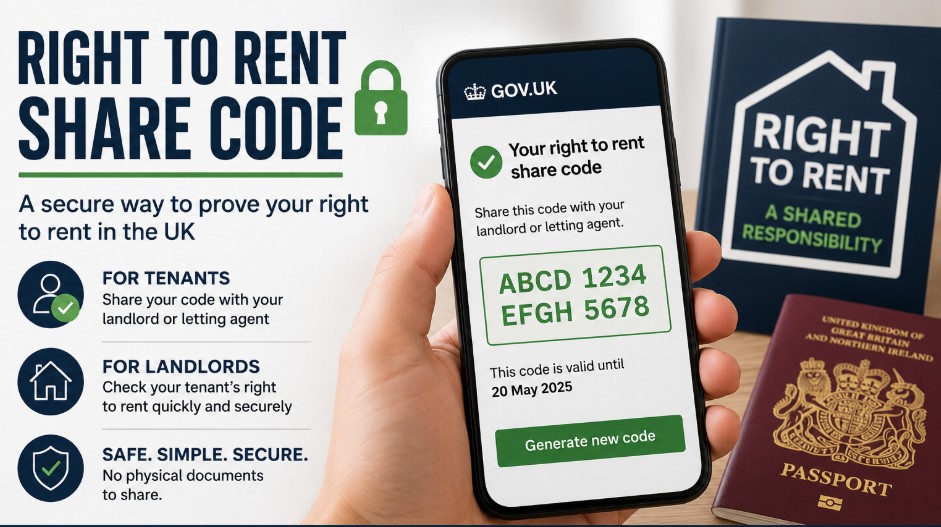
This right to rent share code is a secure, temporary nine-character alphanumeric key generated through the official GOV.UK portal.
It allows landlords and letting agents to instantly verify an applicant’s identity, visa parameters, and legal permission to reside in residential properties without handling physical passports or outdated biometric documentation.
Validating an individual’s immigration status under Home Office compliance rules is a strict legal requirement before any private tenancy agreement in England can proceed. For millions of non-UK nationals, this verification relies entirely on a digital identifier known as the right to rent share code UK.
Key Takeaways
- Digital share codes remain valid for exactly 90 days from generation and must begin with an R prefix to be lawful for private residential tenancies.
- Landlords failing to conduct mandatory checks face strict civil penalties rising to 10000 pounds per occupier for an initial compliance breach.
- Repeat violations within a rolling five-year window trigger statutory fines reaching a maximum of 20000 pounds per unauthorized tenant.
- Home Office immigration checks apply strictly to properties in England and do not extend to private rental markets in Scotland or Wales.
What Is a Right to Rent Share Code?
The transition toward a fully digitized border and immigration system has fundamentally altered how residential tenancies are managed in England.
Historically, landlords relied on physical documentation, such as Biometric Residence Permits (BRPs), to confirm an applicant’s status. However, the Home Office has phased out physical cards in favour of online digital profiles.
The right to rent share code acts as the secure bridge between a tenant’s electronic United Kingdom Visas and Immigration (UKVI) account and a landlord’s statutory checking obligations.
When a prospective tenant’s right to rent share code is entered into the government verification portal alongside the individual’s date of birth, it extracts an official real-time statement of status.
This process ensures personal information remains protected while allowing corporate letting operations and independent property owners to maintain rigorous compliance records.
Format Example: RXX-XXX-XXX (Always 9 Characters with an R Prefix)

Who Needs the One?
Not all individuals looking for a rental property are required to interface with the digital portal. The system categorises applicants based on nationality and the format of their immigration status. Consequently, verification routes change depending on the applicant’s background.
- Digital Status Holders: Anyone holding an eVisa, settled or pre-settled status under the EU Settlement Scheme (EUSS), or a visa managed via the UK Immigration: ID Check app must use this route.
- Physical Document Exceptions: British and Irish citizens do not have a share code and are exempt from the online portal. They must instead prove their status using physical passports, naturalisation certificates, or registered Identity Document Validation Technology (IDVT) channels.
In practice, a corporate letting agent checking a mixed household of applicants will routinely use digital portal routes for international students or skilled workers, whilst executing physical document audits for domestic applicants.
How Does a Right to Rent Share Code Work?
The share code system is designed to protect tenant privacy while allowing landlords to verify legal status instantly without handling sensitive original passports or visa documents.
- Generation: The tenant logs into the official GOV.UK Prove your right to rent service using their identity document details or UKVI account credentials.
- The Key: The system generates a temporary, 9-character alphanumeric cryptographic key that acts as a secure pointer to their live immigration record.
- Verification: The tenant passes the code and their date of birth to the landlord. The landlord enters these details into a separate secure portal (Check a tenant’s right to rent) to view a real-time status page displaying the tenant’s photo, identity details, and whether their right to rent is unlimited or time-limited.
How Do I Get and Generate My Right to Rent Share Code?
To get right to rent share code access, applicants must utilize the official Prove your right to rent to a landlord utility hosted on the main GOV.UK right to rent share code platform.
To ensure a smooth transition, individuals should have their identity documentation ready before initiating the right to rent share code login sequence.
Step-by-Step Generation Guide
- Navigate to the Portal: Open the official GOV.UK Prove your right to rent web service.
- Select Identity Source: Choose the document linked to your digital status, such as your passport, biometric card number, or UKVI account credentials.
- Pass Security Authentication: Enter your date of birth and verify identity via the two-factor email or SMS code linked to your digital account.
- Review Your Profile: Confirm that your online record accurately reflects your current visa status and personal details.
- Initiate Code Generation: Click the option to create a share code specifically designated for a landlord or letting agent.
- Note the Result: Retain the resulting nine-character code, ensuring it begins with the correct letter designation.
When executing this process, ensure you do not inadvertently request a code for employment purposes.
A common pattern observed by relocation agents is that applicants accidentally present a right to work code starting with a W or S, which the residential rental verification system will automatically reject.
To succeed, you must ensure you obtain my right to rent share code with the required rental prefix.
How Do Landlords Carry Out a Right to Rent Share Code Check Online?
For a property manager or landlord, receiving a code is only the initial part of the compliance procedure. To establish a legal safeguard known as a statutory excuse against future enforcement action, you must actively complete the right to rent share code check online via the dedicated landlord portal.
Simply viewing a screenshot of the tenant’s code or looking at their personal profile page does not fulfill statutory requirements.
Step-by-Step Landlord Verification
- Access the official right to rent share code landlord check tool on GOV.UK.
- Input the tenant’s exact 9-character code along with their date of birth.
- Verify that the system outputs an official profile displaying an explicit R prefix statement.
- The Live Match Check: You must physically view the applicant, either in person or via a live video link, and cross-reference the digital photograph on the screen to ensure an exact match.
- Secure Record Archiving: Download the cryptographic PDF profile response generated by the Home Office. Store this document securely in an unalterable format for the duration of the lease plus an additional 12 months thereafter.
Critical Rule: The code must start with the letter R. If the system displays a code starting with W or S, it is intended for employment or social security and cannot be used to establish a statutory rental excuse.
Anonymised operational reviews demonstrate how easily errors occur: a property firm in Manchester accepted an employment-grade share code during a busy intake period.
Because the code layout was structurally valid but technically incorrect for housing, the firm failed a routine audit and could not claim a statutory excuse when an immigration issue emerged later.

Share Codes vs. Alternative Identification Routes
To ensure absolute adherence to the Immigration Act frameworks as they stand as of 2026, the following analytical matrix outlines the clear distinctions between digital codes and alternative physical validation procedures.
| Status or Document Type | Digital Share Code Required? | Code Prefix Validation | Validity Period | Mandatory Action for Landlord |
| Digital eVisa / EUSS Holders | Yes | Must start with R | 90 Days from generation | Download PDF profile, verify live photo match. |
| British Citizens | No | Not Applicable | Indefinite | Check original passport manually or use certified IDSP channels. |
| Irish Citizens | No | Not Applicable | Indefinite | Inspect original passport or passport card manually. |
| Pending Home Office Visa Appeals | No (System locked) | Not Applicable | Requires Landlord Checking Service | Submit online form to obtain a Positive Right to Rent Notice. |
Does the Right to Rent Share Code Apply in Scotland and Wales?
A major source of confusion among nationwide property agencies involves where these immigration laws apply. The Right to Rent scheme, introduced under the Immigration Act 2014, is a devolved matter regarding its practical housing integration.
Current Regional Regulations
- Scotland: There is no legal framework for a right to rent share code Scotland query. Landlords operating in Edinburgh, Glasgow, or Aberdeen are not legally permitted to demand immigration credentials prior to allocating a tenancy agreement. Instead, they must focus on standard tenant referencing, credit assessments, and compliance with local Scottish landlord registration rules.
- Wales: Similarly, a right to rent share code Wales protocol does not exist. Welsh tenancies are governed strictly under the Renting Homes (Wales) Act framework, which does not contain provisions requiring landlords to act as border enforcement authorities.
Attempting to enforce mandatory immigration checks or demanding a share code outside of England can inadvertently expose property companies to serious civil discrimination lawsuits under the Equality Act 2010.
Common Issues and Troubleshooting
Even with a digitized system, tenants and landlords frequently hit minor roadblocks during the onboarding process. Here is how to handle the most common snags:
The Code Starts with the Wrong Letter
- The Issue: The tenant provides a code starting with a W or an S.
- The Fix: Codes are strictly purpose-specific. A code starting with W is a Right to Work code meant for employers. Landlords cannot accept this to establish a statutory excuse. The tenant must log back into GOV.UK and ensure they select the option to prove their right to rent to a landlord, which will output an R-prefix code.
Invalid or Expired Code Error
- The Issue: The landlord enters the code, but the portal returns an error stating it is invalid.
- The Fix: Share codes are only valid for 90 days from the exact time they are generated. If the code has expired, or if the landlord inputs the tenant’s date of birth incorrectly, the system will reject it. The tenant simply needs to log back into the portal and generate a fresh code; there is no limit to how many codes a tenant can create.
Portal Cannot Generate a Code (Pending Applications)
- The Issue: The tenant has an active, in-time visa application or appeal pending with the Home Office, causing the digital portal to lock them out from generating a standard 9-character code.
- The Fix: Landlords should not reject the applicant out of hand. Instead, the landlord must request a manual status check via the online Home Office Landlord Checking Service (LCS). The Home Office will verify the pending application and issue a Positive Right to Rent Notice within 48 hours, which acts as a valid statutory excuse for 12 months.
Fines, Expirations, and Avoiding Discrimination
The financial consequences of overlooking compliance steps are severe. Following sweeping statutory updates, the civil penalty framework penalises non-compliant landlords on a per-occupier basis.
- First Breach Fine: £10,000 per unauthorized occupier
- Repeat Breach Fine: £20,000 per unauthorized occupier
If an owner mistakenly rents a three-bedroom house in London to an entire family without completing formal digital or manual checks, a subsequent Home Office enforcement audit could result in cumulative fines exceeding £30,000 for a single property.
Furthermore, if a landlord knowingly lets a property to an individual without lawful status, the infraction escalates into a criminal prosecution carrying up to five years in prison and an unlimited fine.
Ensuring Non-Discriminatory Best Practices
To avoid costly litigation, property managers must implement a universal verification policy. The Equality and Human Rights Commission, alongside official Home Office codes of practice, warn against profiling applicants based on accent, appearance, or nationality.
Landlords must check the Right to Rent status of every single adult occupant aged 18 or over before signing a lease agreement.

Conclusion
Navigating the contemporary UK rental landscape requires absolute precision when handling digital credentials. To protect your property operations, ensure that every international applicant provides a clear, nine-character code starting with the mandatory rental prefix.
Always confirm the live digital photograph matches the individual standing in front of you, and maintain a permanent, timestamped PDF record of the portal clearance response.
By building these clear verification protocols into your standard tenant onboarding routine, you can confidently secure your statutory excuse, protect your business from severe civil fines, and ensure a fair, non-discriminatory experience for every applicant.
Disclaimer: This compliance article is for informational purposes only and does not constitute formal legal advice.
FAQ
How long does a right to rent share code remain valid?
A digital share code generated via the Home Office portal remains active for exactly 90 days. If the code is not checked online by the landlord within this timeframe, it expires, requiring the tenant to generate a fresh one.
What letter does a right to rent share code start with?
Every valid code designated specifically for residential tenancy checks must begin with the letter R. Codes starting with W or S are invalid for housing and are intended for employment or welfare checks.
What documents do British and Irish citizens use instead of a code?
British and Irish citizens cannot use the digital share code system. Instead, they verify their status using a current or expired passport, a certificate of naturalisation, or via an approved Identity Document Validation Technology provider.
Can a landlord accept a screenshot of a share code?
No, a landlord cannot accept a screenshot or printout. The landlord must actively enter the live code into the official GOV.UK verification interface to confirm the real-time validity of the digital profile.
Do I need to perform follow-up checks if a tenant has limited leave to remain?
Yes, if a tenant’s immigration permission is time-limited, you must conduct a follow-up check before their current permission expires or 12 months from the previous check, whichever is longer.
Can a letting agent conduct the share code check on my behalf?
Yes, landlords can formally transfer the legal responsibility to a letting agent. This arrangement must be explicitly written into a commercial contract to ensure the agent assumes full liability for the statutory excuse.
What happens if a tenant turns 18 during the tenancy agreement?
If an occupant turns 18 while living in the property, the landlord is required to perform a Right to Rent check at the point of the next scheduled statutory review or lease renewal.
