
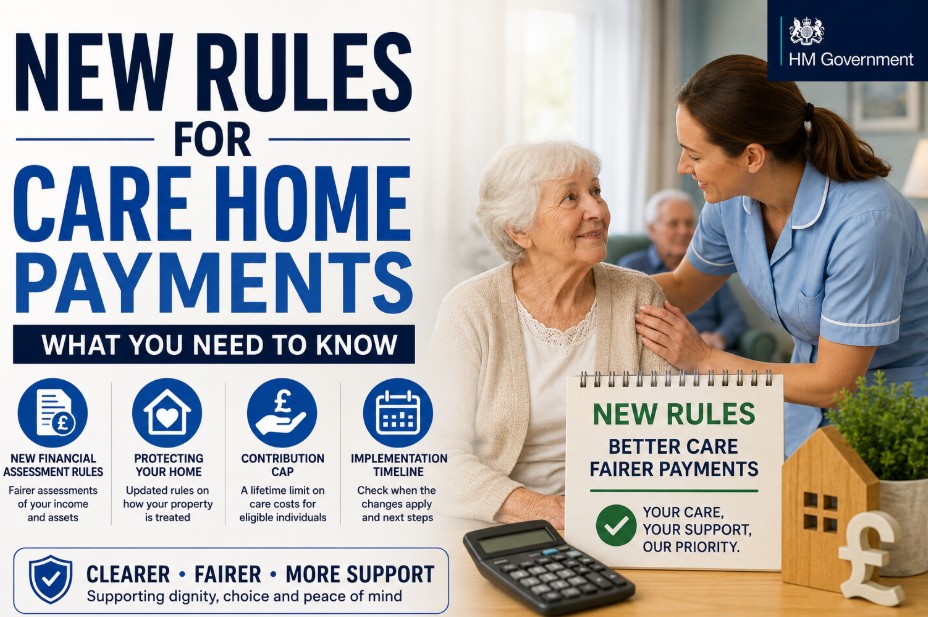
The current landscape regarding new rules for care home payments is often misunderstood due to cancelled legislative reforms. As of 2026, there is no national cap on care costs, and the system remains strictly means-tested based on an individual’s capital, income, and property value.
Key Takeaways
- The government confirmed the previously proposed £86,000 care cost cap will not be implemented, meaning the current means-tested funding model remains in place.
- Individuals with total assets exceeding £23,250 in England are classified as self-funders and are responsible for paying their own full residential care fees.
- Local authorities perform financial assessments to determine if they will contribute to care costs once an individual’s total capital falls below £23,250.
- The 12-week property disregard prevents immediate home sales during the initial transition into permanent residential care if other assets are insufficient.
What is a care home payment?
A care home payment covers the fees for residential or nursing care, typically split into personal care (daily living assistance) and hotel costs (accommodation, food, and utilities). These are funded through personal assets (self-funding), local authority means-tested support, or the NHS for specific health needs.
- Personal Care Component: This covers the cost of staff assistance with daily activities such as washing, dressing, and medication management.
- Hotel/Accommodation Component: This covers the costs of the room, meals, utilities, and general maintenance of the facility.
- Funding Pathways:
- Self-Funding: You pay the full cost if your assets exceed statutory limits.
- Local Authority Support: The council contributes if you meet means-test criteria.
- NHS Funding: Available only if you have a primary medical or nursing health need.
What are the new rules for care home payments?
As of 2026, there are no new legislative rules; the previously proposed £86,000 care cost cap has been cancelled. The system remains strictly means-tested, meaning individuals are responsible for their own care costs until their total assets fall below the current threshold of £23,250.
Because the anticipated national cap on care costs was not implemented, the following rules apply:
- Means-Tested Model: Your financial contribution is calculated based on your total assessable capital and income.
- The £23,250 Threshold: In England, if your total assets (including property) exceed this amount, you are a self-funder and bear the full cost.
- Partial Support: If assets are between £14,250 and £23,250, you may receive local authority support, provided you contribute your available income and a calculated tariff from your capital.
What is the Means-Tested System for Care Home Fees in the UK?
The UK means-test for care funding is a financial assessment conducted by local authorities to determine whether an individual qualifies for public funding, requires a contribution, or must cover 100% of the costs themselves based on total capital assets.
How Funding is Determined?
Funding is strictly divided into two categories: the cost of personal care and the cost of hotel expenses, which include food and accommodation. While the NHS may cover certain clinical nursing requirements, the remaining costs are typically the responsibility of the individual if their capital exceeds statutory limits.
| Capital Value | Funding Status |
| Below £14,250 | Full local authority support (subject to income) |
| £14,250 – £23,250 | Partial contribution required (tariff income) |
| Above £23,250 | Self-funder status (total cost responsibility) |
How do care home payments work?
Care home payments follow a two-stage process: first, a Care Needs Assessment by the local authority to determine the type of care required, followed by a Financial Assessment to calculate exactly how much the individual must contribute toward the fees.
- Care Needs Assessment: Contact your local council’s adult social services. They will evaluate your physical and mental care requirements.
- Financial Assessment: Once needs are established, the council evaluates your capital and income to place you in a funding category (Self-funder, Partial, or Full State Funding).
- Payment Method Setup:
- Direct Payment: Using your personal savings or pension income.
- Deferred Payment Agreement: A legal arrangement with the council allowing you to delay paying costs until your home is sold.
- Third-Party Top-ups: Family may agree to cover the difference if you choose a home that costs more than what the local authority is willing to pay.
What Counts as Capital for Care Home Payments?
During a financial assessment, your local authority calculates your capital to determine your contribution toward care fees. This includes almost all assets you hold, though specific items are disregarded.
Assets Included (Counted as Capital)
The following are typically included in your financial assessment:
- Cash and Savings: Money held in bank accounts, building society accounts, ISA accounts, and NS&I accounts.
- Investments: Stocks, shares, bonds, unit trusts, and investment bonds.
- Property: The value of your main home is generally included unless specific exemptions apply. Any additional property or land you own is also counted.
- Premium Bonds: These are considered part of your total capital.
- Income: While technically assessed separately, regular income like pensions, benefits, and annuities is factored into your total weekly contribution requirement.
Assets Not Included (Disregarded)
The following items are typically excluded from your capital assessment:
- Personal Possessions: Everyday household items, furniture, clothing, jewellery, and sentimental items.
- The Value of Your Main Home: Specifically when your spouse, partner, or a close relative (who is 60+ or disabled) continues to reside there.
- Life Insurance: The surrender value of life insurance policies is typically disregarded.
- One Vehicle: A modest vehicle used for personal transport is usually exempt.
- Pre-paid Funeral Expenses: Costs paid in advance for a funeral are generally disregarded within reasonable limits.
- Jointly Held Assets: If you share an asset with someone else, usually only your share (often 50%) is counted.

How to avoid selling your house to pay for care?
Managing the cost of care without depleting property assets is a common concern for many families. While there is no legal loophole to completely circumvent these costs, specific regulatory mechanisms exist to provide flexibility.
- Confirm if your property is exempt from the financial assessment.
- Assess eligibility for the 12-week property disregard period.
- Discuss a Deferred Payment Agreement with the local council.
- Check if a spouse or dependent relative still occupies the property.
- Utilise NHS Continuing Healthcare funding if needs are primarily health-related.
- Review all available income streams, including pensions and benefits.
Who is responsible for paying care home fees?
The individual receiving care is solely responsible for their own fees. Family members are not legally obligated to pay for a relative’s care home fees from their own money, though they may face changes to their own benefits, such as the Carer’s Allowance,if their caring responsibilities change due to a move into residential care.
Responsibility for care fees only shifts to a family member if they voluntarily sign a contract or a third-party top-up agreement with the care home or local authority.
Are Next of Kin Responsible for Care Home Fees?
No, next of kin are not legally required to pay for a relative’s care home fees from their own personal money.
- Individual Responsibility: The legal obligation to pay for care rests solely with the person receiving the care, using their own income and assets.
- When You Might Become Liable: You could only become financially responsible if you voluntarily sign a contract agreeing to cover the costs, act as a formal guarantor for your relative, or agree to pay a third-party top-up fee to cover the difference between what the local authority pays and the care home’s actual rate.
- Debts After Death: If a resident passes away with outstanding care fees, these debts are paid from the deceased’s estate (their remaining assets). Next of kin are not personally liable for these debts unless they have signed a specific agreement to be so.
When can you assess the NHS healthcare funding?
You can request an assessment for NHS Continuing Healthcare (CHC) if you believe your primary need for care is related to health rather than social care. This is a non-means-tested package funded entirely by the NHS.
If you suspect an individual has a primary health need, you should contact your local Integrated Care Board (ICB) to request an assessment. This can be done at any time, and you have the right to request an independent review if you disagree with the decision.
- How to Apply: Contact your local Integrated Care Board (ICB) to initiate a formal assessment.
- Right to Appeal: If you disagree with the funding decision, you have a formal right to request an independent review.

How to find your eligibility for home care funding?
To determine eligibility, request a free Care Needs Assessment from your local council. If eligible, they will perform a Financial Assessment (means test) to evaluate your capital against the £23,250 threshold. Always check for NHS Continuing Healthcare first, as this non-means-tested funding covers full costs for those with primary health needs.
- Request a Care Needs Assessment: Contact your local council’s adult social services department. Everyone is entitled to this assessment, regardless of wealth.
- Financial Assessment: Once your needs are established, the council will perform a means-test to see if you qualify for full or partial funding.
- Check for NHS Funding: Ask for an assessment for NHS Continuing Healthcare or NHS-funded Nursing Care if the care is primarily medical.
- Seek Professional Advice: For complex financial planning, consult a specialist adviser regulated by the Society of Later Life Advisers (SOLLA).
Differences Between Care Home and Home Care Funding
While the principle of a means test applies to both, the application and costs differ significantly:
| Feature | Care Home Funding | Home Care Funding |
| Primary Scope | Covers accommodation, meals, and 24/7 personal care. | Covers the cost of visiting carers or live-in support within your own home. |
| Property Inclusion | Your home is usually included in the financial assessment unless an exempt person still lives there. | Your home is not included in the financial assessment if you are receiving care in your own home. |
| Costs | Generally higher due to the hotel (room and board) costs included. | Costs are based on hours of care provided; can be cheaper for lower levels of support. |
| Goal | Provides a managed, institutional environment with constant clinical/social support. | Designed to preserve independence and familiarity by bringing support to you. |
Conclusion
The funding system remains complex, but clear pathways exist. Start by requesting a formal Care Needs Assessment from your local authority. Simultaneously, review financial records to confirm your capital status.
If you anticipate becoming a self-funder, seek advice from a specialist financial adviser regulated by the Society of Later Life Advisers (SOLLA) to navigate your options safely.
Disclaimer: This content is for informational purposes only and does not constitute professional financial, legal, or medical advice; please consult a qualified advisor.
FAQ
Can I claim back care home fees?
You may be able to reclaim fees if it is proven that the care was primarily health-based and should have been covered by the NHS under Continuing Healthcare funding.
How do people afford care homes in the UK?
Families typically fund care through a combination of the resident’s pension, income from investments, the sale or rental of property, and government-backed deferred payment agreements.
Do you have to pay for nursing home care in England?
If your assets exceed the upper threshold of £23,250, you are responsible for the full cost of your nursing home care, excluding specific NHS-funded nursing contributions.
How much does a care home cost in Scotland?
Care costs in Scotland follow different thresholds and policies compared to England. Free Personal and Nursing Care is available for eligible residents, regardless of capital, though accommodation costs remain means-tested.
Is end of life care free?
End-of-life care is generally provided by the NHS and is free at the point of delivery if the person meets the specific eligibility criteria for palliative care.
Is there a cap on care home fees in the UK?
Currently, there is no government-mandated cap on the total amount an individual can spend on their own social care costs in England.
