
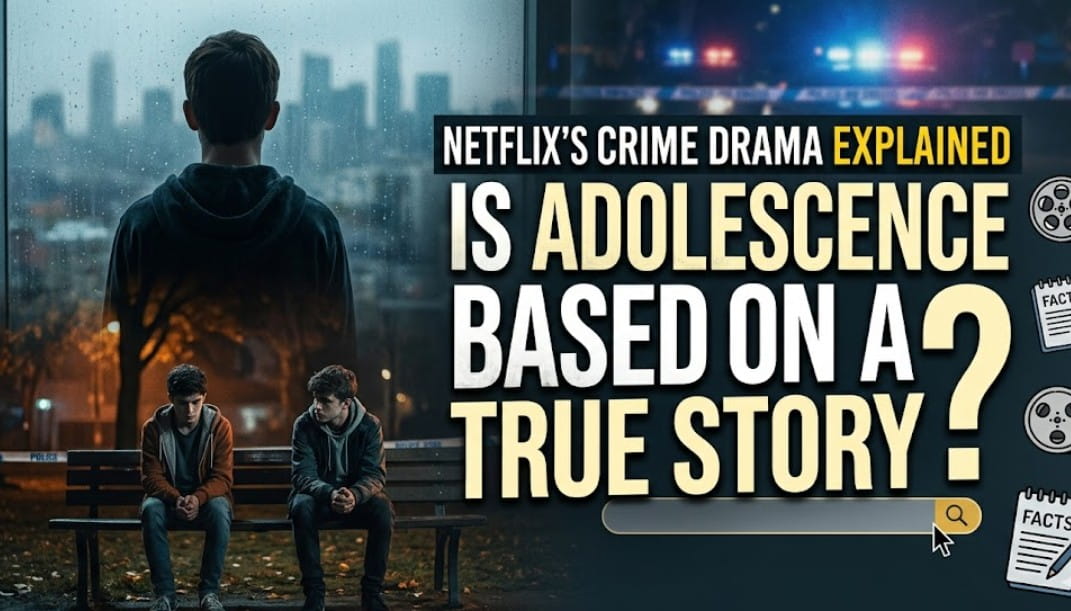
The gripping new Netflix limited series has left viewers across the United Kingdom asking a vital question: Is adolescence based on a true story? The four-part courtroom and crime drama, which follows the harrowing downfall of a 13-year-old boy named Jamie Miller, accused of murdering classmate Katie Leonard, is entirely a fictional narrative.
It was penned by Jack Thorne and Stephen Graham, and directed by Philip Barantini for Warp Films and Matriarch Productions.
However, while the characters themselves do not exist in real life, the series is deeply rooted in contemporary British social crises. The show draws extensive inspiration from the modern UK youth knife crime epidemic and online radicalisation.
Is Adolescence Based on a True Story?
No, Adolescence is a completely fictional production and is not an adaptation of a single, specific real-life criminal trial or historical event.
Creators Jack Thorne and Stephen Graham meticulously constructed the narrative from the ground up rather than adapting a specific case from British legal history.
Like many of the best British crime dramas, the show holds up a mirror to the systemic issues plaguing modern Britain. Instead of pulling from a single headline, the creators have crafted a devastatingly realistic composite of real-world statistics, legal hurdles, and sociological trends, playing them out in gripping real-time.
Key Real-World Inspirations Behind the Series
- The UK Knife Crime Crisis: Script consultations with anti-knife crime charities ensured the sociological depiction of youth vulnerability was accurate.
- Digital Radicalisation: An exploration of how algorithmic pipelines influence isolated teenagers behind closed doors.
- Systemic Legal Failures: A deep look into the mechanics of the youth justice system, specifically police interrogation protocols involving minors.
Who Is Jamie Miller, and Is He Based on a Real Person?
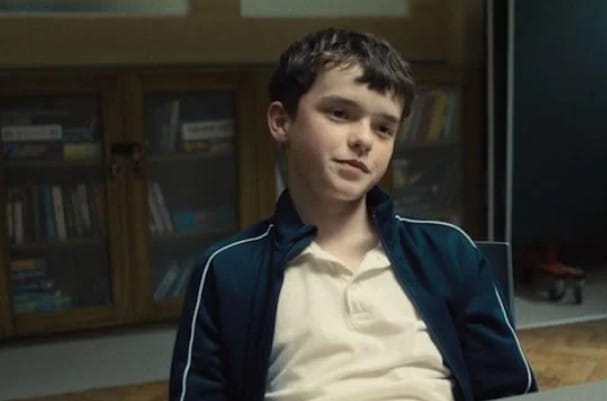
Jamie Miller is an entirely fictional character created for this television series. He is portrayed by breakout actor Owen Cooper in a performance that has garnered massive critical acclaim across the country.
Within the script, Jamie is depicted as an ordinary, quiet northern lad whose life unravels rapidly after he becomes the prime suspect in a brutal stabbing.
Internet rumours on platforms like Reddit have frequently attempted to link Jamie Miller to real historical figures or contemporary teenagers involved in high-profile UK court cases.
These online theories are complete rubbish. The character was designed to represent an everyman archetype, a visual demonstration of how quickly an ordinary minor can become entangled in the complexities of the youth justice system when vulnerable to external influences.
What Real-Life UK Crime Cases Inspired Stephen Graham and Jack Thorne?
While the plot does not adapt one specific case file, the screenwriters heavily researched real-life UK youth homicides from the past decade. Barantini’s creative team looked closely at how local communities react to sudden violence and how families disintegrate under the pressure of a police investigation.
The Disturbing Statistics Behind the UK Knife Crime Epidemic
The overarching inspiration for the series is the ongoing crisis of youth weapon possession across England and Wales. The writers consulted with anti-knife crime charities, including the Ben Kinsella Trust, to ensure the sociological depiction of youth vulnerability was accurate.
According to data from the Office for National Statistics (ONS), offences involving knives or sharp instruments in England and Wales surpassed 50,000 annually in recent counts, marking a grim 4% regional increase.
This worrying trend increasingly involves younger local lads caught up in weapon possession, both as perpetrators and victims.
According to the Children and Young Persons Act 1933 and the standard mandates set across England and Wales, the statutory age of criminal responsibility is strictly set at 10 years old.
Digital Radicalisation and the Manosphere
A core thematic pillar of the series is the exploration of how young boys are influenced by toxic internet subcultures. The script highlights how algorithms push vulnerable adolescents toward algorithmic radicalisation, incel culture, and misogynistic content creators like Andrew Tate.
Rather than attributing youth violence solely to physical peer pressure, the series illustrates how isolated children can be radicalised behind closed doors via smartphones and gaming platforms.
Fact-Checking Social Media Rumours, Reddit Theories, and Brad Pitt Production Links
Viral social media threads have falsely claimed that the show was based on recent, specific, tragic stabbings in London and Southport. These claims are entirely false and have been roundly dismissed by the production team.
Additionally, internet searches linking Hollywood actor Brad Pitt to the project stem from a misunderstanding of the production credits; the series was produced by the UK-based Warp Films alongside Stephen Graham’s independent banner, Matriarch Productions, with no involvement from American production houses.
Was Jamie Guilty of Killing Katie? UK Legal Counterparts
To understand the legal reality behind Jamie Miller’s actions, the series carefully aligns fictional plot points with established British law:
| Aspect of Case | Narrative Representation in Adolescence | Real-World UK Legal Counterpart |
| The Offence | The fatal stabbing of classmate Katie Leonard | Section 1, Homicide Act 1957 |
| The Perpetrator | 13-year-old Jamie Miller (Fictional) | Age of Criminal Responsibility is 10 |
| The Evidence | Forensic links, digital footprints, weapon discovery | Standard Police and Criminal Evidence Act (PACE) protocols |
| The Influence | Online manipulation via manosphere forums | Section 45, Modern Slavery Act 2015 (Coercive Control) |
Is Jamie Portrayed as a Sociopath or a Victim of Abuse?
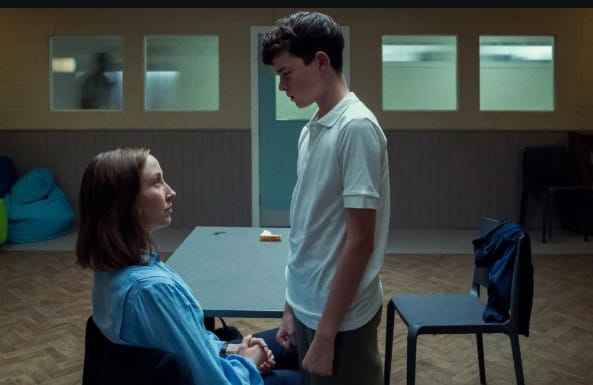
Audiences have debated whether Jamie exhibits clinical sociopathy or if his actions stem from severe trauma. The series makes it clear that Jamie isn’t some cold-blooded sociopath; rather, he is a deeply traumatised, neurodivergent lad who has suffered from silent psychological abuse and isolation.
His vulnerability made him a prime target for online groomers who exploited his need for belonging, twisting his perception of reality until he became capable of an extreme act of violence.
Why Does Jamie Keep Scratching?
Jamie keeps scratching in Adolescence as a severe psychosomatic response to extreme stress, sensory overload, and sheer panic.
Director Philip Barantini used this continuous visual physical tic to show that the 13-year-old minor is completely breaking down psychologically under high-pressure police interrogation tactics.
In youth psychology, such self-soothing or self-harming behaviours are common responses to extreme stress, illustrating that Jamie is psychologically collapsing under the weight of the interrogation.
Key Moments and Metaphors Explained
The psychological weights of the series are anchored in subtle, subtextual actions rather than overt declarations. By tracking these cinematic cues, the narrative exposes the deep emotional fractures within its characters.
What is the Meaning Behind Jamie Eating the Sandwich?
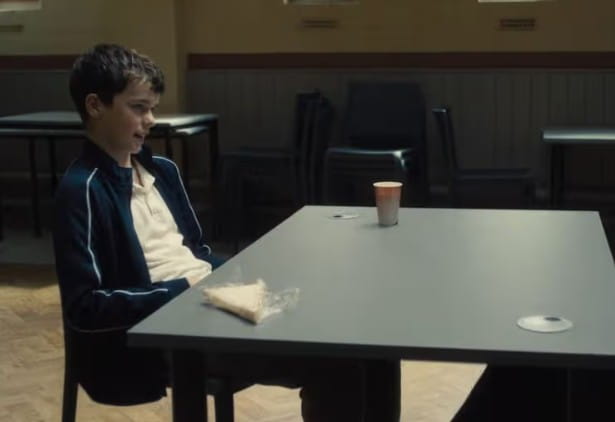
The scene where Jamie eats half a sandwich while in police custody is one of the most analysed moments on Reddit. This moment serves as a powerful metaphor for his regression to basic childhood needs amidst a legal crisis.
It highlights the stark contrast between the gravity of a murder charge and the simple, vulnerable reality of a hungry 13-year-old child who does not fully grasp the permanent consequences of his situation.
What Happened Between Katie and Jamie?
The tragic relationship between Katie and Jamie exploded due to a toxic mixture of rejection, online peer pressure, and fragile adolescent egos. Influenced by internet forums that preach male supremacy, Jamie misread normal teenage interactions.
When Katie rejected his advances, the digital radicalisation he had ingested manifested as physical aggression, leading directly to the fatal confrontation in the park.
Why Did Jade Hit Ryan and Why Did Amy Set Up Nick?
The supporting characters echo the central theme of systemic breakdown:
- Jade hitting Ryan: This act highlights how violence trickles down through families, serving as a desperate reaction to domestic tension and unaddressed grief within the household.
- Amy setting up Nick: This subplot demonstrates how fear and self-preservation drive teenagers to exploit the legal system, using counter-accusations to deflect police attention away from their own minor delinquencies.
The Role of an Appropriate Adult in the UK Legal System
An Appropriate Adult in the UK legal system is a parent, guardian, or social worker tasked with protecting a minor’s rights and welfare during police custody.
Required under PACE Code C regulations, they must ensure the child understands their legal rights during formal interviews and physical searches.
The law dictates that a child cannot be interviewed or searched without the presence of an Appropriate Adult, whose role is to safeguard the minor’s welfare and ensure they understand their rights.
In practice, as shown through Stephen Graham’s character, Eddie Miller, parents often struggle in this role because they are emotionally compromised by the horrific nature of the allegations against their child.
The Ending of Adolescence Fully Explained
The final episode of the limited series delivers a devastating emotional climax that exposes the ultimate cost of systemic neglect and digital radicalisation.
Why Did Jamie Deny the Crime Before Changing His Plea?
Jamie initially denies the killing because his mind has blocked out the sheer horror of the event, a psychological phenomenon known as traumatic amnesia.
He genuinely convinces himself of his innocence as a defence mechanism against his own actions. He only changes his plea to guilty when confronted with undeniable forensic evidence and digital messages, forcing him to accept the reality of what he had done.
The Tragic Significance of the Final Scene and Eddie’s Tears
The series closes with a prolonged shot of Eddie Miller weeping silently in his car outside the youth detention facility. This moment signifies the absolute destruction of the family unit.
Eddie’s tears are not just for his son’s lost future, but represent a profound sense of paternal guilt, the realisation that he was entirely blind to the dark digital world his son was inhabiting right under his own roof.
The Secret Meaning Hidden Within the Final Closing Song
The melancholic track playing over the final credits reinforces the show’s core message.
The lyrics speak directly to isolation, parental blindness, and the invisible dangers of the modern digital landscape, reminding audiences that the tragedy of Jamie Miller is a systemic failure rather than an isolated incident of malice.
The Single-Take Masterpiece (Behind the Scenes)
The show’s technical execution is just as breathtaking as its writing, relying on a high-stakes filmmaking style to amplify the onscreen tension.
Why Was Adolescence Filmed in One Continuous Take?
Director Philip Barantini made the creative choice to film all four episodes in a single, continuous camera take without hidden cuts.
This real-time format removes any sense of cinematic detachment, trapping the audience inside the claustrophobic panic of the investigation along with the characters.
Every ticking second builds relentless tension, mirroring the inescapable momentum of the UK youth justice system.
Owen Cooper’s Historic Breakthrough Performance and Emmy Win
The casting of Owen Cooper is the foundation of the show’s success. Discovered via an open casting call in northern England, Cooper had no previous professional acting experience.
His raw, authentic portrayal of Jamie Miller led to a historic sweep at major award ceremonies, making him one of the youngest actors to ever win a BAFTA and a Primetime Emmy Award for Outstanding Lead Actor in a Limited Series.
Viral claims regarding a military background or astronomical salaries are entirely fabricated internet myths; Cooper was a standard schoolboy before production.
Will There Be a Season 2 of Adolescence on Netflix?
As of 2026, Netflix and Warp Films have confirmed that Adolescence was designed strictly as a self-contained limited series. The narrative arc concerning Jamie and Eddie Miller is officially complete, leaving no plans for a direct continuation or a second season.
However, creators Jack Thorne and Stephen Graham have hinted that they are exploring the possibility of turning the project into an anthology series.
A future iteration could potentially use the same real-time, single-take filming technique to investigate a completely different structural issue within the British legal or social care systems.
The Message Behind Adolescence
In summary, while the show raises heavy questions regarding is adolescence based on a true story, its true power lies in how accurately it mirrors the vulnerabilities of modern youth.
The series is a stark societal warning about the dangers of internet radicalisation and the fracturing of community safety nets in the United Kingdom.
It urges parents, educators, and policymakers to look past the screen and recognise the real-world isolation affecting young people today before it manifests in tragedy.
Verified against UK Home Office, ONS statistical releases, and PACE standard operational guidelines.
Frequently Asked Questions About Adolescence
Is Adolescence based on a true story on Wikipedia?
No. The official Wikipedia entry confirms that the series is an entirely fictional drama created by Jack Thorne and Stephen Graham, though it is heavily informed by real-world social research into British youth crime.
Did the creators race-swap characters from a real-life trial?
No. Because the characters and plot are entirely fictional and not based on any real-life court case, no characters were race-swapped from real trials. The cast was assembled through standard creative auditions.
Is Adolescence worth watching for UK audiences?
Yes. It is a proper masterpiece and highly recommended for viewers interested in gritty British social realism, exceptional acting, and technical filmmaking. However, its intense depiction of raw grief, knife violence, and legal pressure makes it a proper challenging watch for some.
Where can parents find guidance on youth safety and digital radicalisation?
UK parents can access free resources, support, and guidance through established national organisations such as the NSPCC, Internet Matters, and the Ben Kinsella Trust to help navigate online safety.
What is an Appropriate Adult in the UK legal system, as shown in the series?
An Appropriate Adult is a parent, guardian, or social worker tasked with protecting a minor’s rights and mental well-being during police custody, searches, and formal interviews under PACE regulations.
Why does Jamie keep scratching in Adolescence?
The compulsive scratching is a severe psychosomatic physical response to intense stress, panic, and sensory overload experienced by the character during aggressive police questioning.
