
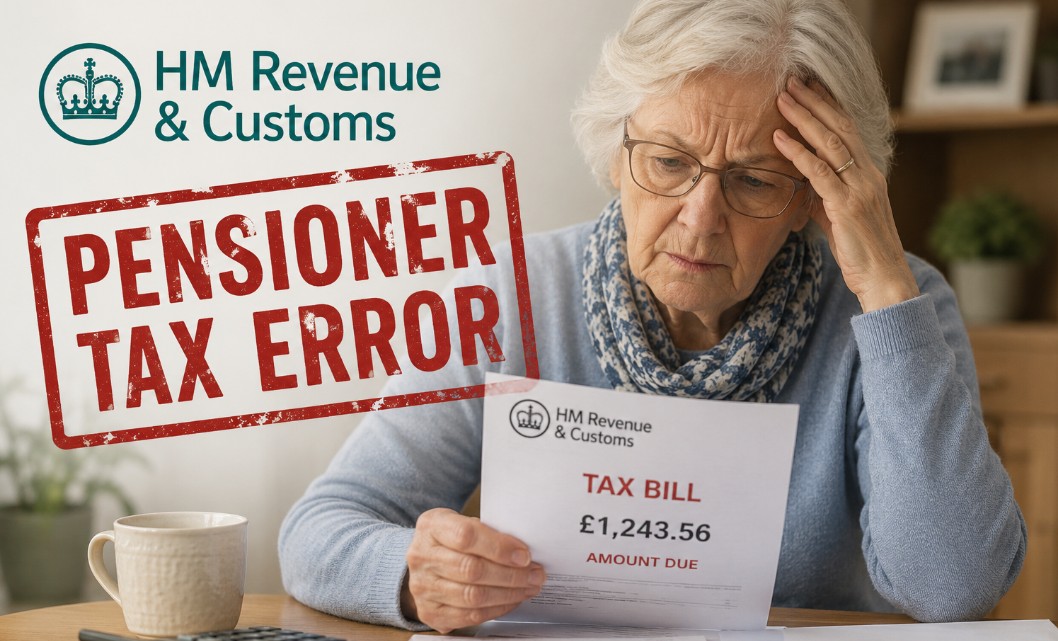
An HMRC pensioner tax error occurs when HM Revenue and Customs applies an incorrect tax code to a retiree’s retirement income streams, resulting in systemic overtaxation or unexpected liabilities.
This issue frequently arises when the Department for Work and Pensions’ state pension interacts with private or occupational pension payouts under automated Pay As You Earn systems, causing miscalculated code allocations like emergency codes or duplicate personal allowances.
What is State Pension Tax?
State Pension tax is not a distinct, standalone levy; rather, the State Pension is treated as ordinary, taxable earned income. While the DWP pays the State Pension gross (meaning they do not deduct tax before sending it to your bank account), the total amount you receive still counts toward your annual personal tax threshold.
If your total combined retirement income, including your State Pension, private pensions, workplace annuities, and investments, exceeds the standard UK personal allowance of £12,570, the excess is subject to regular UK income tax rates (starting at the 20% basic rate).
Because tax cannot be deducted directly from the State Pension, HMRC retrieves what you owe by adjusting the tax codes on your other active, private income channels.
What is the HMRC State Pension Tax Error?
The HMRC State Pension tax error refers to a recurring systemic failure where automated PAYE frameworks miscalculate tax codes following annual pension increases.
These software desynchronizations often treat the statutory State Pension rise as a completely separate, fully taxable secondary employment, leading to immediate overtaxation.
The Dynamics of Fiscal Drag and System Desynchronization
The primary driver behind this friction is the administrative lag in updating the Department for Work and Pensions (DWP) Triple Lock data within the HM Revenue and Customs (HMRC) central database.
When the state pension increases annually, HMRC must adjust individual tax codes to ensure the extra income is balanced against the personal allowance.
However, software synchronisation issues often result in duplicate coding notices or mismatched records, meaning automated PAYE platforms treat the state pension increase as a separate, fully taxable secondary employment.
While public perception has led to widespread accusations of HMRC knowingly overtaxing pensioners to shore up Treasury targets, the structural reality is rooted entirely in fiscal drag:
- Frozen Thresholds: The standard UK personal allowance has remained frozen at £12,570.
- Stagnant Boundaries: As inflation-linked State Pension Triple Lock Boost increases push millions of retirees over this unchanging boundary, automated tax frameworks fail to scale cleanly.
- Aggressive Default Postures: Lacking structural flexibility, the automated systems misinterpret baseline threshold breaches as undeclared income and immediately maximise automated tax collections at source.
The June 2026 Triple Lock Overcharge Scandal
In June 2026, a widespread systemic error was exposed, revealing that HMRC overcharged up to 8.7 million UK pensioners a collective £43.5 million over ten months.
The error occurred because automated tax systems failed to accurately account for the annual rise in the state pension under the Triple Lock mechanism.
This newly uncovered software glitch inflated individual tax records by recording state pension income at £9.05 higher than its actual value per week.
As a direct result, basic-rate taxpayers were overcharged an average of £5 throughout the tax year, highlighting issues similar to those seen in The Caoimhe Jennings Pension Struggle.
This calculation failure primarily struck individuals paying income tax via both Self-Assessment and standard workplace/pension PAYE channels.
HMRC has officially apologised for this multi-million-pound failure and is actively deploying a core database correction patch.
However, shadow ministers and consumer watchdogs are demanding fast-tracked, active manual refunds rather than forcing retirees to wait for slow, back-end cyclical updates.
What is the Reason Behind the HMRC Pensioner Tax Error?
The root cause of the HMRC pensioner tax error stems from three main pressure points: data processing lag between government agencies, automated payroll tracking failures across multiple small private pension pots, and the rigid application of emergency tax codes on first-time lump-sum drawdowns.
- Database Sync Failure: The central communication link between the DWP and HMRC is prone to data processing lag. When annual Triple Lock increases go live, the software systems fail to update personal records at the same speed, leaving automation frameworks working with mismatched financial figures.
- The Proliferation of Inactive Pots: Many modern retirees hold several micro-pensions from various employers throughout their careers. Systemic automation tools struggle to identify which pot is the primary income source, often leading to a split or completely lost personal allowance.
- The First Drawdown Trap: When an individual accesses a flexible cash pot for the first time, payroll systems do not know if this is a recurring monthly salary or a one-off withdrawal. Lacking historical context, the system errs on the side of caution and triggers emergency calculations.
Why Does Your HMRC Pension Tax Code Have Errors?
Your pension tax code contains errors because automated code-driven frameworks struggle to synthesise multiple active revenue sources.
When you draw funds from a mix of state benefits and distinct private providers concurrently, the central system often fails to balance your personal allowances correctly.
The Mechanics of the Standard 1257L Tax Code
The standard tax code for most individuals in the UK is 1257L, which grants the core £12,570 tax-free personal allowance. When you reach state pension age, the DWP pays this benefit gross, without any deductions at source.
To claw back the tax due on that state pension, HMRC subtracts its total value directly from the personal allowance code applied to your private or occupational pension payslips.
For instance, if your state pension sits at £10,500, HMRC trims your private pension tax code down to 207L (representing a remaining £2,070 allowance). If this adjustment is miscalculated or lagging, an immediate coding error hits your monthly private payslip.
The Shock of the HMRC Pension Emergency Tax Code
An HMRC pension emergency tax code triggers automatically when you flexibly access a private retirement pot for the first time.
The automated PAYE system lacks historical payroll context and operates on a non-cumulative Week 1 or Month 1 basis, treats a single one-off withdrawal as a recurring monthly salary, and overcharges you at higher tax brackets.
| Tax Code Indicator | Core Operational Meaning | Direct Impact on Take-Home Cash |
| 1257L | Standard personal allowance applied across a single primary income stream. | Full tax-free allowance distributed evenly across 12 months. |
| BR | Basic Rate code charging a flat 20% tax on every pound received. | No personal allowance applied; heavy overtaxing if it is the sole active pot. |
| 0T | No personal allowance allocated; splits income into progressive bands. | High risk of pushing retirement lump sums into 40% tax brackets. |
| K-Prefix | Income from other sources exceeds the total tax-free personal allowance. | Deductions can swallow up to 50% of the gross pension payment. |
This non-cumulative emergency calculation forces providers to process a one-off withdrawal as if it were a recurring monthly payment.
In practice, if an individual requests a one-off tax-free cash chunk alongside a £10,000 taxable lump sum, the system annualises that single payment into a hypothetical £120,000 salary.
How Does the HMRC Pensioner Tax Error Affect Retirees?
The HMRC pensioner tax error damages retirees by creating severe short-term cash flow bottlenecks, manufacturing artificial ghost tax liabilities on closed income accounts, and forcing individuals to undergo a delayed, complex manual reclamation process to recover their own money.
The consequences of these automated errors extend far beyond minor administrative adjustments. For those living on fixed incomes, the real-world impacts include:
- Severe Cash Flow Bottlenecks: Because emergency tax calculations treat individual lump sums as massive annual salaries, thousands of pounds can be stripped out of a retiree’s bank account instantly. While this stems from a calculation error, the sudden loss of funds can feel as disruptive as direct HMRC bank account deductions, leaving retirees temporarily short on cash for living expenses or planned retirement purchases.
- Unearned Ghost Liabilities: When HMRC’s system views a closed or inactive past workplace pension as still being active, it blocks portions of the personal allowance from being applied to the current primary pension, creating an artificial tax bill.
- The Friction of Delayed Recovery: While the overpaid money belongs to the pensioner, government default structures often hold onto these funds until the end-of-year tax reconciliation cycle unless the individual aggressively pursues a manual refund.

How to Verify If Your Pension Income Has Been Overtaxed?
Spotting an error requires checking your active tax documents against your actual receipts. You can uncover discrepancies by looking for these specific signs:
- Check Your Payslips for Modifiers: Look closely at the tax code displayed on your occupational or private pension payslips. If you spot W1, M1, or X at the end of the code (e.g., 1257L M1), you are actively being placed on an emergency tax track.
- Audit the K Code Warning: If your tax code starts with a K, it means your deductions outstripped your allowance. Cross-reference whether the external income value HMRC is using actually matches what you receive.
- Look for Drop-offs in Take-Home Pay: If your monthly private pension income suddenly drops right after your annual State Pension experiences a Triple Lock increase, it signals that HMRC has over-adjusted your code to compensate for the bump.
To verify potential issues, retirees should log into their official Personal Tax Account (PTA) via the UK government gateway or the HMRC mobile application.
The digital portal displays every recorded income stream, allowing users to cross-reference DWP benefit summaries with private pension allocations.
When reviewing decisions or checking monthly pay packets, a common pattern is finding that a recently closed workplace pension is still listed as active, which locks up a portion of the personal allowance and leaves the current primary pension overtaxed.
Steps to Secure Your HMRC Pension Tax Error Refund
To claim an HMRC pension tax error refund, log into your online Personal Tax Account to identify active coding mistakes, gather your P60 and withdrawal statements, select and submit the appropriate electronic reimbursement form (P55, P53Z, or P50Z), and track the official 30-day processing window.
If an automated error or emergency calculation has compromised your retirement funds, you must take formal action to retrieve the overpaid capital.
Relying on end-of-year automated reconciliations can leave your cash locked in government accounts for up to a year.
- Secure Official Payment Documentation: Gather your latest P60 certificate, your redundancy or retirement termination statements, and your initial flexible withdrawal slip confirming the exact tax deducted.
- Identify the Active Coding Discrepancy: Log in to your online Personal Tax Account to verify if your current code accurately reflects your total combined annual income.
- Select the Correct Electronic Reimbursement Form: Determine which official HMRC repayment path matches your specific withdrawal status to avoid administrative rejection.
- Complete the Detailed Financial Declarations: Input your total expected earnings from all state benefits, employment, and investments for the remaining tax year.
- Submit the Application Securely: Upload the completed documentation through the Government Gateway portal or mail the physical forms directly to the central tax office.
- Track the 30-Day Processing Window: Monitor your bank account for the direct electronic transfer or check for an official P800 calculation letter indicating approval.
- Verify Post-Refund Code Alignment: Confirm with your private pension provider that HMRC has issued a permanent cumulative coding notice to stop future errors.
For general coding errors unrelated to lump-sum drawdowns, escalating your claim requires utilising the dedicated HMRC pension tax contact number to speak with a PAYE advisor. Before dialling, ensure your National Insurance number and P60 are visible.
If HMRC delays updating your records after being notified of a change, you can explicitly cite Extra-Statutory Concession A19.
This safeguard prevents the tax authority from collecting back-taxes if they failed to act on primary employer or DWP information within 12 months of receipt.

How Can a Pensioner Avoid the HMRC Pensioner Tax Error?
Pensioners can avoid HMRC tax errors by making a very small initial flexible drawdown to force the system to generate an updated cumulative code, consolidating stray historical pension pots into one primary account, and pre-emptively updating status changes directly inside their online Personal Tax Account.
- Space Out Small Flexible Drawdowns: If you plan to take money out of a private pot, avoid making a single, large initial request. Making a very small initial flexible drawdown forces the system to generate a real, updated tax code for that pot. Future withdrawals from that specific fund will then use your actual cumulative code rather than crashing into the emergency Month 1 matrix.
- Consolidate Stray Modern Pension Pots: Keeping your workplace history scattered across multiple provider accounts multiplies the chances of a split personal allowance error. Consolidating older, inactive accounts into a primary pension vehicle reduces the numbers your PAYE system has to track.
- Pre-emptively Inform HMRC of Status Transitions: Do not wait for the end-of-year payroll data transfers to run. If you stop working entirely or your taxable benefits change, update your employment status inside your Personal Tax Account manually to prevent the system from registering a ghost secondary income.
Comprehensive Summary of Reclamation Pathways
Unpicking these automated tax discrepancies means knowing exactly which remediation route fits your circumstances. The table below outlines the precise mechanisms required to resolve various structural errors.
| Type of Coding Glitch | Root Systemic Cause | Primary Action Required |
| Emergency Code on Lump Sum (M1) | Auto-annualization of one-off flexible private pension drawdowns. | File Form P55 (partial pot) or Form P53Z (full pot empty) for a 30-day refund. |
| Mismatched State Pension Figures | Delays syncing the annual DWP Triple Lock uplift into the PAYE index. | Phone the HMRC helpline to demand a manual reconciliation against current DWP data. |
| Split Personal Allowance Error | Ghost employment or inactive historical retirement accounts locking code allocations. | Update your digital Personal Tax Account to mark old pension streams as officially closed. |
Managing retirement wealth requires proactive oversight of how state and private funds interact. Systemic errors within tax infrastructure occur frequently, meaning the burden of verification rests entirely on the individual.
By reviewing your tax code, cross-referencing payslips against your online account, and submitting correct paperwork promptly, you can protect your hard-earned retirement capital.
FAQ about HMRC Pensioner Tax Error
Do HMRC automatically refund overpaid tax on pension?
HMRC will automatically refund overpaid tax via a P800 calculation letter, but only after the end of the tax year during annual reconciliation. To secure a rapid refund on emergency overcharges within 30 days, retirees must actively submit specific forms like the P55.
What is the state pension error?
The state pension error relates to systemic database sync issues where HMRC fails to integrate annual DWP Triple Lock increases properly. This causes automated PAYE systems to apply incorrect codes, leading to double taxation or unauthorised emergency deductions on secondary private pensions.
What happens if HMRC makes a mistake?
When HMRC makes a coding mistake, they adjust your tax code to correct future payments and issue an electronic refund or a P800 notice. If their delay caused an underpayment, you can challenge the demand using the Extra-Statutory Concession A19 rule.
What is the HMRC tax warning?
The HMRC tax warning refers to public advisories alerting retirees that taking a single large cash withdrawal from a flexible private pension will automatically trigger emergency Month 1 tax codes, resulting in massive, immediate overtaxation at source.
How long does it take for HMRC to pay back overpaid tax?
Once an official refund application form (such as a P55, P53Z, or P50Z) is accurately completed and processed through the government portal, HMRC aims to issue the repayment directly into your nominated bank account within 30 days.
Can I claim back pension tax relief from HMRC?
Yes, if your pension scheme uses the relief at source method and you pay higher-rate tax, you must claim the extra 20% or 25% tax relief back directly via a Self-Assessment return or by contacting HMRC helpline agents.
Why has my tax code changed on my pension?
Your pension tax code changes when HMRC receives updated income data, such as a new state pension allocation from the DWP. The system reduces your personal allowance on your private pension payslip to collect the tax due on your state benefits.
