
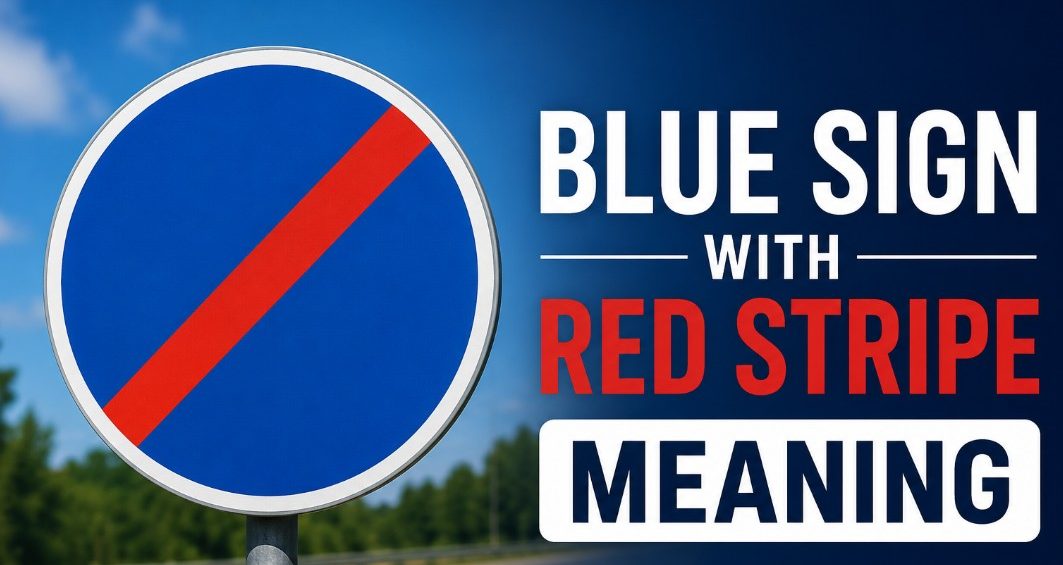
Under the UK Highway Code, a blue circular sign with a red ring and a single diagonal red stripe means a strict No Waiting restriction is in force. This regulatory sign prohibits motorists from parking, idling, or leaving a vehicle unattended during operational hours.
What is the Blue Sign with a Red Stripe Meaning?
A blue sign with red stripe meaning relates strictly to a No Waiting regulatory instruction, designated as Traffic Sign 636 by the Department for Transport. This sign features a deep blue circular background, a solid red outer border, and a single diagonal red stripe cutting from the top-left to the bottom-right.
When a motorist encounters this symbol, it indicates a strict prohibition against parking, idling, or leaving a vehicle unattended during the sign’s hours of operation. Unlike absolute stopping restrictions, it allows brief exceptions for active passenger drop-off or commercial loading if the driver remains with the vehicle.
The Truth Behind UK Restrictive Signage
The truth behind UK restrictive signage is that circular blue signs carry mandatory legal orders, meaning a blue circle with a red border signifies a direct legal prohibition rather than optional or friendly road information.
When a blue circle is wrapped in a red enforcement ring, it transforms from a positive instruction into a direct prohibition. Driving or parking in violation of these visual indicators constitutes a non-endorseable traffic offence, exposing the vehicle owner to civil enforcement penalties.
What Does a Sign in a Blue Circle Mean in the UK?
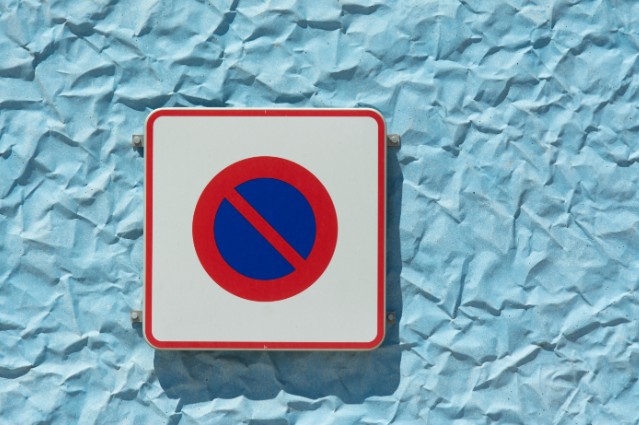
In the UK, a sign in a blue circle means a mandatory action or positive instruction that drivers must obey, such as a minimum speed limit or a specific driving direction, unless it features a red border, which turns it into a prohibition.
The structural design language of British road signs relies heavily on geometric shapes and colour coding to convey immediate messages to drivers moving at speed. Under the standardised system established by the landmark Worboys Committee in the 1960s, circular signs are universally reserved for regulatory mandates.
- Circular Signs: Universally reserved for regulatory mandates and legal orders.
- Standard Blue Circles: Positive instructions telling drivers what action they must perform (e.g., mandatory turn left, minimum speed limits).
- Red Ring Over Blue Circle: A direct prohibition order (e.g., No Waiting), using a hybrid design so curb-side restrictions are instantly recognisable from a distance.
Standard Blue Circles vs. Red Border Exceptions
A standard blue circle without a red border conveys a positive legal instruction forcing drivers to act, whereas adding a red ring and stripe reverses the meaning into an explicit negative restriction.
When a red outer ring and a diagonal stripe are superimposed over that blue circle, the legal context reverses completely. The red ring introduces a prohibition, turning the sign into an explicit restriction.
This specific hybrid design is intentionally distinct from standard white-background prohibition circles (such as speed limits or No Entry signs) to ensure that curb-side stopping restrictions are instantly recognisable from a distance.
Which Sign Means No Stopping in the UK?
The sign that means No Stopping in the UK is a blue circular sign with a red outer ring and a red cross (two intersecting diagonal lines), which marks an absolute Clearway where vehicles cannot halt for any reason.
| Feature | No Waiting Sign | No Stopping Sign (Clearway) |
| Visual Design | Blue circle, red outer ring, single diagonal red stripe | Blue circle, red outer ring, red cross (two intersecting lines) |
| Primary Legal Meaning | Parking and prolonged idling are strictly prohibited. | Absolute ban on stopping for any reason whatsoever. |
| Passenger Drop-off / Pick-up | Permitted if completed quickly and without leaving the vehicle. | Strictly illegal; wheels must not come to a halt. |
| Commercial Goods Loading | Allowed for designated windows unless overridden by kerb blips. | Prohibited entirely, unless in a specially marked bay. |
| Statutory Framework | TSRGD Schedule 4, Item 2 | TSRGD Schedule 4, Item 1 |
Distinguishing the Single Stripe from the Red Cross
Motorists frequently conflate the single diagonal stripe with the prominent blue sign with a red cross. While both share a blue background and a red circular frame, their legal mandates are profoundly different.
The single-stripe sign governs No Waiting, whereas the double-stripe cross indicates an absolute No Stopping order, or an Urban Clearway.
Statistically, the clearway sign remains one of the most misunderstood traffic signs on UK commuter routes. On an urban clearway, a vehicle cannot halt for any reason during operational hours, meaning pulling over to drop off a passenger is an immediate traffic violation.
In contrast, the single-stripe No Waiting sign permits temporary halts for active loading, unloading, or assisting passengers.
How Do Supplementary Time Plates Modulate the Restrictions?
A blue-and-red circular sign rarely stands alone. In almost all urban zones, it is accompanied by a white rectangular information plate mounted directly underneath the main disc.
This dynamic display serves as the definitive legal guide for the restriction, outlining exactly when the No Waiting order is active.
This plate serves as the legal guide for the restriction, outlining exactly when the No Waiting order is active. To avoid a ticket, drivers should do a quick check of the signpost using these steps:
- Locate the nearest vertical signpost relative to the parked vehicle.
- Verify the days of the week listed on the top line of the white plate (e.g., Mon – Sat).
- Check the specific hours of enforcement displayed beneath the days (e.g., 8:00 AM – 6:30 PM).
- Inspect the plate for any specific text exemptions relating to goods vehicles or permit holders.
- Cross-reference the timeline with the current clock time on the dashboard.
- Look for directional arrows on the plate indicating whether the restriction applies to the left or right of the post.
When a red and blue circle is encountered without a supplementary time plate, the restriction defaults to a permanent status. This means the No Waiting order is legally active 24 hours a day, 7 days a week, 365 days a year, matching the enforcement level of standard double yellow lines.
What Happens When There Is No Time Plate?
If a blue sign with a red stripe has no supplementary time plate, the restriction defaults to permanent 24/7 enforcement, mirroring the legal strength of standard double yellow lines.
When a red and blue circle is encountered without a supplementary time plate, the restriction defaults to a permanent status. This means the No Waiting order is legally active 24 hours a day, 7 days a week, 365 days a year, matching the enforcement level of standard double yellow lines.
What Does a Single Red Line Mean on UK Roads?
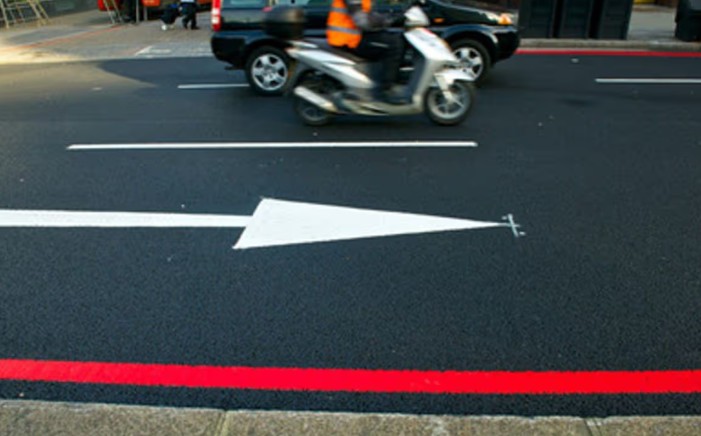
A single red line on a UK road means that stopping, loading, and waiting restrictions are strictly enforced during specific daytime hours dictated by nearby roadside signage, usually matching peak commuter times.
To keep traffic moving and reduce urban congestion, highway authorities pair these roadside signs with painted lines on the tarmac. While the blue sign with a red stripe serves as the upright legal warning, it is traditionally synchronised with single yellow lines painted along the curb.
When you see a single yellow line, its active enforcement hours are precisely dictated by the accompanying blue and red sign. Outside of those specific times, the restrictions lapse, and standard parking or loading may resume.
The Operational Rules of Red Routes
Red routes apply stricter stopping bans on major arterial roads, using single or double red lines to completely override standard yellow line parking allowances during controlled hours.
- Double Red Lines: These indicate a permanent, 24/7 prohibition against stopping, waiting, or loading. They operate completely independently of any supplementary time plates.
- Single Red Line: This indicates that stopping restrictions are active during specific, high-volume windows of the day, typically commuting hours.
- Specially Marked Bays: Boxed areas painted in white or red dashed lines along a red route indicate specific zones where limited loading or disabled parking is permitted at specified hours.
- Kerb Chevron Blips: Small yellow or red vertical marks painted onto the side of the kerb indicate that loading or unloading is entirely banned, regardless of what the roadside sign permits.
When a single red line is painted on the road, its active hours are dictated precisely by the accompanying blue sign with a red stripe. Outside of those specific operational hours, the restrictions lapse, and standard parking or loading patterns may resume.
What Are the Parking Exemptions for Blue Badge Holders?
The UK Department for Transport provides specific statutory concessions for disabled motorists holding a valid Blue Badge. On roads governed by a blue sign with a single red stripe (or corresponding single yellow lines), Blue Badge holders are legally permitted to park for a maximum of three hours.
To use this exemption safely, the vehicle must display both the blue badge and the matching blue parking clock, set to the exact quarter-hour of arrival. This concession provides a critical lifeline for mobility-impaired individuals conducting essential business within congested town centres.
When Loading Bans Override Blue Badge Exemptions?
An active loading ban, marked by vertical chevron blips on the kerb, completely overrides the Blue Badge exemption, making parking illegal even within the standard three-hour window.
A common pattern in enforcement disputes involves motorists misjudging the authority of kerb markings. A Blue Badge does not grant an absolute right to park anywhere.
If the kerb displays vertical chevron blips, it indicates that a loading ban is concurrently in operation.
A loading ban completely overrides the Blue Badge parking concession, meaning that parking there will result in immediate enforcement action, even if the vehicle is within its three-hour parking window.
What Are the Penalties for Disobeying These Signs?
The penalty for disobeying a blue No Waiting sign is a Civil Penalty Charge Notice (PCN) ranging from £50 to £160, which does not result in driving licence points but can escalate to towing if traffic is blocked.
Enforcement of No Waiting zones is handled primarily by local authorities through Civil Enforcement Officers, or via fixed automated CCTV cameras monitoring high-risk arterial roads. Failing to comply with a valid restriction results in the issuance of a Penalty Charge Notice (PCN) or a Fixed Penalty Notice (FPN).
| Enforcement Action | Penalty and Outcomes (UK) |
| Financial Penalty (London) | £130 to £160 (reduced by 50% if paid within 14 days) |
| Financial Penalty (Outside London) | £50 to £70 (reduced by 50% if paid within 14 days) |
| Driving Licence Points | 0 Points (Civil infraction, not a criminal driving offence) |
| Vehicle Impoundment / Towing | Allowed if blocking a critical red route or causing danger |
In practice, a parking infraction under a No Waiting sign remains a civil matter rather than a criminal offence. Consequently, these penalties do not result in points being added to a UK driving licence, unlike severe safety violations such as speeding or crossing a red traffic signal.
However, ignoring an outstanding PCN can lead to escalating statutory debts, the involvement of county court bailiffs, and potential vehicle clamping or impoundment.

Quick Takeaway for UK Drivers
When navigating UK urban spaces, avoiding administrative fines requires a precise approach to reading roadside signage.
Ultimately, a blue sign with a red stripe means a strict curb-side waiting ban for British motorists in 2026. If a blue circle with a single red stripe is visible, assume parking is prohibited until the supplementary plate has been fully inspected and verified.
For those seeking comprehensive photographic examples of every official variant, consulting the Department for Transport’s official Know Your Traffic Signs manual remains the definitive path toward total road compliance.
FAQ about the Blue sign with red stripe meaning
What is the sign with a red circle and a line on a white background?
A white circular sign with a red border and a single diagonal red line indicates a specific prohibition for a particular vehicle class or activity, such as a No Cycling or No Left Turn instruction.
What does a blue 30 sign mean in the UK?
A blue circular sign containing the number 30 indicates a mandatory minimum speed limit of 30 miles per hour, requiring drivers to maintain at least that speed unless traffic conditions prevent it.
What is the white sign with a black diagonal line in the UK?
A circular white sign featuring a single bold, black diagonal stripe indicates that the national speed limit applies, lifting any previous localised numerical speed restrictions on that stretch of road.
Can I stop briefly next to a blue sign with a red stripe if my engine is running?
No. Leaving the engine running does not exempt a vehicle from the restriction. If the vehicle is stationary and passenger dropping or loading is not actively occurring, a parking violation is committed.
How do these signs differ from standard double yellow lines?
Double yellow lines indicate a 24/7 waiting restriction painted on the road surface, whereas the blue circular sign can apply to flexible, time-restricted periods dictated by its underlying text plate.
What does a blue square sign with a red T mean?
A square or rectangular blue sign displaying a red letter T serves as an information sign indicating a dead-end road or a no-through road ahead.
Can delivery drivers load goods next to a blue sign with a red stripe?
Yes. Commercial vehicles are generally permitted to drop off or collect heavy goods within these zones, provided they do not exceed the time limits specified on the local council’s supplementary plates, and no active kerb blips are present.
