
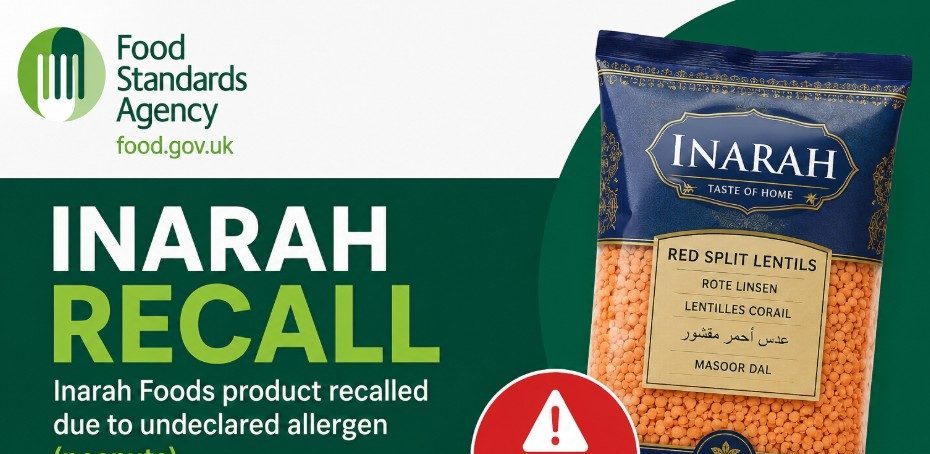
The Food Standards Agency (FSA) has issued a nationwide Food Alert for Action (FAFA) regarding all frozen products supplied by Inarah’s Frozen Foods Ltd. Due to critical failures in food safety traceability and hygiene documentation, these products are considered unsafe to eat.
Consumers and businesses must immediately stop the sale and consumption of any items branded as Inarah’s Frozen Foods, Inarah’s Fine Foods, or New York Crispy
What Triggered the Food Standards Agency Inarah Recall?
The FSA issued this recall because Inarah’s Frozen Foods Ltd failed to demonstrate that their products were manufactured, handled, or stored in compliance with UK food safety laws, posing a potential risk of bacterial contamination.
Under the General Food Law Regulation, every food business in the UK must maintain a transparent paper trail for all ingredients. Without this, the regulator must assume the products pose an active health risk.
A FAFA is a high-priority enforcement tool used when local authorities must intervene directly at the retail level to remove potentially contaminated stock from the supply chain.
What Food Products Are Included in the Recall?
All frozen products, regardless of pack size, batch code, or best-before date, branded under Inarah’s Frozen Foods, Inarah’s Fine Foods, or New York Crispy are subject to this recall.
The scope of this notification covers the entire range of products from the central manufacturer, as the compliance failure affects the facility’s baseline operational controls. No individual batch is deemed safe.
| Brand Name | Food Product Classification | Distribution Scope / Facility |
| Inarah’s Frozen Foods | Poultry, Beef, Fish, Vegetarian | National Wholesale (Walsall, WS2 9HQ) |
| Inarah’s Fine Foods | Speciality Meats & Prepared Blends | Independent Retailers (Stoke-on-Trent) |
| New York Crispy | Breaded Poultry & Finger Foods | Convenience Stores (Bradford, BD9 4TS) |
How to Check Recalled Products on the FSA UK Recalls List?
You can verify if your items are affected by checking the official Food Standards Agency recall database. Follow these steps to confirm if your stock is part of the withdrawal:
Mandatory Verification Steps for UK Stock Checking
- Check the official registry: Start by heading to the Food Standards Agency recall database, where you can browse the latest enforcement notices in real-time.
- Filter for urgent alerts: Use the search filters on the FSA recall page to specifically narrow down the list to ‘Food Alerts for Action’ (FAFA).
- Cross-reference the brand identity: Inspect frozen packaging labels specifically for the three target entities: Inarah’s Frozen Foods, Inarah’s Fine Foods, or New York Crispy.
- Audit the physical plant codes: Check the back of the outer film or cardboard boxing for the primary production locations in Walsall, Stoke-on-Trent, or Bradford.
- Verify the batch exemption status: Confirm that the stock falls under the all dates and all sizes blanket designation established by the Food Standards Agency Inarah recall alerts framework.
- Consult local authority data bulletins: Review regional environmental health logs for specific wholesale distribution manifests relevant to your county.
- Cross-check wider supermarket updates: Review contemporary retail records to ensure no cross-contaminated or white-labelled derivatives are present in warehouse storage.
How Do I Know If I Have Purchased Recalled Food from Supermarkets?
Independent grocers and mainstream supermarket chains handle product alerts through distinct internal tracking mechanisms. While the Food Standards Agency Inarah recall primarily penalises items distributed through independent convenience store networks and cash-and-carry hubs, tracking general supermarket notices follows a parallel protocol.
Key Food Retailer Safety Portals
- Aldi Product Recall List: Check the central customer notice board online or at the store entrance for updates on frozen items or third-party meat components.
- Lidl Recall List: Review the product recall Lidl digital portal, which catalogues specific batch numbers, manufacturer details, and date codes for items withdrawn from shelves.
- M&S Recalls: Monitor the dedicated Marks & Spencer food safety hub, which details immediate point-of-sale withdrawals concerning allergens or production faults.
- General Food Supermarket Recalls Today: Use an aggregated food safety service to track daily notices across smaller regional retail outlets and multi-buy discounters.
A common pattern is that independent mini-markets may source stock from multi-tier secondary wholesalers.
For example, an independent retailer in the Midlands recently discovered affected New York Crispy cartons mixed inside a pallet of standard commercial frozen goods. Business owners should review their physical invoices against the official supplier list rather than relying solely on product branding.

What Immediate Actions Must UK Food Businesses Take?
Under the Food Safety Act, businesses are legally required to immediately isolate all affected products, stop further sales, and document the safe disposal of the contaminated inventory.
If an enforcement officer conducts an unannounced inspection, you must be able to provide evidence that the stock has been removed from the human food chain. Failure to comply can result in administrative penalties or criminal prosecution.
What Happens If I Eat Recalled Food?
Consuming these products increases the risk of contracting foodborne illnesses like Salmonella or Listeria, which may not be visible or detectable by smell, even after thorough cooking.
If you have ingested these products, immediately monitor your health for symptoms such as high fever, severe stomach cramps, or vomiting, and contact NHS 111 if symptoms appear.
Immediate Steps for Your Safety
If you believe you have already consumed these products, follow these steps to manage your health and mitigate further risk:
- Cease Consumption Immediately: Do not open, cook, or sample any remaining items branded as Inarah’s or New York Crispy, regardless of storage time.
- Isolate the Packaging: Place the item inside a sealed plastic bag within a domestic waste bin to prevent cross-contamination with kitchen surfaces.
- Monitor for Gastrointestinal Symptoms: Watch for the onset of high temperatures, severe abdominal cramping, vomiting, or acute diarrhoea.
- Contact Public Health Services: If symptoms manifest within 12 to 72 hours of ingestion, seek professional assessment via the NHS 111 service.
- Request a Financial Refund: Return to the specific independent retailer with proof of purchase or a photo of the product label to claim a full refund under consumer protection laws.
Why Cooking Does Not Solve the Problem?
Unlike standard food spoilage, the risk here is structural rather than surface-level. Because the manufacturer cannot verify baseline processing hygiene, there is no guarantee that raw ingredients were stored at correct temperatures throughout the supply chain.
Standard domestic cooking temperatures may fail to neutralise concentrated bacterial toxins or resistant pathogens if the items were previously subjected to repeated thawing and refreezing, or were contaminated during the initial processing phase.
Summary of Regulatory Compliance Steps
The FSA continues to monitor independent retail networks to ensure these untraceable frozen products are removed from circulation. If you find these items in your freezer or warehouse, isolate them immediately.
Consumers should return the product to the store for a full refund; businesses must document the disposal to remain compliant with UK food safety standards.
To protect your household, double-check your freezer against the affected facility locations in Walsall, Stoke-on-Trent, and Bradford.
For business owners, immediate isolation of these products is the only way to stay compliant with national food safety requirements.
FAQ about Food Standards Agency Inarah recall
What specific brands are included in the Inarah recall?
The recall covers three distinct labels supplied by the central manufacturer: Inarah’s Frozen Foods Ltd, Inarah’s Fine Foods, and all frozen products branded under the New York Crispy label.
Are any specific expiry dates or batch codes exempt from the alert?
No batch codes are exempt. The Food Standards Agency has classified all sizes, pack weights, and use-by or best-before dates across these brands as unsafe for human consumption.
What types of food are affected by this regulatory warning?
The scope includes all frozen poultry items, frozen beef products, frozen fish portions, and all prepared frozen vegetarian selections manufactured by the company.
Why did the FSA issue a Food Alert for Action instead of a standard notice?
A Food Alert for Action is issued when a manufacturer fails to provide adequate food safety and traceability records, requiring local authorities and environmental health teams to actively remove products from the market.
Where were these unsafe frozen food items distributed in the UK?
The products were distributed nationwide through independent convenience stores, regional wholesalers, and cash-and-carry outlets across England, Wales, and Northern Ireland.
Can I cook these frozen products thoroughly to make them safe to eat?
No. Because the manufacturer cannot verify baseline processing hygiene, cooking the food is not an acceptable remedy. The products must be disposed of or returned to the retailer.
How do I get a refund for my affected New York Crispy items?
Consumers can return the product or packaging to the point of purchase. UK food businesses and independent retailers are instructed to provide full refunds for these recalled items.
