
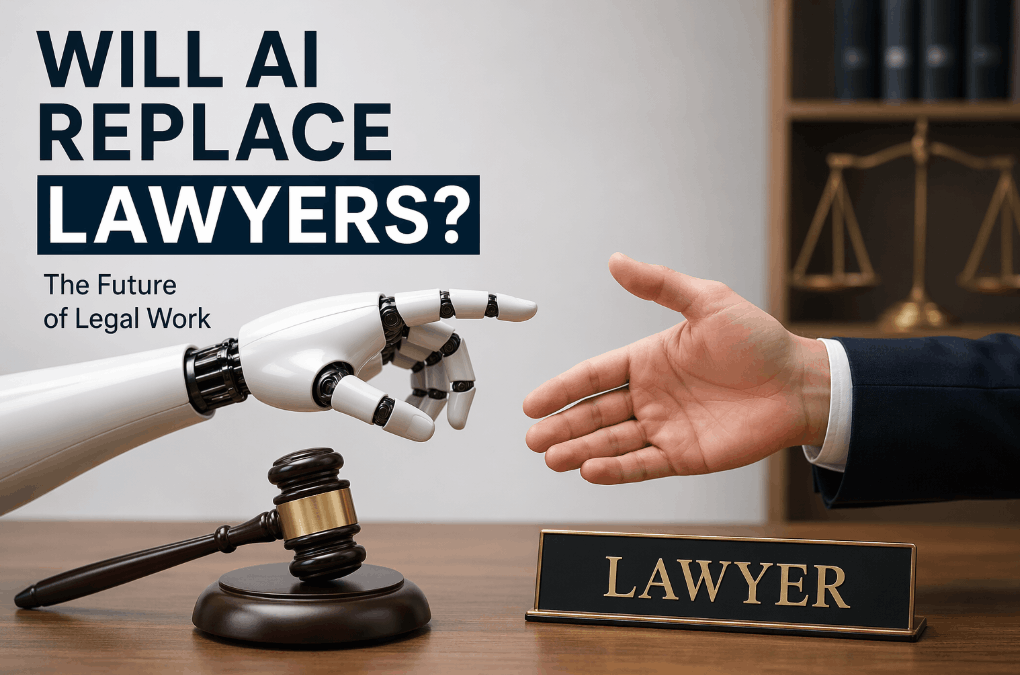
Artificial intelligence will not replace lawyers in the foreseeable future, but it is fundamentally restructuring the legal profession.
While AI automates document review, legal research, and administrative tasks, it lacks the ethical judgment, nuanced advocacy, and accountability required by the UK legal system.
The real shift is not the disappearance of the solicitor, but the widening gap between traditional practitioners and those adopting a tech-first approach. In the current market, the competitive advantage has moved decisively toward those who treat algorithms as an extension of their own expertise.
Will AI replace lawyers in the UK?
Artificial intelligence cannot replace lawyers because the UK legal framework relies on human accountability, ethical discretion, and complex negotiation, traits AI does not possess.
While Agentic AI now manages high-volume technical workflows, the Solicitors Regulation Authority (SRA) continues to mandate a human-in-the-loop to ensure accuracy and protect legal professional privilege, making total replacement legally and practically impossible.
The divide between manual labour and legal logic
The distinction between labour and logic is the primary reason for job security in the legal sector. AI excels at the labour, parsing thousands of pages of disclosure or drafting standard-form contracts.
However, it fails at the logic of law, which involves interpreting a judge’s temperament, navigating the emotional volatility of a client, and taking professional liability for a decision.
In practice, a solicitor’s value has shifted from being a repository of information to a strategic navigator of that information.

Why AI cannot replace lawyers through ethical and practical limitations
The security of the legal profession is anchored in a unique intersection of regulatory necessity and the high-level cognitive demands of the UK court system, factors that automated systems are fundamentally unable to replicate.
One significant barrier is the issue of hallucinations. Even in 2026, Large Language Models (LLMs) can occasionally manufacture case law or misinterpret a statutory instrument.
- Professional Accountability: A software programme cannot be sued for negligence or struck off a roll. The SRA and the Bar Standards Board require a named human professional to bear the risk of legal advice.
- Contextual Nuance: In a UK employment tribunal, the reasonableness of an employer’s action is often a grey area. AI struggles with subjective standards that depend on societal norms and evolving human values.
- The Advocacy Gap: A machine cannot read a courtroom’s energy or pivot a cross-examination strategy based on a witness’s body language.
| Feature | AI Capabilities | Human Lawyer Value |
| Data Processing | Instant analysis of millions of documents. | Verifying accuracy and identifying context. |
| Risk Management | Identifies patterns in historical data. | Applies ethical judgment and professional liability. |
| Negotiation | Suggests best fit settlement figures. | Understands leverage, emotion, and empathy. |
| Creative Strategy | Limited to existing data patterns. | Develops novel legal theories for new precedents. |
How can a lawyer use AI technology for their growth?
Lawyers are currently entering an era of Augmented Lawyering, where the goal is to increase the profit-per-earner by offloading low-value tasks.
To grow in this environment, a solicitor must transition from a traditional fee-earner to a legal technologist who manages AI agents.
- Deploying RAG Systems: Use Retrieval-Augmented Generation to query your firm’s private internal database rather than the open internet, ensuring 100% relevance to UK law.
- Predictive Litigation Analytics: Use AI to analyse the historical ruling patterns of specific judges or the success rates of opposing counsel in similar High Court cases.
- Automated Time Entry: Growth is often hindered by admin drain. AI tools now capture billable increments by analysing your activity, ensuring no revenue is lost.
- Drafting 2.0: Use AI to generate the first draft of a witness statement or a Share Purchase Agreement (SPA), allowing you to spend your time on bespoke clauses.
- Sentiment Analysis: Applying AI to client communications to flag disgruntled clients or urgent matters before they escalate.
- AI-Driven Business Development: Identifying potential litigation triggers for corporate clients by monitoring global regulatory changes in real-time.
Navigating the shift in junior associate roles
The traditional grunt work of a trainee or junior solicitor is vanishing. When reviewing decisions made in mid-tier UK firms, a common pattern is the replacement of manual document coding with AI-first workflows.
For a junior lawyer to grow, they must demonstrate AI Supervision skills, proving they can audit an AI’s output for compliance with the Solicitors’ Code of Conduct.

Is AI legally allowed to give advice in the UK?
Currently, no AI platform is authorised by the Legal Services Board to practice law independently. Providing legal advice is a reserved activity under the Legal Services Act 2007.
While AI can provide legal information, the moment that information is tailored to a specific set of facts with the intent of being relied upon, it crosses the line into regulated territory.
Best practices for maintaining professional oversight
- Data Isolation: Ensure the client’s data is processed within a UK-based, GDPR-compliant server.
- Initial Querying: The solicitor uses a prompt to extract relevant statutes and precedents.
- Fact Verification: The human lawyer cross-references the AI’s citations against official sources like legislation.gov.uk.
- Strategic Layering: The lawyer adds a layer of advice regarding the client’s specific commercial or personal goals.
- Conflict Check: A human verifies that the AI’s suggested path does not create a conflict of interest.
- Final Certification: The solicitor signs off on the document, accepting full professional liability.
Realistic implementation of AI agents
Looking at a typical high-street conveyancing practice in Manchester, the practical benefits become clear.
Previously, a solicitor might spend hours checking titles and identifying restrictive covenants. By using an AI agent, they can identify these issues in seconds.
The solicitor’s growth comes from taking on triple the caseload while maintaining the same staff overhead, effectively decoupling hours worked from revenue generated.
| Risk Category | AI Limitation | Mitigation Strategy |
| Confidentiality | Public AI may train on your data. | Use private, zero-retention enterprise AI. |
| Accuracy | Potential for hallucinated citations. | Mandatory human verification of all case links. |
| Bias | AI may reflect biases in historical data. | Periodic diversity and fairness audits of AI logic. |
The impact of AI on the billable hour model
The most significant disruption is not to the lawyer’s job, but to how they get paid. As AI completes tasks in minutes that previously took hours, the traditional UK billable hour is becoming obsolete.
Firms are pivoting toward value-based pricing, where a client pays for the outcome rather than the time spent.
- Fixed-Fee Certainty: AI allows firms to predict how much effort a case will take, enabling more competitive fixed-fee quotes.
- Efficiency Premiums: Firms that work faster using AI keep the time savings as profit rather than billing fewer hours.
- Subscription Models: Some corporate firms are using AI to provide ongoing compliance monitoring as a monthly subscription service.
Understanding the 2026 regulatory environment
In line with the UK Government’s pro-innovation approach to AI regulation, the SRA has issued updated guidance emphasizing that the solicitor remains the ultimate responsible party. A common pattern in recent tribunal warnings is the emphasis on transparency.
If you are using AI to draft a significant portion of a client’s work, that client may have a right to know how that technology impacts their costs and data security.

Summary of the 2026 legal landscape
The trajectory of the UK legal industry suggests that we are witnessing a professional upgrade rather than a replacement. Mastery of the routine has been handed over to machines, leaving the solicitor free to focus on the high-stakes, strategic advisory work that defined the profession at its inception.
The most successful legal professionals in 2026 are those who have automated the routine to master the complex.
To future-proof your career, focus on developing expertise in high-level strategy, emotional intelligence, and AI oversight.
The hybrid professional, one who pairs an instinctive grasp of the law with the speed of modern automation, is now the benchmark for excellence across the UK legal sector.
FAQ about will AI replace lawyers
Will AI replace junior lawyers or paralegals?
Rather than eliminating entry-level roles, technology is accelerating the career path for junior staff. By automating the drudgery of document discovery, trainees can spend more time on high-level case strategy and direct client management earlier than previous generations allowed.
Can AI represent me in a UK court?
No. The right of audience in UK courts is restricted to qualified barristers, solicitors, and legal executives. A machine cannot address a judge or provide oral advocacy in any formal legal proceeding.
Does AI make legal services cheaper?
In many cases, yes. By reducing the time required for administrative and research tasks, firms can offer more competitive pricing, particularly in areas like conveyancing, simple wills, and uncontested divorces.
Is ChatGPT safe for legal research?
Standard versions of ChatGPT are not recommended for legal research as they can hallucinate fake cases. Professional legal-grade AI tools (like Lexis+ AI or Westlaw Precision) should be used instead.
Will law degrees become obsolete because of AI?
No, but the curriculum is changing. UK law schools are increasingly incorporating “legal tech” modules, as the value of a degree now lies in understanding legal theory and AI management rather than rote memorisation.
Can an AI sign a legal contract?
An AI cannot be a party to a contract or provide a legally binding signature. Contracts must be signed by natural persons or authorised representatives of legal entities (like companies).
What happens if an AI makes a legal mistake?
The human solicitor who relied on the AI is held professionally liable. This is why “Human-in-the-loop” (HITL) is a mandatory standard for UK legal professionals using generative technology.
