
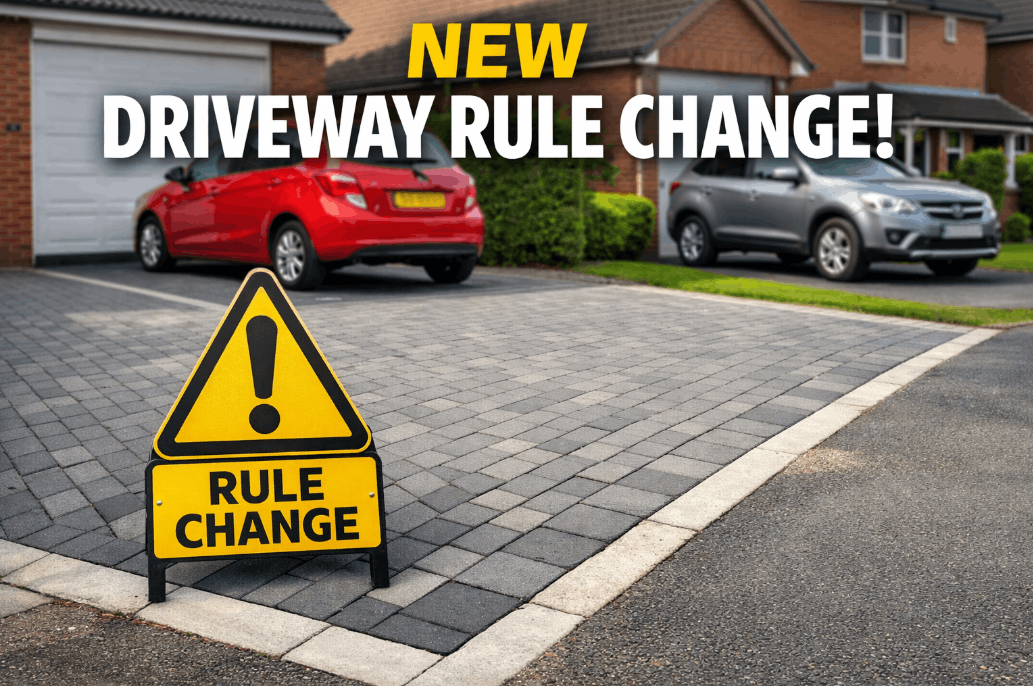
The new driveway rule change in 2026 requires that any front garden surface exceeding five square metres must use permeable materials or direct run-off to a lawn or border to meet SuDS requirements.
At the same time, recent updates to Permitted Development rights now allow homeowners to install wall-mounted EV charging points and upstanding units without full planning permission, provided they adhere to specific size and proximity limits.
What is the new driveway rule change for UK homeowners?
The 2026 updates centre on two main objectives: managing environmental flood risks and supporting the UK’s transition to electric vehicles. Homeowners must now ensure any new hardstanding is “porous” to prevent overwhelming local sewer systems.
Furthermore, changes to the General Permitted Development Order have streamlined the process for adding EV infrastructure to private driveways, cutting out unnecessary paperwork and the associated costs of a full planning application.
How mandatory SuDS standards impact your project
In my experience assisting property owners with land disputes, the most significant misunderstanding involves the “five-square-metre” threshold.
If you pave over a front garden with non-porous materials like standard concrete or tarmac without a drainage solution, you are technically in breach of planning law.
This isn’t just a recommendation; it is a legal obligation under the Flood and Water Management Act. The goal is to reduce surface water runoff, which is a leading cause of urban flash flooding in the UK.
Do I need planning permission for a driveway in 2026?
Under current Permitted Development Rights, you generally do not need planning permission if the new surface is porous or if the water is directed to a natural drainage area within your property boundaries.
However, if you intend to use impermeable materials for a surface larger than five square metres, a full planning application is mandatory.
The 2026 Homeowner Compliance Checklist:
- Calculate the total surface area of the proposed driveway.
- Select a permeable material such as gravel, porous asphalt, or permeable block paving.
- If using impermeable stone, ensure a soakaway or rain garden is installed.
- Verify if your property is subject to an Article 4 Direction, which may restrict these rights.
- Check if your home is a Listed Building, as these require specific consent regardless of material.
- Consult the local highway authority if your project requires a “dropped kerb” for vehicle access.
- Retain all receipts and material specifications for your home’s “deeds file” to simplify future sales.
Why are the 2026 EV charging rules different?
The government’s recent push toward Net Zero has led to the deregulation of EV charge point installations.
Previously, many homeowners were faced uncertainty regarding the height of charging pedestals and their proximity to the public highway.
EV Charging: How the rules have changed
| Feature | Old Regulation | 2026 Rule Change |
| Planning Permission | Often required for pedestals | Permitted Development (most cases) |
| Pedestal Height | Strictly limited | Up to 2.3 metres (non-highway) |
| Property Type | Residential only | Expanded to off-street parking |
| Environmental Impact | Not considered | Focus on sustainable installation |
Local authorities are generally taking a more pragmatic approach to EV installations, provided the unit does not exceed 0.2 cubic metres. However, if you live in a flat or a conservation area, these exemptions may still be restricted, requiring a quick consultation with your local planning officer.

How does Schedule 3 of the Flood and Water Management Act affect you?
A common pattern is for homeowners to assume that “gravel is always fine.” While gravel is permeable, the sub-base beneath it must also be porous. If a contractor lays gravel over an old concrete base, the system fails SuDS standards.
Approved materials for a compliant finish
- Permeable Block Paving: Features wider gaps filled with fine aggregate to allow water to seep through.
- Porous Asphalt: Specially formulated with reduced “fines” to create voids for water transition.
- Resin-Bound Surfacing: A mixture of resin and stone that is naturally porous (unlike resin-bonded, which is not).
- Reinforced Grass/Gravel: Plastic or concrete grids that allow vegetation to grow while supporting vehicle weight.
Can you replace an existing driveway without permission?
When reviewing decisions made by local authorities, I’ve found that “like-for-like” replacements are often misunderstood.
Replacing an old, cracked tarmac driveway with new tarmac is technically a new installation of an impermeable surface. If the area is over five square metres, your project falls directly under the 2026 compliance requirements.
The risks of skipping planning approval
The financial implications go beyond simple fines. I recently encountered a case where a homeowner in the Midlands was forced to dig up a newly laid £8,000 driveway because they had not installed a soakaway, and a neighbour had reported the runoff into the street.
Crucially, solicitors are now flagging non-compliant driveways during the “property information form” (TA6) stage of a house sale, which can stall or collapse a chain.
Summary of Permitted vs. Restricted Projects
| Project Type | Status | Requirement |
| Gravel Driveway | Permitted | Must have a porous sub-base |
| Concrete (>5m²) | Restricted | Requires Planning Permission |
| Permeable Paving | Permitted | No application needed |
| EV Wall Box | Permitted | Must be <0.2 cubic metres |
| New Dropped Kerb | Restricted | Highway Authority License required |
What are the specific requirements for a dropped kerb?
Even if your driveway surface is perfectly compliant, you cannot legally drive across a pavement to access it without a dropped kerb. This is a separate legal process managed by your local council’s Highways Department, not the Planning Department.
- The Application: You must apply for a Section 184 licence.
- Safety Audit: The council will check sightlines and proximity to junctions or bus stops.
- The Work: Usually, only council-approved contractors can perform the physical excavation to ensure underground utilities aren’t damaged.
Final Summary and Next Steps
Getting your driveway project right in 2026 comes down to early planning and choosing the right drainage strategy. To ensure your project is legal and adds value to your home, follow these steps:
- Verify the size: Anything over 5m² needs a drainage strategy.
- Choose materials wisely: Prioritize resin-bound, permeable blocks or gravel.
- Consult Highways: If you need a dropped kerb, start this 3-month process early.
- Check EV limits: Ensure any charger installation stays within the 0.2 cubic metre volume limit to avoid planning fees.
FAQ about new driveway rule change
Does the 2026 rule apply to back gardens?
Generally, no. The strict SuDS rules for permeable surfaces specifically target front gardens that face a highway, as this is where runoff enters the public drainage system most aggressively.
What is the 5-square-metre rule?
If your new driveway or hardstanding area is smaller than five square metres, you can use any material you like. Anything larger must be permeable or have a dedicated drainage system.
Can I use “Resin-Bonded” stone for my driveway?
No, resin-bonded (where stone is scattered over glue) is impermeable. You should choose “Resin-Bound” (where stone and resin are mixed) to ensure the surface is SuDS-compliant and porous.
How much does a planning application cost?
If you fail to meet the permeability rules, a planning application typically costs around £250 in England, plus the cost of professional drawings and potential delays to your project.
Are gravel driveways always compliant?
Only if the water can soak into the ground. If the gravel is laid on top of an old impermeable surface like concrete, it is not compliant with the new driveway rule change.
Do I need permission for an EV charging post?
Under the latest updates, most charging pedestals under 1.6 metres (or 2.3 metres in non-residential car parks) are covered by Permitted Development, provided they aren’t near a highway.
What happens if I ignore the rules?
Your local council can issue an enforcement notice. This requires you to return the land to its original state or replace the surface with compliant materials at your own expense.
Does this apply to Scotland and Wales?
Yes, though the specific legislation names may differ (such as SABs in Wales), the requirement for sustainable drainage and EV infrastructure updates is a UK-wide priority.
