
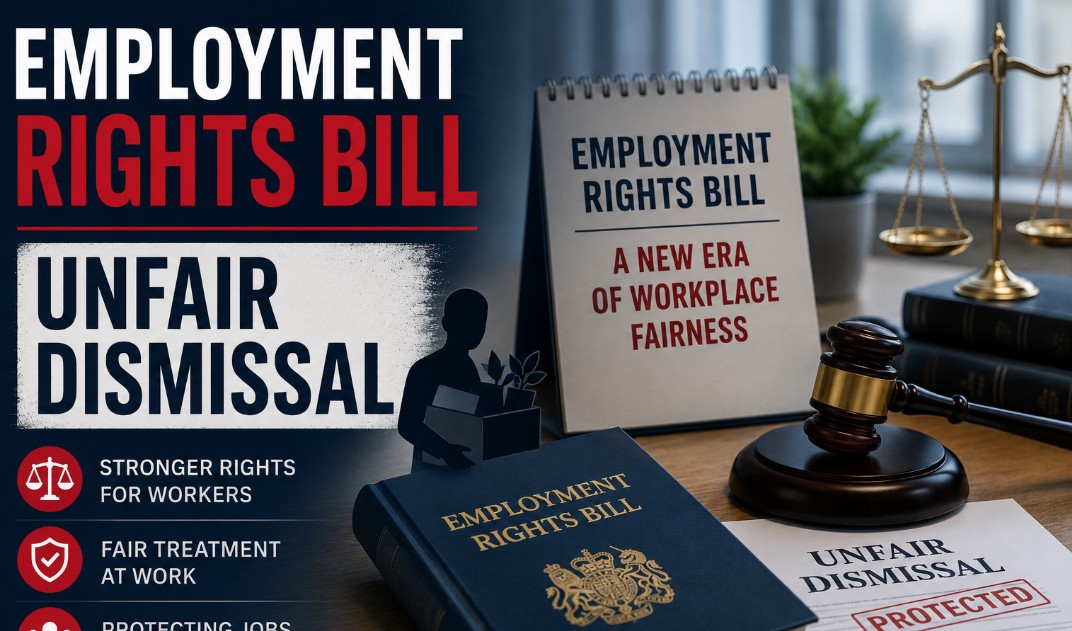
The landscape of British employment law is undergoing its most profound transformation in a generation. With the passage of the landmark legislation, the historical frameworks governing workplace protections, employer liabilities, and tribunal processes have been fundamentally reordered.
Navigating the massive transformations surrounding the employment rights bill unfair dismissal rules requires a precise understanding of how these new statutory instruments interact with the legacy foundations established under the Employment Rights Act 1996.
What is the Employment Rights Bill?
The Employment Rights Bill (enacted as the Employment Rights Act 2025) is a major UK legislative overhaul designed to strengthen job security, eliminate one-sided workplace flexibility, and slash the qualifying period for unfair dismissal.
The Act completely dismantles the long-standing two-year rule that left millions of workers without meaningful protection during their initial twenty-four months of service.
By replacing it with balanced, modern protections, it aims to uphold basic worker dignity while establishing an equitable, highly codified compliance timeline for UK businesses.
When is the Employment Rights Bill Implemented?
The Employment Rights Act 2025 is implemented via a phased, multi-year roadmap running from early 2026 through January 1, 2027, to prevent operational gridlock within UK businesses.
The rollout occurs across four distinct statutory trigger points:
- February to April 2026 Milestones: Immediate implementation of Day One Statutory Sick Pay (SSP) eligibility and enhanced immediate protections regarding workplace harassment and industrial action.
- October 2026 Trigger Point: The formal extension of the employment tribunal claim time limit, moving from the legacy 3-month window to a strict 6-month filing limit for claimants.
- January 1, 2027 Deadline: The final implementation date when the unfair dismissal rules drop to the new 6-month threshold.
The Retrospective Trap: On 1 January 2027, any existing employee who already possesses six months of service or more instantly acquires full ordinary unfair dismissal protection.
Consequently, any individual hired on or before 1 July 2026 will automatically cross the safety threshold the moment the calendar turns to 2027.
How does the Employment Rights Bill Unfair Dismissal Transform?
The framework transforms unfair dismissal by shifting the balance of power to the worker early in the employment cycle and removing the statutory upper limit on financial compensation.
The historical legal safety net that allowed businesses to part ways with a new starter with minimal legal risk during their first two years has effectively vanished.
This forces UK organizations to radically accelerate their performance evaluation timelines, turning probation periods into high-stakes regulatory windows.
What Is the New Rule for Unfair Dismissal in the UK?
The new rule for unfair dismissal in the UK establishes a statutory six-month qualifying threshold of continuous service for ordinary claims, while completely abolishing the statutory compensatory cap.
While initial policy proposals aimed to make ordinary unfair dismissal a strict Day One right, extensive consultations with trade unions and business representatives resulted in this balanced, six-month compromise.
Any employee who reaches six months of continuous service now holds the full statutory right to bring an ordinary unfair dismissal claim before an Employment Tribunal.
Furthermore, by removing the ceiling on compensatory awards (which previously capped payouts at a set statutory limit or one year’s gross pay), tribunals will now calculate financial remedies based purely on the actual and projected career losses evidenced by the claimant.
Key Legislative Shifts at a Glance
| Legislative Feature | The Old Regime (Pre-Reform / legacy 1996 Act) | The New Regime (Employment Rights Act 2025) |
| Qualifying Service Window | 2 Years (24 Months) of continuous service required. | 6 Months of continuous service required. |
| Compensatory Award Cap | Lower of 52 weeks’ gross pay or statutory limit (£123,543). | Completely abolished; uncapped based on actual financial loss. |
| Written Reasons for Dismissal | Only available after 2 years of service. | Mandatory upon request after 6 months of service. |
| Fire and Rehire Tactics | Permissible under strict SOSR business reorganisations. | Declared automatically unfair under standard conditions. |
What Does the Employment Rights Bill Unfair Dismissal Mean for Employers?
For employers, the legislation means old risk-management strategies are obsolete, forcing an operational shift toward compressed performance windows and high-stakes litigation tracking.
The structural reality introduces three fundamental business pressures:
- Compressed Performance Windows: Employers no longer have a relaxed 24-month horizon to monitor a worker’s fit. Underperformance, cultural misalignment, or capability issues must be identified and managed rigorously within the first 90 to 120 days.
- Unprecedented Financial Liability: Removing the compensation cap entirely forces businesses to view dismissals through the lens of a high-stakes discrimination or whistleblowing claim. Financial losses will now be calculated using equity, bonuses, complex pension structures, and long-term career degradation. A single mismanaged termination of a senior executive could result in massive, uncapped damages.
- Increased Settlement and Litigation Friction: Because workers have more leverage earlier, contested exits will become harder and more expensive to settle via compromise agreements. Employers will be forced to compile bulletproof paper trails to justify everyday terminations.
Who Is Eligible to Apply for Unfair Dismissal Under the New Rules?
Eligibility for unfair dismissal applies to all employees in England, Scotland, and Wales, split between ordinary protection at six months and automatic protection from day one.
The reduction of the qualifying service window means that eligibility now extends to an additional 6.3 million UK workers. It is essential to distinguish between the two structural tiers of protection:
- Ordinary Unfair Dismissal: Requires meeting the 6-month continuous service threshold.
- Automatically Unfair Dismissal: Requires no qualifying service whatsoever (Day One Right). If an employee is terminated during their first week of work due to a protected characteristic, whistleblowing, or fire and rehire practices, they are fully eligible to apply for an Employment Tribunal remedy.
When Can an Employment Rights Bill Unfair Dismissal Be Claimed?
An unfair dismissal claim can be launched either immediately from day one if the reason is legally automatically unfair, or precisely at the six-month mark for standard ordinary disputes.
An employee gains the legal standing to file an unfair dismissal claim under two distinct structural scenarios:
- Upon Reaching 6 Months of Service (Ordinary Unfair Dismissal): For standard claims involving capability, conduct, or redundancy, the right triggers precisely at 6 months of continuous service. If an employer terminates the contract after this point without a genuine fair reason or fails to follow a transparent disciplinary process, a claim can be made.
- From Day One of Employment (Automatically Unfair Dismissal): The 6-month wait window disappears entirely if the termination is categorised as automatically unfair. A claim can be launched immediately, even during an employee’s first week, if the dismissal is tied to whistleblowing, exercising statutory rights, or if an employer unprocedurally dismisses a worker who says, I had an accident at work, following an injury on duty.
What Are the Five Fair Reasons for Dismissal Under the Employment Rights Act?
The five fair reasons for dismissal preserved under the new legislation are capability, conduct, redundancy, statutory illegality, and some other substantial reason (SOSR).
Despite the dramatic compression of the probation window, the core statutory grounds for terminating an employee remain anchored to the framework originally laid out in the Employment Rights Act 1996 and preserved under the Employment Rights Act 2025.
To avoid successful tribunal challenges, an employer must prove that the principal reason for termination falls squarely within one of these five categories:
- Capability or Qualifications: This addresses an employee’s structural inability to perform the job duties due to documented skill deficits, lack of mandatory certifications, or long-term ill health.
- Conduct: Addressed when an employee breaches explicit company rules, commits acts of misconduct, or acts in a manner that degrades workplace safety. If disciplinary actions are taken, an employee should verify their statutory protections when suspended from work pending investigation to check if proper procedures are being kept.
- Redundancy: Occurs when a business has a genuine requirement to close a location, reduce headcount, or cease operations in a specific structural sector.
- Statutory Illegality: This applies when continuing to employ the individual would directly violate the law, such as a commercial delivery driver losing their driving licence or an employee losing their legal visa right to work in the UK.
- Some Other Substantial Reason (SOSR): A broad catch-all category for unique, severe business justifications, such as unresolvable, fundamental conflicts of interest or a complete, documented breakdown in mutual trust and confidence.
Operational Misconduct Benchmarks
Operational misconduct benchmarks are the legally defensible standards used to establish gross misconduct, which permits immediate dismissal without notice.
When establishing conduct-based terminations, employers frequently misjudge the threshold for immediate dismissal. To ground an employer’s defense, what are 5 examples of serious misconduct? Legally defensible examples include:
- Theft, fraud, or deliberate falsification of company corporate records.
- Physical violence, threats, or explicit acts of unlawful harassment and bullying.
- Gross negligence that directly endangers the health and safety of other workers.
- Serious insubordination or intentional, fundamental refusal to carry out lawful, reasonable contractual instructions.
- Malicious and unauthorized access to or distribution of secure company data assets.
What Section of the Employment Rights Act Is Unfair Dismissal?
The legal mechanisms governing termination exist as an evolving chain of legislative amendments:
- Section 94 (Employment Rights Act 1996): This remains the foundational core codifying the right not to be unfairly dismissed. It has not been replaced.
- Section 25 (Employment Rights Act 2025): Heavily modifies the framework by slashing the minimum service requirement from two years to six months.
- Section 124 (Repealed): The historical section of the 1996 Act that previously restricted the financial exposure of businesses by enforcing strict statutory caps on compensatory awards has been repealed, unlocking uncapped economic consequences for non-compliant employers.
How to Prove Unfair Dismissal and Avoid Tribunal Penalties?
To prove a dismissal is fair and avoid tribunal penalties, an employer must demonstrate both a valid substantive reason and strict adherence to a procedurally fair termination process.
Every termination process must align perfectly with the Acas Code of Practice on Disciplinary and Grievance Procedures.
This means notifying the worker in writing of the allegations, conducting an impartial investigation, providing all evidence to the worker before a meeting, granting the statutory right to be accompanied by a colleague or trade union representative, and extending a clear right to appeal.
Evidentiary Checklist for Defensible Dismissals:
An evidentiary checklist for defensible dismissals requires an employer to maintain clean, sequential paperwork from day one of employment to justify a termination within the 6-month window.
To establish that an employment separation was handled lawfully, specific evidentiary documentation must be meticulously maintained throughout the abbreviated window:
- Signed Employment Contract with explicit probation terms
- Documented Weekly/Monthly Performance Reviews from Week 1
- Written formal warnings outlining specific improvement metrics
- Comprehensive Investigation Notes & Witness Statements
- Formal Invitation Letter detailing the right to accompaniment
- Contemporary Minutes of the formal disciplinary/probation hearing

What Happens If an Employer Is Found Guilty of Unfair Dismissal?
If an employer is found guilty of unfair dismissal, the Employment Tribunal can order uncapped financial compensatory awards, employee reinstatement, or corporate re-engagement.
While financial restitution remains the most common route, the law outlines three primary remedies:
- Compensatory Awards: Financial awards calculated to replace lost wages, benefits, and bonus allocations directly caused by the dismissal. Because the statutory cap has been lifted, this figure can easily spiral into hundreds of thousands of pounds for senior workers if alternative comparable employment is difficult to secure.
- Reinstatement: A formal tribunal order forcing the employer to restore the individual to their exact previous role, treating them as if the dismissal never occurred.
- Re-engagement: An order requiring the employer to place the worker in an alternative, comparable position within their broader corporate structure.
Beyond direct awards, non-compliant firms face massive operational friction. The newly formed Fair Work Agency holds expanded enforcement powers to investigate systematic employment breaches, enforce state-level penalties, and publicly name non-compliant operations.
Summary and Immediate Operational Next Steps
To adapt to the six-month unfair dismissal window, UK businesses must immediately shorten contractual probation milestones, retrain line management, and audit notice period calculations.
Waiting until month five to address underperformance is no longer a viable option, as statutory notice periods can easily push an employee past the six-month protection threshold.
Firms must implement three immediate structural changes:
- Shorten Probationary Milestones: Restructure employment contracts to feature a crisp three- or four-month formal probation period, leaving a deliberate buffer window to execute a lawful dismissal if standards are missed.
- Train Line Management Immediately: Equip team leaders to document performance deviations from week one, ensuring all feedback is delivered in writing.
- Audit Onboarding and Notice Calculations: Ensure that required contractual notice periods are factored into any end-of-probation decisions so that continuous service does not accidentally roll over the 6-month mark.
FAQ
Can an employee still claim ordinary unfair dismissal during their first week of work?
No. Ordinary unfair dismissal requires a minimum of six months of continuous service. However, if the termination is based on automatically unfair grounds, such as whistleblowing, health and safety disclosures, or discrimination, there is no service requirement.
What are the chances of winning an unfair dismissal claim at an employment tribunal?
Success depends heavily on documentation. Tribunals rule strictly against employers who fail to adhere to the Acas Code of Practice. If an employer holds no written evidence of poor performance during probation, the chances of losing the claim escalate significantly.
Does the new 6-month qualifying threshold apply across the entire UK?
The Employment Rights Act 2025 applies directly to England, Scotland, and Wales. Employment law remains separately legislated within Northern Ireland, meaning their distinct regional service thresholds and statutory frameworks continue to apply until local assemblies choose to align.
What is the new time limit for an employee to bring an unfair dismissal claim forward?
Under the updated implementation roadmap, the historical three-month window for filing a claim has been doubled. Employees now have exactly six months from the effective date of termination to initiate the Acas early conciliation process.
Disclaimer: This article provides general regulatory information; it does not constitute formal legal advice.
