
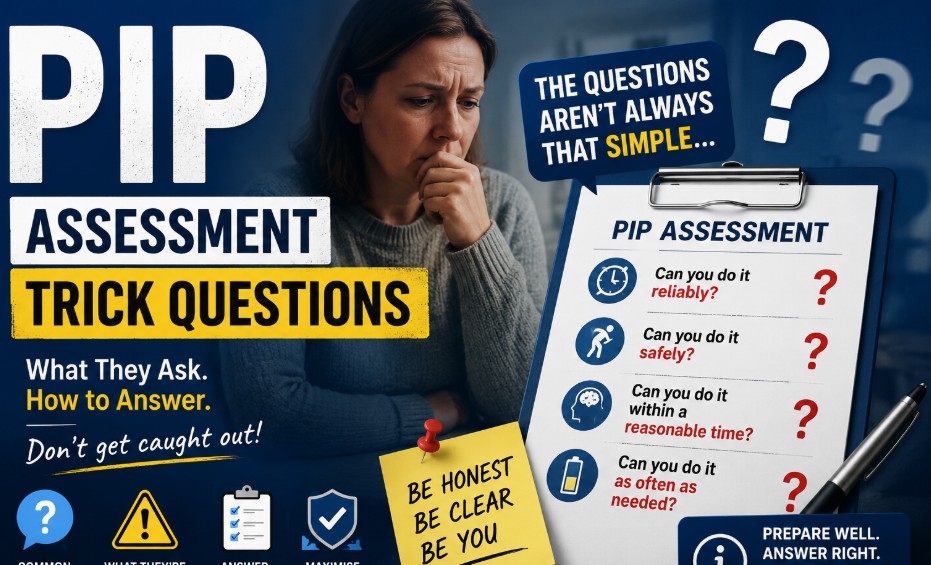
Personal Independence Payment PIP assessment trick questions are evidence-gathering tools used by the DWP to verify a claimant’s functional capabilities against their reported limitations.
These inquiries focus on the reliability of daily living activities, specifically whether tasks are performed safely, to an acceptable standard, repeatedly, and within a reasonable timeframe.
What are PIP assessment trick questions?
The term trick question in the context of a Personal Independence Payment (PIP) assessment refers to seemingly casual, conversational inquiries used by Health Professionals to gather data.
While they may feel like traps, they are evidence-gathering tools intended to verify if your functional capabilities match the descriptions provided in your initial claim form.
They aim to observe your functional reliability, essentially checking if you can perform a task safely, to an acceptable standard, repeatedly, and within a reasonable timeframe.
Why are PIP assessment trick questions asked?
These questions are asked to bridge the gap between your self-reported limitations and the assessor’s professional observation. The DWP uses them to:
- Establish Consistency: By asking the same thing in different ways, they check for contradictions in your account.
- Infer Functional Ability: Questions about daily habits (like pet ownership, shopping, or even if you can travel abroad) are used to infer physical tasks like bending, lifting, carrying, or cognitive tasks like planning and concentration.
- Observe Unconscious Behavior: They monitor how you move, sit, and speak while you are not focusing on performing your symptoms, to see if your day-to-day mobility matches your stated restrictions.
Common challenges faced during PIP assessments
Claimants often struggle because they are in an unfamiliar environment, dealing with stress or physical pain. Common hurdles include:
- The Good Day Bias: Naturally wanting to present oneself in the best light can lead to minimizing symptoms.
- Politeness Habits: Using social pleasantries like I’m fine or I manage is often recorded as literal evidence of health.
- The Assumed Knowledge Gap: Believing the assessor has read and understood all your medical evidence in detail, leading to under-explaining your needs.
- Vague Communication: Using general terms (I struggle a bit) instead of describing the specific functional barrier.
How to avoid common challenges?
- Focus on the Worst Day: Always answer based on your most difficult days, not your best or even average days.
- Avoid Social Autopilot: Replace I’m fine with specific statements about your current pain, anxiety, or fatigue levels.
- Be Descriptive, Not Just Affirmative: Never answer Yes or No. Always add the context of how or if you can complete a task safely and reliably.
- Use Your Support: Take a trusted person with you; they can act as a memory aid and provide an objective account of your daily struggles.
The DWP assesses your functional ability based on the Reliability Standard. If you cannot complete an activity safely, to an acceptable standard, repeatedly, or within a reasonable time, the law dictates that you are considered unable to perform that specific task.
Some of the PIP assessment trick questions
| Casual Question | Hidden Intent | How to Answer Accurately |
| How was your journey here? | Assess mobility & planning. | It was very difficult. I needed help getting to the car and had to rest due to pain before entering. |
| What did you have for breakfast? | Assess cooking/safety. | My partner made toast as I cannot safely use the toaster or handle hot pans due to tremors. |
| Do you have any pets? | Assess bending/walking. | I have a dog, but my carer walks him. I cannot manage the lead or walk any distance. |
| Do you use a smartphone? | Assess dexterity/cognition. | I use it for basics, but I often drop it due to grip issues and struggle to focus on the screen. |
| How are you today? | Assess general state. | I am in significant pain today and feeling very anxious about this assessment. |
| Do you drive? | Assess concentration/safety. | I drive only short distances on familiar routes on good days; otherwise, I am unsafe due to brain fog. |
| Do you have any hobbies? | Assess social/concentration. | I used to paint, but I can no longer, because I cannot concentrate for more than five minutes. |
| How do you do your shopping? | Assess physical capability. | I have it delivered. I cannot carry bags or walk around the aisles due to my mobility issues. |
| Can you manage your money? | Assess cognitive function. | I find it very stressful and need my daughter to help me check my bills and ensure they are paid. |
| What did you do this morning? | Assess routine/care needs. | I needed help getting out of bed and assistance with washing and dressing due to stiffness. |
How to respond to PIP assessment trick questions confidently?
Confidence comes from preparation and a clear understanding of the Reliability Standard.
- Request Clarification: If you don’t understand a question, ask the assessor to explain it further. You are fully entitled to that clarity.
- Add the Why: After every answer, immediately explain the barrier you face. For instance, if you mention cooking, add: …but only by using a microwave, as the hob is unsafe due to my seizures.
- Stay on Criteria: Remember the four pillars of reliability: Is it safe? Is it to an acceptable standard? Can you do it repeatedly? Is it within a reasonable time? If you fail any of these, you are not managing the task.
- Pause: Do not feel pressured to answer immediately. Take a breath to ensure your response accurately reflects your reality.

How can I be prepared for PIP assessment trick questions with evidence and documentation?
Preparation is your strongest defense against the ambiguity of the assessment. You can review the official guidance on how the DWP evaluates these criteria by visiting the official PIP assessment guide on GOV.UK.
- Draft a Daily Diary: Record your challenges over one week, focusing on every activity from morning to night.
- Gather Medical Documentation: Include recent GP letters, specialist reports, and current medication lists.
- Use Professional Statements: Request a letter from a social worker or carer who observes your difficulties firsthand.
- Reference the Criteria: Align your evidence with the specific activities (e.g., Preparing Food, Managing Therapy).
- Be Precise with Timing: Note how long tasks take and the pain levels experienced during them.
- Include Occupational Therapy Reports: These are highly valued as they specifically assess functional ability.
- Review your PA4: After the decision, check the assessment report for factual errors.
In practice, when claimants bring a structured diary to the assessment, it serves as a reliable memory aid, ensuring no critical information is omitted due to anxiety or stress.
Addressing PIP assessment trick questions for mental health
Mental health conditions often involve invisible symptoms that are harder to quantify than physical mobility. Assessors may ask about social interaction or budgeting, which can feel like a departure from your primary health complaint.
The goal of these questions is to see if your mental health condition creates a barrier to planning and following journeys or engaging with other people.
- Focus on the why: Don’t just say you don’t go out; explain that the fear of a panic attack prevents you from navigating a busy environment.
- Explain the support needed: If you need a friend to attend the appointment to prevent distress, state this clearly as a requirement for social interaction.
- Highlight unpredictability: If your condition fluctuates, emphasize that your ability to concentrate is not reliable or repeatable.

What not to say to a PIP assessor?
Certain responses can inadvertently damage a claim by creating a false impression of health. Avoid generic, upbeat statements that are not representative of your daily experience.
- I am fine, thank you. Even if this is a polite habit, it is often recorded as evidence of good health.
- I manage. This phrase is dangerous because it implies functionality without qualification.
- I just get on with it. While this sounds resilient, the DWP interprets this as having no functional restriction.
- It depends on the day. If you say this, immediately follow up with: On most days, I am unable to…
Summary
Success in a PIP assessment requires shifting the focus from beating the system to accurately documenting functional reality.
Staying informed on the latest payment rates and preparing by detailing your worst days, while aligning your needs with DWP criteria, is essential.
If the initial decision is incorrect, the Mandatory Reconsideration process is a standard step to rectify errors.
FAQ
Are there official PDF guides for these questions?
No, the DWP does not publish cheat sheets or official PDFs of trick questions. Any document claiming to be an official list of trick questions is likely an unofficial compilation and should not be relied upon as government policy.
Can I be fired during a PIP while waiting for my DWP PIP claim?
A Performance Improvement Plan (PIP) at work is an employment matter, while DWP PIP is a welfare benefit. Being on a work PIP does not provide legal immunity from dismissal. Seek advice from ACAS regarding your employment rights.
Why do people fail PIP even when they feel they were honest?
Failure often occurs due to a lack of alignment between the claimant’s description of their life and the specific legal criteria for the benefit. The assessor scores based on functional descriptors, not simply on the honesty of the claimant.
Should I bring a support person to my assessment?
Yes, having a family member or friend present can provide essential support and help you recall details about your condition. They can also offer their observations on your needs during the assessment.
How to successfully challenge a PIP decision?
If you disagree with the decision, you can request a Mandatory Reconsideration. Focus your appeal on specific inaccuracies in the assessment report rather than general disagreement with the outcome.
Are phone assessments different from face-to-face?
No, the underlying assessment criteria remain identical. However, in phone assessments, you lose the visual cues of the assessor observing your physical pain or movement, making clear verbal communication even more critical.
