
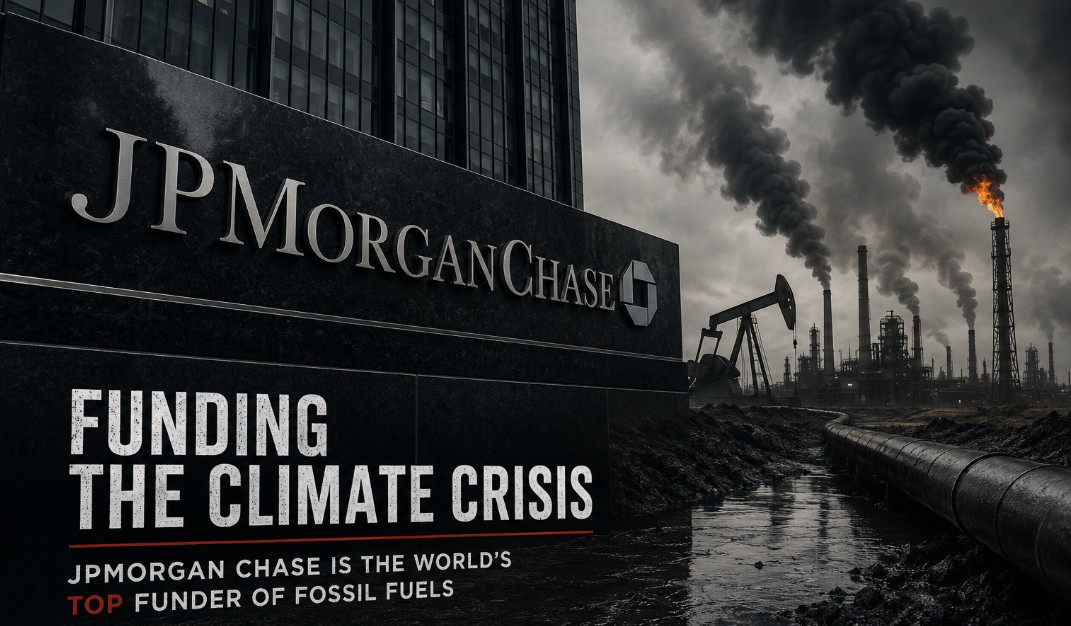
JPMorgan Chase remains the world’s largest financial supporter of fossil fuels, providing $58.2 billion globally in the last annual tracking cycle, according to the June 2026 Banking on Climate Chaos report. This capital deployment represents a 12.5% year-on-year increase in high-carbon energy lending and underwriting, solidifying the bank’s top global ranking.
What is the Scale of JPMorgan Chase Fossil Fuel Funding?
JPMorgan Chase fossil fuel funding reached $58.2 billion globally in the latest annual tracking cycle, marking a 12.5% year-on-year increase in high-carbon energy lending and underwriting. This data, published in the June 2026 Banking on Climate Chaos report, solidifies the bank’s top global ranking.
This massive capital deployment represents a significant escalation in high-carbon financial exposure.
While international climate agreements call for a rapid reduction in oil, gas, and coal investments, the bank’s capital allocation has moved in the opposite direction, widening the gap between its commercial operations and global decarbonisation targets.
The $8.7 Trillion Global Footprint
The $8.7 trillion global footprint represents the total cumulative capital funnelled into high-carbon industrial projects by the world’s top 65 banking firms since 2016.
Published by an NGO consortium including the Rainforest Action Network and BankTrack, this macro portfolio positions JPMorgan Chase as the foundational anchor.
To appreciate the scale of this capital flow, it helps to look at the historical context since the Paris Agreement.
Within this massive global portfolio, JPMorgan Chase serves as the leading transaction engine, outstripping major North American competitors like Bank of America and Wells Fargo in sheer transaction volume.
Why is JPMorgan Chase Under Scrutiny for Fossil Fuel Funding?
JPMorgan Chase is under scrutiny because it remains the leading global financier of fossil fuels, drawing intense criticism from UK institutional investors, regulators, and corporate clients. This scrutiny intensified after 2026 data revealed its underwriting and lending to oil, gas, and coal climbed to $58.2 billion.
This aggressive capital allocation highlights a wider strategic divergence between major North American financial groups and their European counterparts.
As UK and European institutions face tightening regulatory penalties for high-carbon exposure, the bank’s continued expansion in conventional energy sectors has made it a primary target for international climate campaigns and institutional policy reviews.
Why are people boycotting J.P. Morgan?
People are boycotting J.P. Morgan due to the bank’s active scaling of high-carbon investment portfolios alongside its concurrent retail expansion via the Chase UK digital application.
Activist networks and UK local authority pension funds have initiated these commercial divestment campaigns following major rollbacks in corporate sustainability.
Public pressure, legal challenges, and targeted corporate divestment campaigns against the financial institution have intensified significantly.
UK businesses and consumers are increasingly looking at the environmental footprint of their financial partners, creating a reputational risk for organizations that continue to maintain active transactional accounts with the firm.
JPMorgan Chase Net Zero Banking Alliance Exit
The JPMorgan Chase Net Zero Banking Alliance exit refers to the bank’s high-profile, strategic withdrawal from the UN-backed climate coalition.
This structural move dismantled the formal external compliance guardrails that bound the financial institution to specific, independently verified interim carbon-reduction milestones.
By removing itself from these strict multilateral climate coalitions, the bank shifted away from binding international timelines.
The leadership team now prefers to manage its energy lending and client transition risks via flexible internal metrics, a move that critics argue severely undermines independent accountability and global net-zero coordination.
What is the Dark History of J.P. Morgan?
The dark history of J.P. Morgan refers to the late 19th and early 20th-century practice of Morganisation, where the original financier consolidated vast industrial monopolies.
This corporate strategy ruthlessly prioritized industrial yield, capital aggregation, and centralized control over labor safety and community environmental impacts.
Modern critics argue that this fundamental corporate DNA persists within the institution today. The current strategy focuses on locking in predictable, long-term commercial interest fees from infrastructure debt and energy underwriting.
This financial positioning often clashes directly with national carbon reduction targets, such as the UK’s legally binding net-zero statutory frameworks.

How much does JPMorgan Chase direct to fossil fuels vs clean energy?
JPMorgan Chase directs capital using an internal energy-supply financing ratio of 1.13:1, claiming it facilitates $1.13 for low-carbon energy for every $1.00 allocated to fossil fuels. However, independent findings show this ratio drops under 0.6:1 when evaluating direct core underwriting for energy production.
The corporate leadership team actively defends its capital allocation strategy by highlighting its dual role in ensuring short-term global energy security while simultaneously funding low-carbon technologies.
The bank rejects the premise that it is ignoring the energy transition, pointing instead to its proprietary internal tracking metrics and a corporate pledge to finance a total of $1 trillion in sustainable development and green initiatives by the end of 2030.
The Transatlantic Financing Disconnect
Independent financial analysis reveals that United States-based clearers are responsible for 32.2% of all global fossil fuel funding. This volume represents the single largest regional concentration of high-carbon underwriting in the world, driven heavily by domestic political counter-pressures against environmental compliance.
The following data table contrasts official corporate disclosures with the independent findings published in the June 2026 Banking on Climate Chaos report:
| Financed Emissions Metric | JPMorgan Chase Corporate Position | 2026 Banking on Climate Chaos Findings |
| Annual Fossil Financing Volume | Calculated via internal client transition risk profiles. | $58.2 Billion annually (12.5% year-on-year increase). |
| Energy Supply Investment Ratio | Disclosed as 1.13:1 (in favor of clean/low-carbon energy facilitation). | Under 0.6:1 when evaluating direct capital underwriting for energy production. |
| Post-Paris Agreement Cumulative Funding | Managed via sector-specific internal carbon intensity metrics. | Over $430 Billion in direct high-carbon sector exposure since 2016. |
| Net-Zero Framework Alignment | Governed through independent internal climate oversight committees. | No binding external milestones following the strategic exit from the NZBA. |
What is the impact of JPMorgan Chase fossil fuel funding in the UK?
The impact of JPMorgan Chase fossil fuel funding in the UK manifests as heightened Scope 3 financed emissions risks for domestic corporate clients. Because foreign investment banks operating in London follow divergent operational models, UK firms using these credit lines face potential supply chain compliance failures.
The financial decisions made at the bank’s global headquarters carry profound structural implications for the UK financial ecosystem, particularly across the corporate landscape of London and Canary Wharf.
While the Bank of England has introduced stricter climate risk scenarios and enhanced capital risk buffers for domestic clearers, foreign institutions operate under highly different domestic political frameworks.
The Transatlantic Regulatory Divergence
When reviewing corporate banking options, UK treasurers face a fractured market. Major domestic institutions, such as Barclays, HSBC, and NatWest, have implemented strict structural exclusions on funding new oil and gas fields, driven by local regulatory scrutiny and pressure from the Financial Conduct Authority (FCA).
Conversely, US-headquartered investment banks face intense counter-pressure in their domestic markets, where several state attorneys general launched anti-ESG probes.
This domestic political pressure drove the mass exodus of North American banks from global climate alliances. As a result, JPMC can offer corporate lending lines to multinational energy clients that are increasingly restricted by UK-regulated domestic lenders.
Verified against the statutory climate disclosure guidelines issued by the Financial Conduct Authority (FCA) and the legally binding UK net-zero frameworks.
Risks for Corporate Supply Chains
Risks for UK corporate supply chains emerge under the Streamlined Energy and Carbon Reporting (SECR) framework.
Because commercial banking services fall under Scope 3 financed emissions, a UK enterprise utilizing a high-carbon financial institution can see its independent sustainability ratings downgraded by major European procurement teams.
This compliance risk is a growing concern for mid-market and large enterprises operating in the UK.
A company may successfully reduce its Scope 1 and Scope 2 operational emissions, only to have its carbon ledger penalized because its primary credit facilities, revolving corporate loans, or treasury management services are provided by a primary global fossil fuel financier.
What are the main green banking alternatives for UK companies?
The main green banking alternatives for UK companies include Triodos Bank, Charity Bank, and The Co-operative Bank. Restructuring commercial banking relationships and moving deposit lines to these specialized providers removes corporate capital from the high-carbon lending ecosystem entirely.
For UK businesses seeking to minimize their indirect environmental footprint and shield their commercial operations from reputational supply chain risks, transitioning corporate accounts is highly effective.
These alternative institutions operate under strict, transparent investment charters that explicitly exclude fossil fuel exploration, extraction, and high-impact carbon refining.
Top Fossil-Free Institutional Alternatives
Several prominent commercial banking options operate inside the UK market with strict, legally binding exclusions against high-carbon sector financing:
- Triodos Bank: A dedicated sustainable banking provider that enforces a 100% transparent lending model, directing corporate capital exclusively into environmental, social, and cultural enterprises.
- Charity Bank: Ideal for social enterprises and non-profit corporate entities, maintaining a strict ethical investment charter that completely excludes fossil fuel exploration and production.
- The Cooperative Bank: Operates under a customer-led ethical policy that legally bars the provision of banking services to companies whose primary business involves fossil fuel extraction or high-impact carbon refining.
The 6-Step Corporate Treasury Migration Process
To systematically execute a corporate transition away from high-carbon financial exposure, corporate finance directors can implement the following structured verification process:
- Request Financed Emissions Data: Formally petition the incumbent relationship manager for an explicit breakdown of the bank’s local and global financed emissions intensity metrics.
- Review Sector Exclusion Policies: Audit the bank’s official corporate governance statements to verify if they maintain strict, unwaived bans on Arctic drilling, oil sands development, and new coal-fired power infrastructure.
- Analyze Scope 3 Exposure: Use carbon accounting software platforms to quantify the precise impact of institutional banking relationships on the firm’s indirect Scope 3 carbon profile.
- Isolate Capital Reserves: Separate operational working capital from long-term capital reserves, ensuring investment portfolios avoid high-carbon asset-backed securities.
- Issue a RFI to Sustainable Lenders: Draft a formal Request for Information (RFI) targeting certified B-Corp financial institutions or clearers with verified science-based targets.
- Execute Managed Treasury Migration: Systematically transition payroll, merchant services, and foreign exchange facilities over a structured 90-day window to eliminate operational business disruption.
Final Summary
The latest 2026 financial tracking data confirms that the structural divide between North American and European banking strategies has reached a critical inflection point.
For UK business owners and corporate treasurers, selecting a financial partner is no longer a purely transactional decision based on credit terms and baseline merchant fees.
As regulatory frameworks like SECR expand and consumer scrutiny intensifies, continuing a commercial relationship with a primary fossil fuel financier carries tangible, systemic risks for a company’s brand capital and supply chain viability.
Organizations aiming to future-proof their operations should actively audit their financed emissions footprints and explore transition paths toward sustainable banking frameworks.
FAQ
Which bank is the largest funder of fossil fuels globally?
JPMorgan Chase holds the top position globally, having committed $58.2 billion to the fossil fuel sector over the last annual tracking cycle. This allocation places the bank ahead of other major global capital providers, including Bank of America and Mitsubishi UFJ.
Is JPMorgan Chase bigger than Amazon?
In terms of total balance sheet asset exposure, JPMorgan Chase is vastly larger, managing over $4.1 trillion in assets. However, Amazon maintains a higher public equity market capitalization. Both exercise dominant, concentrated structural power within their respective global sectors.
How does J.P. Morgan defend its continued fossil fuel underwriting?
The firm emphasizes the critical need to preserve near-term energy security and global supply reliability. They prioritize an internal energy-supply financing ratio of 1.13:1, focusing on gradual, client-led corporate transitions rather than sudden, blunt sector divestment.
How do US banking climate rollbacks affect UK corporate entities?
When US lenders exit international climate frameworks like the NZBA, it creates a widening compliance gap. UK firms using these institutions face increased Scope 3 financed emissions reporting pressures and potential supply chain compliance conflicts within European markets.
What percentage of global fossil fuel financing comes from US banks?
According to the latest 2026 data, United States-based financial institutions are responsible for 32.2% of all global fossil fuel funding, representing the single largest regional concentration of high-carbon capital underwriting in the world.
