
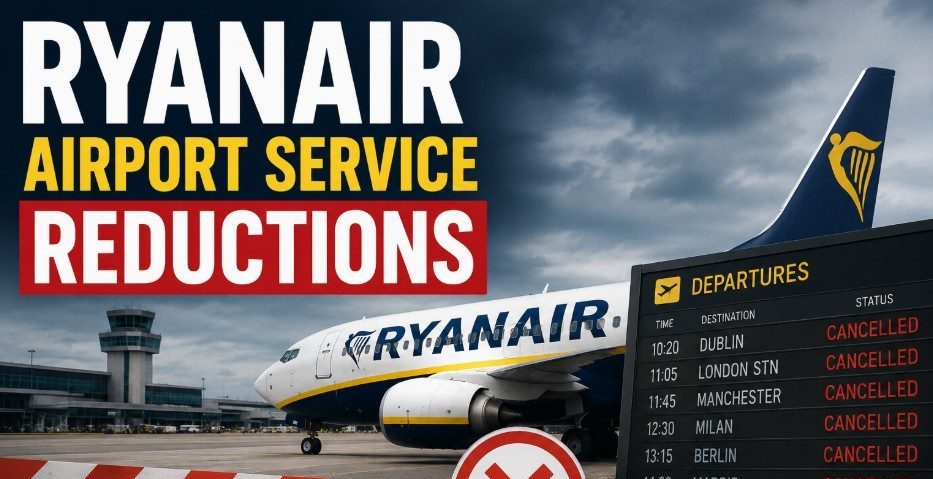
To keep fares low and dodge rising airport fees, Ryanair is launching a major shakeup of its European schedule. The budget carrier is pulling planes out of high-tax countries and trimming flights at several key hubs, leaving thousands of British holidaymakers searching for alternative routes, schedule verifications, and updated compensation frameworks.
What Are the Recent Ryanair Airport Service Reductions?
Recent Ryanair airport service reductions involve a massive network overhaul, cutting millions of seats and closing regional bases across Europe.
Driven by rising local airport infrastructure fees and national aviation taxes, Ryanair is shifting its Boeing 737 fleet away from high-cost markets like Germany and Spain toward lower-cost regulatory environments like Poland, Italy, Sweden, and Albania.
Instead of contracting its overall global fleet, the airline is shifting its Boeing 737 aircraft to expanding, low-cost regulatory environments.
Markets like Poland, Italy, Sweden, and Albania are receiving the reallocated capacity, while traditional holiday and city-break routes face significant consolidation.
Which UK Airports and Routes Are Facing Ryanair Service Cuts?
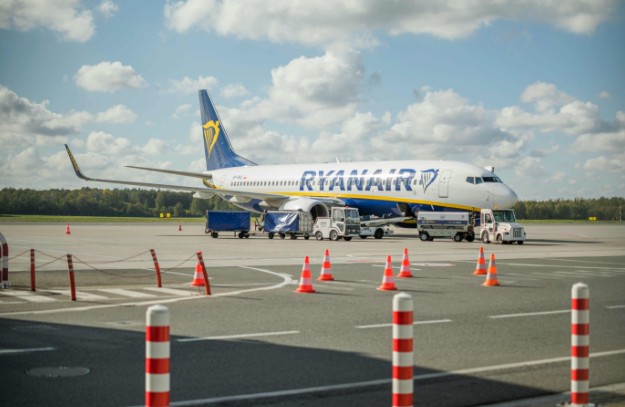
The UK routes and airports affected by Ryanair service reductions are primarily multi-frequency daily flights out of major bases like London Stansted and Manchester Airport, alongside a total capacity freeze at Dublin Airport.
These targeted frequency optimisations consolidate lower-load flights to combat rising local cost pressures and domestic slot allocation updates.
London Stansted and Manchester Frequency Optimisations
At major UK bases like London Stansted and Manchester Airport, operations have encountered a dual challenge: rising local cost pressures and the UK government’s emergency relaxation of the use it or lose it airport slot rules.
This policy shift allows carriers to hand back take-off and landing slots without losing their historic rights for subsequent seasons.
Consequently, Ryanair has selectively optimised its timetable, pruning low-load, multi-frequency daily flights to consolidate passengers onto fewer, highly efficient departures.
The Dublin Airport Growth Freeze
Across the Irish Sea, the ongoing impasse over the historic 32 million annual passenger cap at Dublin Airport has led to a flattening of Ryanair’s nearby expansion plans.
With the cap strictly enforced, the carrier has frozen local capacity growth, shifting its planned summer schedule additions elsewhere and limiting short-haul options for UK passengers using Dublin as a transit connection.
What Routes Are Ryanair Cutting Across Europe?
The European routes cut by Ryanair include full base closures in Berlin, Germany, and total regional airport exits across Spain, Belgium, and Portugal.
These international cuts remove over 3.5 million seats from regional schedules, directly severing direct European flight corridors previously available to UK travellers.
- Germany: Ryanair will completely close its seven-aircraft operational base at Berlin Brandenburg Airport, slashing its flight schedule to the German capital by 50% according to airport capacity data. This directly impacts routes feeding Berlin from Edinburgh, Manchester, London, and Birmingham. Furthermore, operations remain suspended at Dortmund, Dresden, and Leipzig.
- Spain: The airline is cutting approximately 1.2 million regional seats, based on seasonal timetable updates. It has completely exited Asturias Airport and Vigo-Peinador Airport, suspended all flights to Tenerife North, and finalised the closure of its base at Santiago de Compostela.
- Belgium: Over one million seats are being pulled from Brussels and Charleroi airports following disputes over passenger levy increases, as confirmed by regional aviation data.
- Portugal: Capacity has dropped by 22%, driven by a complete cancellation of six routes serving the Azores region.
| Target Country | Affected Regional Airports / Bases | Estimated Capacity Reduction | Primary Commercial Cause |
| Germany | Berlin Brandenburg, Dortmund, Dresden, Leipzig | 50% reduction in Berlin; full suspension at regional sites | 10% upcoming airport fee hike; high national aviation tax |
| Spain | Asturias, Vigo, Tenerife North, Santiago de Compostela | 1.2 million seats cut across the regional infrastructure | 6.62% increase in airport charges by operator AENA |
| Belgium | Brussels National, Brussels Charleroi | 1.1 million seats removed from regional schedules | Implementation of a €3–€10 progressive passenger levy |
| Portugal | Ponta Delgada (Azores), regional connections | 22% total capacity reduction across the network | Escalating air traffic control (ATC) charges |
Why Is Ryanair Cutting Services and Shifting Capacity?
Ryanair is cutting services and reallocating capacity to protect its narrow profit margins against rising airport aeronautical charges and high government passenger taxes. Aircraft are being systematically moved to more competitive regions to defend market dominance against low-cost rivals like Wizz Air and easyJet.
The Escalating Battle Over Rising Local Airport Access Fees
The airline’s standard business model relies heavily on low airport aeronautical charges to maintain cheap baseline ticket pricing. When airport operators implement flat-rate fee increases, that slim margin completely vanishes.
Corporate leadership has made it clear that their exit from regional Spanish hubs is a direct response to the 6.62% fee hike enacted by airport operator AENA.
Similarly, the planned base closure in Berlin was triggered by an official notice of an additional 10% fee compounding between 2027 and 2029, according to Ryanair’s latest market capacity reports.
Rising Government Aviation Taxes and Environmental Levies
National passenger taxes act as a direct drag on budget airline pricing. Ryanair leadership has repeatedly penalised states that maintain high environmental or departure levies.
While countries like Sweden have moved to abolish aviation taxes to stimulate tourism, Germany’s increased aviation tax burden and Belgium’s progressive passenger levies have made those routes unsustainable within Ryanair’s low-fare algorithm.
Airline Market Share Battles
The competitive landscape of European short-haul aviation is evolving rapidly. Rivals are also turning up the heat. easyJet is expanding its fleet through major leasing deals, while Wizz Air continues its aggressive push into Eastern Europe and the Mediterranean.
This fierce competition has forced Ryanair to pivot. Simultaneously, Wizz Air’s aggressive low-cost expansion into Eastern Europe and specific Mediterranean markets has forced Ryanair to reallocate aircraft to territories where it can protect its market-share dominance at a lower cost per seat.
What Are Your Rights If Your Ryanair Route Is Cancelled?
Under UK law via Retained EU Regulation 2004/204 (UK261), passengers affected by Ryanair route cancellations have a statutory right to choose between a full cash refund within seven days or alternative re-routing to their destination, which includes rebooking on rival carriers if necessary.
Right to Re-routing vs. Full Cash Refunds
If your Ryanair route is cancelled, you have the statutory right to choose between a full cash refund to your original payment method within seven days or alternative re-routing on the earliest available departure under comparable transport conditions, including flights on rival airlines.
- A Full Cash Refund: Paid within seven days via the original payment method.
- Alternative Re-routing: Transport to the final destination at the earliest available opportunity under comparable transport conditions.
In practice, airlines must offer re-routing on rival carriers (such as easyJet, British Airways, or Wizz Air) if their own next available departure delays the passenger significantly.
Travellers should carefully review the digital options inside the standard Ryanair booking portal to avoid accidentally accepting unwanted vouchers instead of a mandatory cash alternative.
When Are You Entitled to Cash Compensation?
UK261 statutory cash compensation between £220 and £520 applies only if Ryanair provides less than 14 days’ notice of a cancellation.
If notice is given more than 14 days before departure, no cash compensation is due, and the airline’s liability is limited to refunds or free rebooking.
- Greater than 14 days’ notice: If Ryanair notifies the passenger of a route cancellation or service reduction more than 14 days before the scheduled departure, no statutory cash compensation is due. The airline is only required to issue a refund or process a free re-booking.
- Less than 14 days’ notice: If the cancellation notice lands within this critical two-week window, passengers may claim fixed statutory compensation ranging from £220 to £520, depending on the route distance, unless the airline proves the cancellation was caused by extraordinary circumstances (such as severe weather or air traffic control strikes).
Does Ryanair Have a 24-Hour Grace Period?
No, Ryanair does not offer a free 24-hour grace or cooling-off period for customer cancellations.
Any passenger-initiated changes or cancellations made immediately after booking incur heavy change fees or full base fare forfeiture; free options only apply if the cancellation is carrier-led.
The 40-Minute Rule and Airport Survival
The Ryanair 40-minute rule is a strict operational deadline that automatically closes bag-drop desks, document verification check-in counters, and boarding gates exactly 40 minutes before departure.
Missing this threshold results in automatic seat forfeiture and hold baggage offloading without a refund.
What Is the 40-Minute Rule for Ryanair?
The 40-minute rule is a strict operational cutoff. Exactly 40 minutes before the scheduled departure time, Ryanair permanently closes its bag-drop desks, document verification counters, and boarding gates.
The airline’s ground infrastructure operates on rigid turnaround cycles, often lasting just 25 minutes.
If a passenger is standing in a security queue or an airport retail outlet when the 40-minute threshold passes, their seat is automatically forfeited, the luggage is offloaded, and no refund or free transfer is permitted.
Is 2 Hours Before a Flight Enough for Ryanair?
Arriving 2 hours before a Ryanair flight is sufficient only for passengers with hand luggage who have completed digital check-in.
Passengers checking in hold luggage or requiring manual document verification stamps should arrive 2.5 to 3 hours before departure.
- Hand Luggage Only (Digital Check-In): Arriving 2 hours prior provides a sufficient safety buffer to clear standard airport security and reach remote departure piers.
- Checked Bags or Visa Checks: Arriving 2.5 to 3 hours ahead is highly recommended if dropping a 10kg or 20kg bag, or if travelling on a non-UK/EU passport that requires a physical document stamp at the Ryanair desk.
- The One-Hour or 20-Minute Risk: Arriving at the airport terminal just 1 hour before departure leaves virtually no margin for security delays. If you show up with just 20 minutes to spare, you will miss the flight entirely, as the departure gates close strictly 20 minutes before takeoff.
Free Seat Allocations vs. Paid Check-In Windows
To maximise cost efficiency, passengers opting for the free random seat allocation must complete their digital check-in within a narrow operational window.
The free check-in window opens exactly 24 hours before scheduled takeoff and closes 2 hours before departure.
Passengers who fail to check in via the mobile application or website before this 2-hour cutoff will be charged a compulsory £55 per-passenger airport check-in fee at the terminal.
Mastering the Ryanair Baggage Rules
Ryanair baggage rules strictly limit standard ticket holders to one small personal cabin item measuring up to 40cm x 20cm x 25cm that must fit beneath the forward seat.
Exceeding these dimensions or carrying multiple unapproved bags triggers a gate baggage fee of £46 to £70.
Small Personal Bags vs. 10kg Priority Carry-Ons
Every baseline Ryanair ticket includes a single, complimentary small personal item (such as a laptop bag, small backpack, or handbag). This item must fit entirely underneath the seat in front of you.
- Dimensions: The maximum allowable size for this personal item is 40cm x 20cm x 25cm.
- Rules for Handbags and Small Backpacks: A woman’s standard handbag counts as that one permitted personal item. If a passenger carries both a backpack and a separate handbag to the boarding gate, they will be stopped by gate agents and charged a gate-departure fee to consolidate or check the luggage.
- Gate Strictness: Gate agents routinely deploy metal sizer boxes. If a 10kg priority carry-on bag or a small personal item exceeds the structural dimensions due to protruding wheels or packed pockets, the bag will be transferred to the aircraft hold for a fee typically ranging from £46 to £70.
Permitted and Prohibited Cabin Items
Carriage rules at UK airports remain subject to both Department for Transport regulations and specific airline safety provisions:
In-Flight Consumption and Comfort Restrictions
Ryanair inflight rules strictly prohibit the consumption of personal or duty-free alcohol onboard.
Frequent travellers also advise avoiding fresh hot drinks due to standard aircraft holding tank safety studies, and avoiding rigid denim clothing to mitigate cabin-pressure bloating.
Once onboard, specific behavioural and comfort rules apply to all passengers during transit.
- Bought Alcohol: Passengers are strictly prohibited from consuming their own alcohol onboard the aircraft. Any duty-free alcohol purchased at the airport terminal must remain sealed inside its official security bag for the duration of the flight.
- In-Flight Hot Drinks: Regular travellers frequently advise against ordering fresh coffee or tea on board short-haul aircraft. This advice stems from water safety studies regarding standard aircraft holding tanks, alongside the practical reality that turbulence can make hot liquids hazardous in dense cabin seating.
- Cabin Dress Code Advice: Flight crews recommend avoiding tight, unyielding denim jeans on flights over two hours. The drop in cabin pressure can cause normal gastrointestinal expansion and water retention, making rigid clothing highly uncomfortable.
Minor Passengers and Seating Accessibility Rules
Managing family travel or coordinating travel for teenagers requires an understanding of Ryanair’s specific age restrictions.
Can a 16-Year-Old Fly Alone with Ryanair?
Ryanair enforces a clear policy regarding young travellers: they do not carry unaccompanied minors under the age of 16. A teenager who has reached their 16th birthday is legally permitted to fly completely alone as an adult on Ryanair routes.
However, because the airline does not offer an unaccompanied minor escort service or special assistance personnel for older children, anyone under the age of 16 must be accompanied on the same booking reference by an adult passenger aged 18 or older.
Aeroplane Seat Dimensions and Physical Fit
Standard cabin seating across Ryanair’s Boeing 737-800 and 737-8200 Gamechanger fleet features a uniform width of approximately 17 inches (43 cm), with a standard seat pitch (legroom) of roughly 28 to 30 inches.
In terms of physical fit, a passenger matching a standard UK clothes size 22 will typically fit within the 17-inch structural seat boundary.
However, comfort can vary based on individual proportions. If the standard seatbelt feels a bit tight, just ask the cabin crew during boarding for a complimentary extension belt.
Final Summary and Strategic Next Steps
The current wave of Ryanair airport service reductions highlights how quickly low-cost carriers will adjust their networks when operating costs rise.
For UK travellers, navigating these changes successfully requires a proactive approach to booking management and a clear understanding of airport deadlines.
If your upcoming holiday route faces consolidation or cancellation, log in to your digital booking dashboard immediately to evaluate alternative departure dates or verify your eligibility for a full cash refund under UK261 guidelines.
When preparing for the remaining scheduled services, ensure your luggage complies precisely with the small personal bag dimensions (40cm x 20cm x 25cm) and complete your digital check-in within the 24-hour free window to avoid unexpected fees at the terminal.
FAQ about Ryanair Airport Service Reductions
Is Ryanair permanently leaving regional UK airports?
No, the airline is optimising specific frequencies rather than abandoning the UK market. The primary structural cuts and full airport exits are concentrated across regional Spain, Germany, Belgium, and Portugal.
What are the main alternative airlines covering the axed Ryanair routes?
Depending on the specific region, easyJet, Wizz Air, Jet2, and British Airways provide direct alternative capacity on overlapping European short-haul corridors.
How do I check if my upcoming summer holiday flight is affected?
Log directly into the My Bookings section of the official Ryanair mobile application or website. The carrier is legally required to dispatch email alerts regarding schedule modifications to the address used during booking.
What is the 3-1-1 rule on Ryanair?
The 3-1-1 rule is the standard terminology for liquid restrictions: 100ml maximum per container, stored inside one clear 1-quart (or 20cm x 20cm) plastic bag, with one bag permitted per individual passenger.
How much is a 10kg check-in bag on Ryanair?
Prices vary dynamically based on the demand of the route and booking timing, typically ranging between £11.99 and £40.00 if added online, but increasing significantly if purchased at the airport terminal.
Can I drop my bag 3 hours before a flight?
Yes, standard airport check-in and bag-drop counters generally open 2 to 3 hours prior to the scheduled departure time, closing strictly at the 40-minute mark.
Do Ryanair give you a free seat 24 hours before takeoff?
Yes, passengers who choose not to purchase a specific seat premium can check in online starting 24 hours before departure to receive a randomly allocated seat free of charge.
Will a size 22 fit in a Ryanair seat?
Yes. Ryanair’s seats are 17 inches wide, which typically accommodates a UK size 22. If you need a little extra room to buckle up comfortably, the crew can provide an extension belt.
