
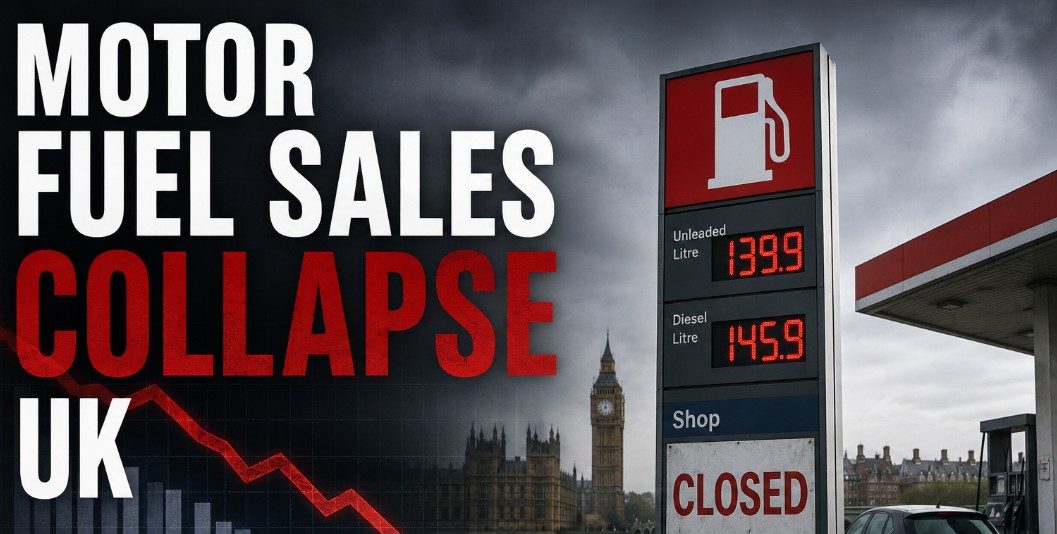
A Motor Fuel sales collapse UK analysts were not fully predicting took hold in April 2026, as total retail sales volumes fell by 1.3%. This contraction was heavily weighted by the automotive sector, where price-sensitive consumers drastically reduced non-essential travel.
Key Economic Indicators (April 2026)
- Automotive Fuel Sales Volume: -10.2% (Driven by price sensitivity and post-panic consumption).
- Total UK Retail Sales Volume: -1.3% (Reflects a broader squeeze on disposable income).
- Core Retail Sales (Ex-Fuel): -0.4% (Highlights moderate high street and online slowdown).
- Clothing Store Sales: -2.4% (Lowest volume since June 2025 due to price-led lifestyle shifts).
Why did motor fuel sales collapse UK?
The 10.2% collapse in motor fuel sales was not caused by a physical shortage of petroleum, but rather by a tactical refusal by the British public to purchase fuel at peak prices following a 6.1% stockpiling surge in March 2026.
- The Stockpiling Hangover: Consumer behaviour shifted rapidly from a March panic-buy, driven by fears of Middle East conflicts, to a deliberate reduction in non-essential journeys in April.
- Price Sensitivity: As global crude oil benchmarks spiked, retail forecourt prices escalated, forcing households to choose between discretionary travel and essential cost management.
- Demand Destruction: The drop confirms that modern UK consumers are highly responsive to price shocks, using volume reduction as a mechanism to balance household budgets.
Why has petrol gone up so quickly in the UK?
UK petrol prices accelerated rapidly due to a direct pass-through of global Brent crude costs crossing the $100-a-barrel threshold, combined with the rocket and feather pricing structure employed by retail networks.
- The Supply Shock: Open conflict in the Middle East drove Brent crude prices higher, causing petrol prices to peak at 158.52p per litre and diesel to surge past 191p per litre.
- Rocket and Feather Pricing Explained: Retailers are quick as a rocket to raise prices when wholesale costs rise to protect margins, but slow as a feather to lower them when wholesale markets stabilise, extending consumer financial pain.
How retail fuel dynamics impact consumer wallets?
The recent Motor Fuel sales collapse UK market trends show that while volumes dropped, nominal cash spending remained high, as a single 55-litre fill-up breached the £100 barrier, fundamentally altering household balance sheets.
- The £100 Fill-Up Threshold: A standard 55-litre family car tank breached the psychological barrier of £100 for a single fill-up, structurally altering weekly household balance sheets.
- Cash Value Disconnect: While physical volumes decreased by 10.2% in April, the total nominal cash spent on fuel remained elevated due to the sheer scale of the pump price spikes.
- Commercial Margin Squeeze: Independent retailers faced intense inventory replacement costs, passing wholesale volatility directly to consumers within 48 hours of international market shifts.
Could the UK run out of fuel?
No, the UK is not at risk of running out of fuel. The recent drop in retail sales volume is entirely a demand-side contraction driven by consumer choices and price resistance, rather than a supply-side disruption or physical shortage at domestic distribution networks.
The UK maintains substantial strategic petroleum reserves and highly diversified supply routes designed to withstand international shocks without triggering empty forecourts.
The resilience of the UK’s fuel supply chain relies on a highly integrated, multi-stage distribution network:
Is the UK Self-Sufficient in Petrol and Diesel?
While the UK is a net exporter of petrol, it remains a net importer of diesel and jet fuel, meaning the domestic market remains inherently linked to global trade flows.
Even with significant domestic refining capacity, the UK relies on imported unrefined crude, leaving pump prices exposed to international market fluctuations.
Primary sources and mechanisms of UK fuel security
- North Sea Production: Domestic crude extraction provides a stable baseline of raw material, though much of it is sweet crude exported for specialised processing abroad.
- Import Diversification: The UK has systematically eliminated reliance on Russian energy corridors, shifting supply chains to secure partners across the US, Norway, and Northwest Europe.
- Refining Constraints: Structural shifts toward electric vehicles have altered long-term refinery investment strategies, capping the expansion of domestic hydrocarbon processing.
Impact on the Wider Retail Landscape
The sharp motor fuel sales volume decrease has functioned as a significant drag on the broader UK high street. ONS data proves that when automotive fuel is removed from the monthly calculation, total retail sales fell by a far more modest 0.4%.
This disparity demonstrates that escalating energy costs act as a direct squeeze on discretionary consumer spending across non-essential retail sectors.
A clear example of this ripple effect was observed in the fashion industry. Clothing store sales suffered a 2.4% drop in April 2026, sliding to their lowest overall volume since June 2025.
As commuters and families were forced to allocate a larger share of their disposable income toward essential transport costs, secondary spending on new apparel and lifestyle goods was immediately curtailed.
Has petrol ever been rationed in the UK?
Yes, fuel rationing has occurred historically in the UK, but it is entirely disconnected from modern market fluctuations. The most notable instances took place during World War II and the 1956 Suez Crisis, where the government issued physical coupon books to manage severe state-level geopolitical supply blockades.
A common pattern during modern price spikes is a surge in online rumours regarding potential fuel allocations. However, contemporary market adjustments are handled exclusively through pricing mechanics and consumer demand destruction.
The 10.2% drop in sales volume confirms that modern market forces naturally regulate consumption without requiring statutory intervention or state-mandated restrictions.
Summary
The Motor Fuel sales collapse UK sales volume is 10.2% during April 2026, highlighting the direct impact of global geopolitical shocks on domestic retail habits.
Faced with rapid pump price surges following the Middle East conflict, British motorists demonstrated significant financial discipline by cutting discretionary trips and delaying refuelling.
This shift created a ripple effect across the high street, pulling down broader retail sales volumes and impacting sectors like fashion.
As wholesale prices begin to show minor corrections, the market outlook remains closely tied to international commodity stability and overall consumer confidence.
FAQ about Motor Fuel sales collapse UK
Why are UK petrol stations empty?
UK petrol stations are not physically empty; rather, they are experiencing a sharp drop in customer transaction volumes. Motorists are intentionally delaying refuelling and reducing car journeys to avoid paying peak retail prices.
Why are we running out of diesel?
The UK is not running out of diesel, though the market remains structurally tight because the nation relies on international imports for roughly half of its total diesel consumption, keeping prices highly reactive.
How long will petrol be available in the UK?
Petrol will remain widely available across the UK for decades. While the government maintains long-term net-zero targets and transition timelines for electric vehicles, fossil fuels continue to have robust supply chain support.
Will the UK run out of jet fuel?
No. Jet fuel availability is managed through commercial pipeline networks directly linking domestic refineries to major airports like Heathrow and Gatwick, ensuring consistent inventory levels for commercial aviation.
Will fuel prices go down after a ceasefire?
A geopolitical ceasefire typically eases speculative premiums in global oil markets, which can pull wholesale costs down. However, domestic pump prices usually take several weeks to drop due to slow retail adjustment practices.
Which company has the most petrol stations in the UK?
The UK market is led by major supermarket chains like Tesco, alongside global energy brands including Esso, Shell, and BP, which collectively dictate the primary pricing trends across British forecourts.
